


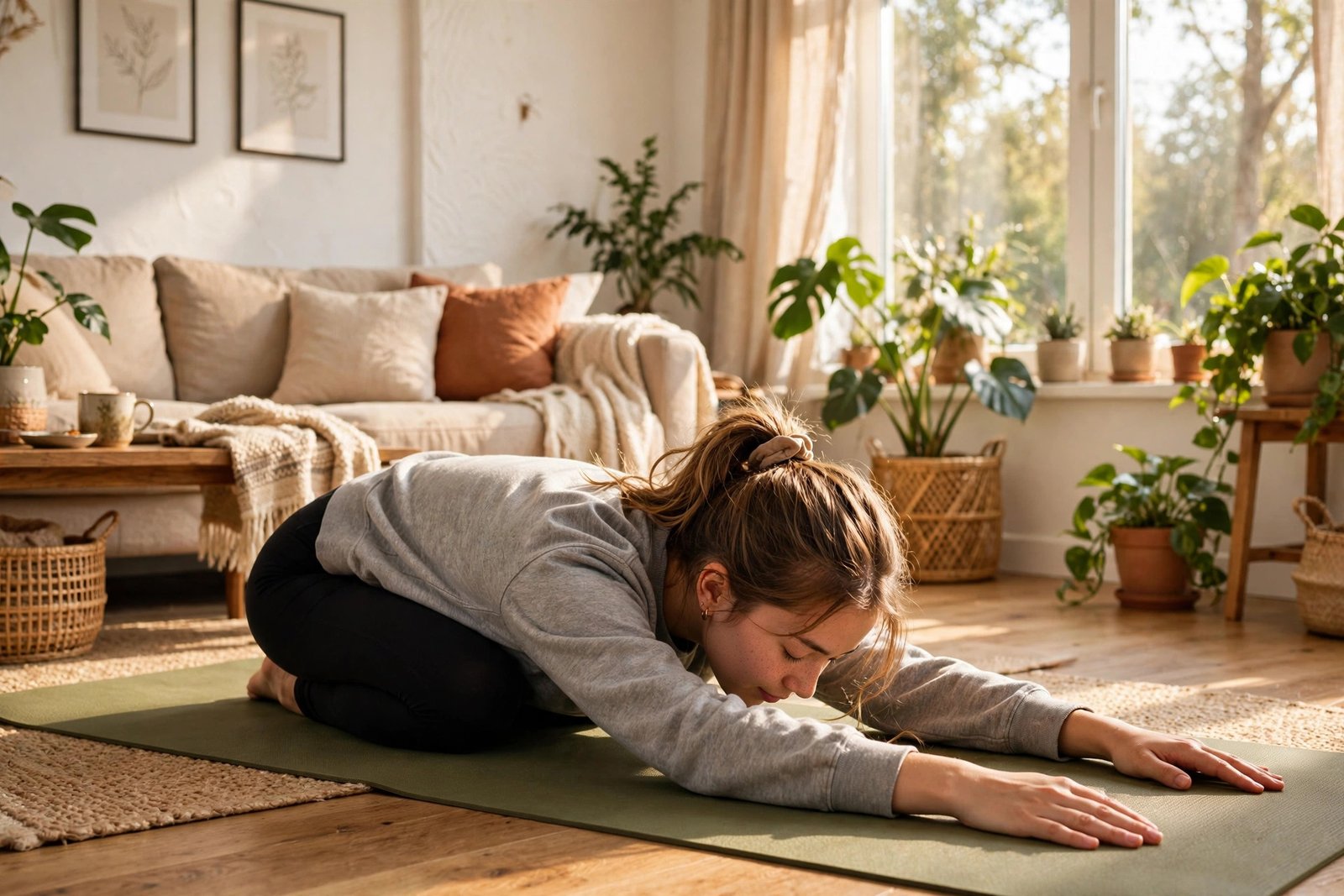
There are few stretches as gentle and comforting as the child’s pose stretch. This simple pose folds your body into a restful shape. As a result, it calms your mind while easing tension in your back, hips, and shoulders.
You might already know this pose from a yoga class. However, you do not need to practice yoga to enjoy it. In fact, anyone can use the child’s pose stretch at home, at the gym, or in a small quiet corner.
In this guide, you will learn how to do it with safe form. Additionally, you will discover its benefits, smart modifications, and simple breathing cues. Finally, you will feel confident adding it to your daily routine.
What Is the Child’s Pose Stretch?
The child’s pose stretch is a resting yoga pose with roots in traditional practice. In Sanskrit, it is called Balasana, which means “child’s pose.” Indeed, it mimics the natural curled shape that children fall into when they rest.
To do it, you kneel on the floor and fold your torso over your thighs. Meanwhile, your arms reach forward while your forehead rests toward the ground. As a result, your spine lengthens and your whole body softens.
Unlike deep or intense stretches, this one asks very little of you. Therefore, it works well for beginners and for people returning to movement after a break. Moreover, it is a favorite resting pose between harder exercises.
Many people think of it only as a yoga move. In fact, physical therapists and trainers use it too. For instance, they recommend the child’s pose stretch for back relief, hip mobility, and stress reduction.
How to Do the Child’s Pose Stretch Step by Step
Good form makes this pose feel amazing instead of awkward. First, follow these simple steps and take your time. There is no rush to get it perfect on day one.
- Start on all fours. Place your hands under your shoulders and your knees under your hips. Also, spread your fingers wide for a stable base.
- Bring your big toes together. Let your knees spread a little wider than your torso. Also, this wider stance gives your belly room to rest.
- Sit your hips back. Slowly lower your hips toward your heels. In addition, keep your hands planted as you move back.
- Walk your hands forward. Stretch your arms out in front of you with palms facing down. Finally, let your forehead rest on the floor or a soft surface.
- Relax and breathe. Soften your shoulders away from your ears. As a result, your whole body will grow heavy with each slow breath.
That is the full child’s pose stretch in five simple moves. Now hold the final shape and breathe deeply. Stay for 30 seconds to several minutes, depending on how you feel.
Setting Up Your Position
Your starting position sets the tone for the whole stretch. First, choose a soft surface like a yoga mat or carpet. Indeed, a hard floor can make your knees uncomfortable very fast.
Check that your wrists feel happy under your shoulders. Also, spread your fingers wide for better support. In fact, small setup details make a big difference in comfort.
Finding the Right Fold
As you fold forward, think of lengthening rather than collapsing. For example, reach your fingertips forward while your hips sink back. As a result, you create a gentle stretch along your entire spine.
If your forehead does not reach the floor, that is completely fine. For instance, rest it on a folded blanket, a cushion, or your stacked fists. The goal is relaxation, not touching the ground.
Benefits of the Child’s Pose Stretch
This simple pose offers more than meets the eye. In fact, it stretches, relaxes, and restores all at once. Here are the main benefits you can expect from regular practice.
It eases lower back tension. Sitting all day compresses your lower back. The child’s pose stretch gently lengthens the spine and releases that built-up tightness. As a result, many people feel relief within the first minute.
It opens the hips. The wide-knee version gives your inner hips a soft, passive stretch. In addition, it helps your hip joints move more freely over time. For more ideas, explore these hip mobility exercises to pair with this pose.

It calms your nervous system. Folding inward has a naturally soothing effect on the body. Consequently, your breathing slows down and your heart rate follows. As a result, stress and mental chatter begin to fade away.
It stretches the shoulders and arms. Reaching forward opens the front of the shoulders. It also gently stretches the lats, the large muscles along your sides. Moreover, this is especially helpful if you hunch over a desk all day.
It aids recovery between workouts. After running, lifting, or a tough class, this pose helps your body downshift. Indeed, it brings fresh blood flow to tired muscles without adding strain. Therefore, it makes a perfect cool-down move.
Breathing in the Child’s Pose Stretch
Breathing turns this pose from a simple stretch into a full-body reset. In fact, your breath guides how deeply you relax. Follow these cues for the best experience.
Breathe into your back. As you inhale, feel your ribcage expand toward the ceiling. For example, imagine your breath filling the space between your shoulder blades. Indeed, this deep back breathing massages your spine from the inside.
Exhale and soften. With each exhale, let your body sink a little heavier into the mat. Also, release your jaw, your shoulders, and your belly. Finally, let gravity do the work instead of your muscles.
Try a slow count. First, inhale for four counts, then exhale for six counts. The longer exhale switches on your body’s relaxation response. As a result, you will notice a real wave of calm after a few rounds.
Modifications for Tight Hips and Knees
Not everyone can fold deeply into this pose right away. For instance, tight hips, sensitive knees, or a stiff back can make the classic shape uncomfortable. However, small tweaks make the child’s pose stretch work for almost every body.
If Your Hips Feel Tight
Tight hips often lift your sitting bones away from your heels. When this happens, place a firm pillow between your calves and thighs. As a result, your hips can rest instead of strain.
You can also widen your knees even further apart. In addition, a wider stance gives your torso more room to drop down. Consequently, you will feel the stretch without forcing your hips at all.

Another option is the side-to-side arm reach. First, walk your hands slightly to the right and hold. Second, walk your hands to the left and hold there. This adds a lovely stretch along your sides. Moreover, it keeps the pose interesting while your hips gradually open.
If Your Knees Hurt
Knee discomfort is the most common issue with this pose. First, fold a thick blanket and place it behind your knees. As a result, the bend softens and pressure on the joint eases.
Also, you can try the pose on a bed. The soft surface cushions your knees completely. In addition, you will still get most of the back and shoulder benefits.
You can also skip the full fold entirely. For example, sit on a sturdy chair, spread your knees, and fold your torso forward between them. This chair version is gentle and very effective. For more gentle options, see these stretching exercises for beginners.
Common Mistakes in the Child’s Pose Stretch
Even a simple pose can go wrong with poor habits. For instance, watch out for these common mistakes. Fixing them will make the stretch far more comfortable.
Holding your breath. Many people tense up and forget to breathe deeply. However, shallow breathing keeps your muscles tight and alert. Therefore, keep your breath slow and steady the whole time.

Forcing your forehead down. Straining to touch the floor creates neck tension. In contrast, resting on a prop keeps everything easy. Your neck should feel long and relaxed, never crunched.
Collapsing the shoulders. Letting your shoulders creep up by your ears adds tension. However, you can fix this in seconds. Consciously slide them down and away from your ears. In addition, keep your neck in line with your spine.
Rushing the pose. Dropping in and out quickly misses the whole point. Indeed, this pose rewards patience and stillness. Finally, stay at least 30 seconds so your muscles have time to release.
How Long Should You Hold the Child’s Pose Stretch?
There is no single perfect hold time for everyone. However, your goal can guide you well. Here are simple guidelines you can follow.
For a quick reset: hold for 30 seconds to 1 minute. For example, this works well between work tasks or between exercises. Even a short hold can ease a stiff and achy back.
For deep relaxation: stay for 2 to 5 minutes. First, settle in with props and slow, even breathing. This longer hold is wonderful before bed or after a hard workout. Our morning flexibility routine pairs it with other gentle moves for tight hips and back.
Listen to your body always. If something pinches or feels sharp, come out of the pose right away. Indeed, mild stretching sensations are fine, but pain is a signal to stop. For authoritative step-by-step guidance, see Yoga Journal’s child’s pose guide and the ACE Fitness exercise library.
When to Practice the Child’s Pose Stretch
You can use this pose at many points in your day. For example, it works as a morning wake-up, a midday reset, or a bedtime wind-down. Each timing offers its own special reward.
In the morning, it gently wakes up a stiff spine. After hours of sitting, it reverses the hunch of desk work. Before bed, it quiets a busy mind. Consequently, many people practice it twice a day.
It also fits neatly into workouts. Use it as a warm-up to check in with your body. In addition, use it between sets as active recovery. Finally, end your session with a long, restful hold.
The best time, however, is the time you will actually do it. Pair it with an existing habit, like your morning coffee or evening TV time. As a result, the habit will stick with far less effort.
Frequently Asked Questions
Is the child’s pose stretch good for lower back pain?
Yes, it is one of the gentlest poses for a sore lower back. Indeed, it decompresses the spine and relaxes the muscles along it. However, skip it during a sharp flare-up and check with your doctor first.
Can beginners do the child’s pose stretch?
Absolutely. In fact, it is one of the best poses for beginners because the floor supports you fully. First, start with props and short holds. Over time, your body will open up naturally.
Why do my knees hurt in child’s pose?
Knee pain usually comes from the deep bend in the joint. Therefore, place a folded blanket behind your knees to reduce the angle. If pain persists, try the chair version described above.
Should my arms go forward or back in child’s pose?
Both are correct and offer a slightly different feel. For example, arms forward stretches the shoulders and lats more deeply. In contrast, arms resting back alongside the body feels more restful and passive.
Can I do the child’s pose stretch every day?
Yes, daily practice is safe for most people. Moreover, it is gentle enough for a morning or bedtime routine. In fact, consistency brings the best results over time.
What is the difference between child’s pose and extended child’s pose?
The classic version rests your arms alongside your body. The extended version, on the other hand, reaches your arms forward for a deeper stretch. Try both and choose the one that feels better today.
Conclusion
The child’s pose stretch proves that simple can be powerful. Indeed, it needs no equipment, no experience, and only a few minutes. Yet it delivers real relief for your back, hips, and mind.
Start today with just one minute. First, use props freely and breathe slowly. Also, let your body soften into the shape with every exhale. Finally, notice how this humble pose may become your favorite part of the day.
