

You crush a workout, feel proud, and then wake up the next morning barely able to sit down. At that point, one question pops up: should you stretch sore muscles, or is it better to leave them completely alone?
Sound familiar? It is a fair question, and in fact, the answer is simpler than most fitness advice makes it sound.
Soreness can feel alarming, especially when you are new to exercise. However, that dull ache is usually a normal sign that your muscles are adapting. Indeed, stretching feels like the natural fix, and sometimes it truly is.
First, in this guide, you will learn what sore muscles really are. Then you will see when gentle stretching helps, and when rest is the smarter choice. By the end, you will know exactly how to handle your next sore morning with confidence.
What Sore Muscles Really Are: DOMS Explained Simply
That next-day ache has a name: delayed onset muscle soreness, or DOMS for short. It usually shows up 12 to 24 hours after a workout. Then it peaks between 24 and 72 hours, and finally fades within 3 to 5 days.
DOMS happens when you do something your muscles are not used to. For example, this is often exercise where the muscle lengthens while it works, like lowering weights, walking downhill, or doing lots of squats.
These moves create tiny, harmless tears in the muscle fibers. Consequently, your body repairs them, and the repair process causes mild inflammation and tenderness.
In fact, soreness is not caused by lactic acid, even though many people still believe that myth. Lactic acid clears from your muscles within about an hour after exercise. DOMS, on the other hand, is your body’s normal repair response.
Here is the encouraging part: your body adapts quickly. As a result, the next time you repeat the same workout, you will usually feel less sore. In other words, scientists call this the repeated bout effect.
Therefore, soreness is not a badge of honor, but it is also not a sign that something went wrong. It simply means you challenged your muscles in a new way. Knowing this helps answer the big question: should you stretch sore muscles, or simply let time do its work?
Should You Stretch Sore Muscles? The Short Answer
Yes, you can stretch sore muscles, but keep it gentle. Indeed, that is the whole rule in one sentence. Aggressive stretching on sore muscles, on the other hand, usually makes things worse.
Now for an honest note about the science. Researchers have studied this question for decades. Their overall finding is humbling, however.
For instance, a large systematic review and meta-analysis found that post-exercise stretching had no meaningful effect on muscle soreness itself. In other words, stretching does not cure soreness or clearly speed up healing.
That does not mean stretching is useless, however. In addition, gentle stretching can loosen stiff joints, improve blood flow, and simply make you feel better.
The key difference is your goal. Therefore, stretch for comfort and easy movement, not to “fix” the soreness, and you will be fine.
This is why the question “should you stretch sore muscles” has a two-part answer. If a friend asked me, “Should you stretch sore muscles after a brutal leg day?” I would give the same two-part answer.
Gentle stretching is a yes. Aggressive, painful stretching is a clear no. Finally, the sections below show you exactly where the line sits.
When Should You Stretch Sore Muscles, and When Should You Rest?
First, most everyday soreness is a green light for gentle movement. If your muscles feel dull, achy, and stiff but you can still move normally, light stretching is fine. For example, if your legs ache after a long hike but you can walk without limping, a few easy stretches are perfectly safe.

Your body also gives you clear signals when stretching is the right call. Similarly, warmth and mild stiffness usually respond well to easy movement. Indeed, many people feel noticeably better after five minutes of gentle stretching plus a short walk.
Sometimes, however, soreness is actually a warning sign. If you are wondering, “Should you stretch sore muscles today, or rest instead?” run through the checklist below first.
When any red flag shows up, rest is the smarter choice. The short version: should you stretch sore muscles that feel dull and symmetrical? Yes.
But a sharp, one-sided pain? Rest instead.
5 Signs You Should Rest Instead of Stretching
1. Sharp or stabbing pain: dull aches are normal, but sharp or stabbing pain is not. If a movement produces a sudden, intense pain, stop right away, because that pain can signal a strain or tear that stretching will aggravate.
2. Swelling, redness, or warmth in one spot: for instance, mild, even soreness across a muscle is typical. Noticeable swelling or heat in one specific area, however, points to something more serious, so rest the area and consider seeing a professional.
3. Soreness that is much worse on one side: in contrast, DOMS usually feels fairly symmetrical. If one leg or arm hurts far more than the other, treat it with extra care, because asymmetric pain deserves rest, not stretching.
4. Soreness that lasts longer than five days: normal soreness fades within 3 to 5 days. However, if pain is still strong after a week, it may be an injury rather than DOMS, so skip the stretches and get it checked.
5. Dark urine or extreme weakness is rare, however, and it matters: very dark, tea-colored urine after intense exercise can signal a serious condition called rhabdomyolysis. Similarly, seek medical help promptly if you feel extremely weak or cannot move a limb normally.
When none of these red flags appear, you are dealing with ordinary DOMS. In that case, gentle stretching is safe and often feels good. Therefore, most of the time the answer is a confident, careful yes.
How Should You Stretch Sore Muscles Safely?
First, gentle is the key word, and it has a specific meaning here. Stretch only to the point of mild tension, never pain.
On a scale of 1 to 10, aim for about a 3 or 4. For example, if you have to hold your breath or grit your teeth, you have gone too far.
This is the practical side of the question “should you stretch sore muscles”: keep every move easy, and stretching stays helpful.

The 6 Rules of Gentle Stretching on Sore Days
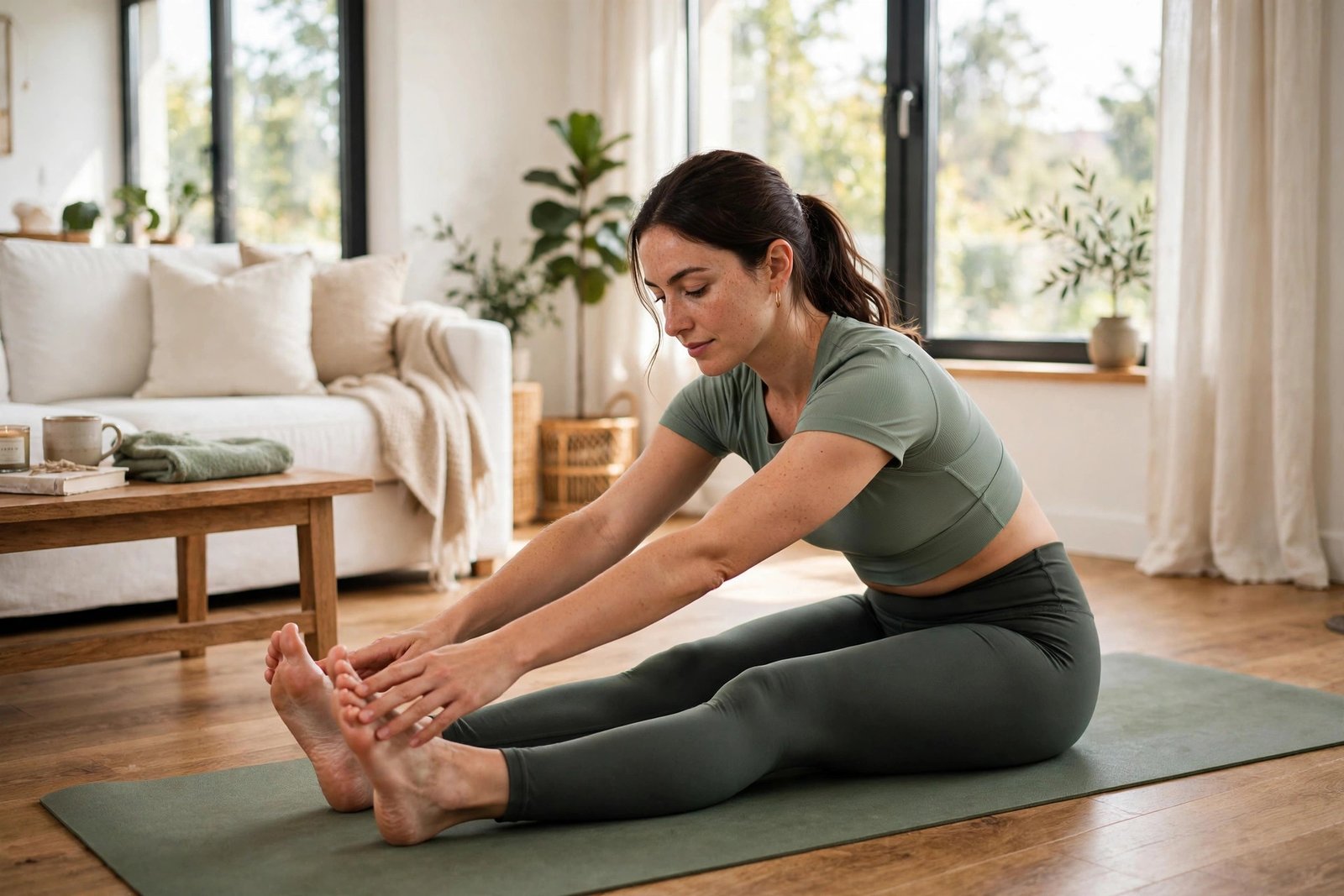
1. Warm up first: do two to three minutes of easy walking or marching in place before you stretch. As a result, warm muscles respond better and feel less cranky, while cold, stiff muscles are easier to irritate.
2. Hold each stretch for 20 to 30 seconds: move into the stretch slowly and hold it steady. There is no need to hold longer on sore days; in fact, two to three easy rounds per muscle group is plenty.
3. Never bounce: for instance, bouncing forces the muscle past its comfort zone, and on sore muscles that extra force can cause small new tears. Instead, hold still and breathe deeply.
4. Breathe and relax into it: slow breathing tells your nervous system that everything is safe. As a result, the muscle releases a little more with each exhale, and in addition, relaxed stretching simply feels better.
5. Stretch the sore area, not just around it: indeed, it is fine to stretch the exact muscles that ache. Just keep the intensity low; similarly, nearby tight muscles often appreciate attention too.
6. Stop if the soreness gets worse: a stretch should never increase your pain. However, if the ache sharpens while you hold the position, ease off immediately, because your body is giving you useful feedback.
A Simple 5-Minute Gentle Routine for Sore Days
For example, here is an easy sequence you can do at home with no equipment. Move slowly between positions and skip anything that feels wrong.
Child’s pose, 30 seconds: first, kneel, sit back toward your heels, and reach your arms forward. As a result, this gently opens the back, shoulders, and lats.
Standing calf stretch, 30 seconds per leg: place your hands on a wall, step one foot back, and press the heel down. Meanwhile, keep the back leg straight and the stretch mild.
Gentle standing quad stretch, 30 seconds per leg: hold a chair for balance, bend one knee, and catch your ankle behind you. Keep your knees close together and your torso tall.
Seated figure-four hip stretch, 30 seconds per side: sit tall, cross one ankle over the opposite knee, and lean forward slightly. You should feel a mild pull in the outer hip.
Cross-body shoulder stretch, 30 seconds per arm: bring one arm across your chest and support it with the other hand. Consequently, this eases the shoulders and upper back.
Slow neck tilts, 20 seconds per side: tilt your ear toward your shoulder and hold. Meanwhile, keep your shoulders relaxed and away from your ears.
Finally, repeat the full sequence once or twice if you have time. For more ideas, our static stretching guide walks through each type of stretch in detail.
What Actually Helps Sore Muscles Recover Faster
Here is the truth most fitness marketing will not tell you: time is the main cure for soreness. In fact, no stretch, supplement, or gadget can skip the repair process.
However, several simple habits can make those sore days noticeably more comfortable. Many people ask, “Should you stretch sore muscles to recover faster?” The honest answer is that the habits below matter far more.
Keep moving gently: for example, light activity like a short walk or easy cycling increases blood flow to sore muscles. As a result, stiffness fades faster. Just keep the effort easy, and avoid training the same sore muscles hard.
Use heat for comfort: for instance, a warm shower or heating pad can relax tight, achy muscles. Indeed, heat feels especially good on stiff backs and legs. In contrast, save ice for sharp injuries with swelling.
Try foam rolling: similarly, gentle foam rolling can ease the feeling of tightness in sore muscles. Our foam rolling guide shows safe techniques for every major muscle group.
Sleep well and hydrate: your body does most of its repair work while you sleep. Therefore, a full night of rest matters more than any recovery trick.
In addition, drinking enough water supports normal muscle function. If soreness keeps you restless at night, a calming evening stretching routine can help you unwind before bed.
Eat enough protein: in addition, muscles need protein to rebuild after hard workouts. You do not need anything fancy. For example, regular balanced meals with a good protein source are enough.

Finally, be patient with the process. Soreness usually fades within two to five days.
Moreover, the next time you do the same workout, it will likely hurt much less. That adaptation is real progress, even when it does not feel like it.
For a clear overview of soreness and safe self-care, the Cleveland Clinic’s guide to delayed onset muscle soreness is a trustworthy place to start. Researchers have also published a detailed systematic review on post-exercise stretching and recovery for readers who want the deeper science.
Frequently Asked Questions About Stretching Sore Muscles
Here are the questions I hear most often about this topic. Each one circles the same core worry: should you stretch sore muscles, and what are the limits?
Should You Stretch Sore Muscles Every Day?
Yes. Should you stretch sore muscles every day? You can, gently, while they recover.
In addition, daily light stretching keeps you moving and prevents stiffness from building up. Just keep every session easy and pain-free.
Does Stretching Make Soreness Go Away Faster?
Unfortunately, no. In fact, research shows that stretching does not meaningfully speed up soreness recovery.
It can, however, make you feel more comfortable while you wait. Think of it as comfort care, not a cure.
Is It Okay to Work Out With Sore Muscles?
Usually, yes, if the soreness is mild. For example, a light workout or easy cardio is fine and may even loosen you up. However, avoid training the same sore muscles hard until the soreness fades.
How Long Should You Hold Each Stretch on a Sore Day?
Hold each stretch for 20 to 30 seconds and repeat two to three times. In fact, longer holds do not add much benefit on sore days. Short, gentle rounds are the sweet spot.
Should You Stretch Before a Workout to Prevent Soreness?
However, stretching beforehand will not prevent next-day soreness. A proper warm-up with light movement is more useful. For example, five minutes of easy cardio prepares your muscles better than static stretching.
What Is the Difference Between Soreness and an Injury?
For instance, soreness feels dull, achy, and spread across the muscle, and it appears a day or two after exercise. In contrast, an injury usually causes sharp pain, swelling, or bruising, and it often starts during the workout. Therefore, when in doubt, rest and get professional advice.
Conclusion: Be Gentle, and Listen to Your Body
So, should you stretch sore muscles? Yes, gently, briefly, and only when it feels right.
Keep the intensity low, skip the aggressive deep stretches, and watch for the red flags we covered. Indeed, most soreness is simply your body getting stronger, and it will pass in a few days.
The next time you wake up achy, you will know exactly what to do. In other words, move a little, stretch a little, and give your body the time it needs. Finally, consistency beats intensity, and the gentlest path is often the fastest one back to feeling great.
