

Animal flow exercises for beginners are the perfect starting point if you want one workout that builds strength, mobility, and coordination all at once. Moreover, this ground-based movement system uses animal-inspired positions linked by smooth transitions. In addition, you need zero equipment and only a small patch of floor.
If you have seen people moving like beasts and apes on a mat, you have seen Animal Flow. In this guide, you will learn what the system is, how its parts fit together, and the three foundational moves every beginner needs. Finally, you will combine them into a simple 10-minute starter flow you can practice at home.
What Is Animal Flow? A Look at the System
Animal Flow is a branded movement discipline created by fitness educator Mike Fitch. In addition, it blends bodyweight training, ground-based mobility, and playful animal-inspired positions. However, it is not random. Indeed, every move has a name, a purpose, and clear technique cues.
In fact, the official system is built from six components that always work in the same order. Firstly, you prepare the body. Secondly, you activate key muscles. Finally, you learn the moves and link them into flows. As a result, beginners always know what to practice next.
Here are the six components you will encounter:
- Wrist mobilizations: gentle stretches and circles that prepare your wrists for ground work, since your hands carry much of your weight.
- Activations: simple holds like the Beast and the Crab that wake up the whole body and build the connection between your upper body, core, and legs.
- Form-specific stretches: mobility stretches that open the hips, shoulders, and spine and prepare your body for the deeper positions in the system.
- Traveling forms: animal-style movements that move you across the floor, such as the Beast reach or the Crab walk, which build coordination and endurance.
- Switches and transitions: the movements that connect one position to another, acting as the “glue” that turns separate moves into a real flow.
- Flows: linked sequences where everything comes together; your first flow will be very simple, and that is exactly the right way to start.
For a deeper look at the official method, you can visit the official Animal Flow website. In addition, it offers instructor programs and certification courses for those who want to go further. For now, though, everything in this guide is enough to begin.
Animal Flow Exercises for Beginners: What Makes the System Different
You may wonder how Animal Flow differs from simply crawling around like an animal. The answer is structure. Animal flow exercises for beginners follow one specific system with its own names, cues, and progressions. Indeed, every move is taught the same way, no matter who teaches it.
On the other hand, generic animal-style workouts have no official rules. Nevertheless, they are playful and fun, but they do not build on each other in a set order. Therefore, they are great for casual movement but harder to progress with.
If you prefer the playful, no-rules approach, our guide to primal movement exercises for beginners covers it as a simple at-home circuit. For this article, however, we will stay with the official Animal Flow system. Consequently, you will learn the discipline the way it was designed.
Before You Begin: 5 Simple Ground Rules
Although Animal Flow is gentle on joints when you start slowly, your wrists, knees, and shoulders do real work here. Consequently, a few ground rules will keep your first sessions safe and enjoyable.
- Clear your space: you need about a 6-by-6-foot patch of clear floor, so move furniture and rugs aside for stable hand and knee placement.
- Warm up your wrists: spend at least two minutes on wrist circles and gentle stretches before every session, because sore wrists are the number one beginner complaint.
- Start on a mat or carpet: a yoga mat, carpet, or even a folded blanket cushions your knees during floor work.
- Go slow before you go smooth: master each static position first, and only add movement once the shapes feel easy.
- Stop if something hurts: muscle effort and mild stretch feelings are normal, but sharp or pinching pain means you should ease off or skip the move.
The 3 Foundational Animal Flow Exercises for Beginners
Animal flow exercises for beginners are built on three foundational positions: the Beast, the Crab, and the Ape. Indeed, most flows are simply smooth ways of moving between these three shapes. Once you can hold each one comfortably, you are ready to start flowing.
Practice each move on its own for a few days first. For instance, spend five minutes with the Beast on Monday and the Crab on Tuesday. As a result, your body learns the shapes before you ask it to link them together.
1. The Beast
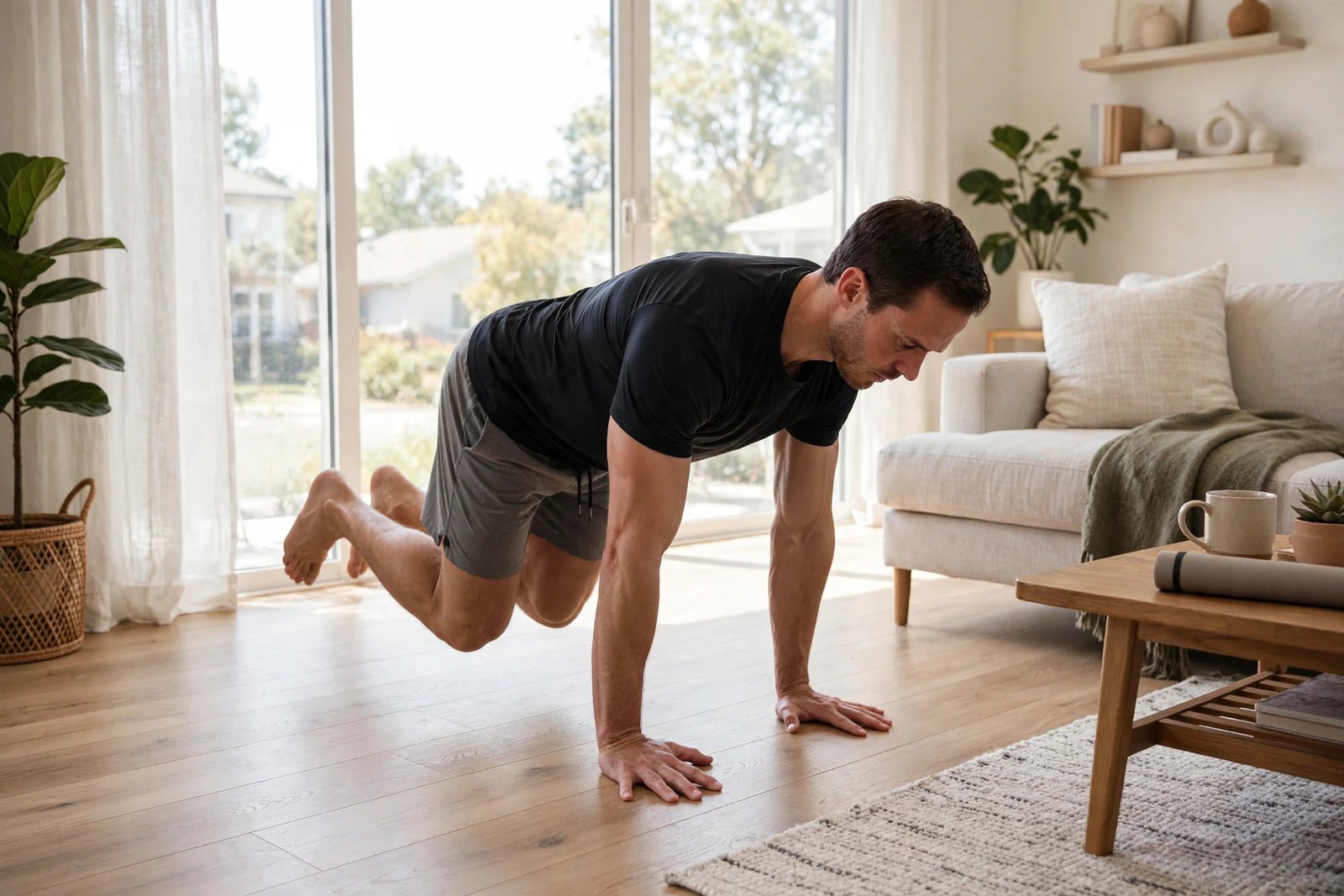
The Beast is the home base of Animal Flow. Firstly, start on all fours with your hands under your shoulders and your knees under your hips. After that, lift your knees about two inches off the floor while keeping your back flat like a tabletop.
Moreover, this position wakes up your core, shoulders, and hips all at once. Meanwhile, hold it for 20 to 30 seconds and breathe normally. For example, count five slow breaths before setting your knees back down.
A common mistake is letting the hips sag or piking them up high. Instead, keep the knees low and the spine long. Think of balancing a glass of water on your lower back.
2. The Crab
The Crab is the mirror image of the Beast. Sit on the floor, place your hands behind you with your fingers pointing away, and lift your hips toward the ceiling. Meanwhile, your knees stay bent while your chest opens upward.
In addition, this move stretches the front of your shoulders and strengthens the back of your body. Moreover, it builds the wrist strength you need for the rest of the system. Finally, hold for 20 to 30 seconds, or five slow breaths.

If your shoulders feel tight, you can reduce the lift. Keep your hips a little lower until your chest opens over time. After all, consistency, not depth, is what matters here.
3. The Ape
The Ape is a playful low squat that builds hip mobility. Stand with your feet slightly wider than your shoulders and drop into a deep squat. Then place your hands on the floor in front of you while keeping your heels down.
Similarly, this position opens your hips, ankles, and inner thighs while teaching your body to stay relaxed low to the ground. Hold for 20 to 30 seconds and let your knees gently push outward.

If your heels lift off the floor, do not worry. Many beginners start that way. Until your ankle mobility improves, you can place a rolled towel under your heels.
Animal Flow Exercises for Beginners: Your First 10-Minute Starter Flow
Once you can hold the Beast, the Crab, and the Ape comfortably, you are ready to link them. Indeed, this simple starter flow introduces switches and transitions in the gentlest way possible. It takes about ten minutes, including a short warm-up and cool-down.
Firstly, spend two minutes on wrist mobilizations. Do slow wrist circles, then gentle palm stretches against the floor. Meanwhile, take slow breaths through your nose to settle into practice mode.
Secondly, practice each position on its own for one minute. Hold the Beast, then the Crab, then the Ape. As a result, your muscles remember each shape and the flow part feels much smoother.
Now the flow itself. Start in the Beast and hold for three breaths. Then sit back into the Ape, hold for three breaths, and press your hands forward to return to the Beast. Repeat this slow Beast-to-Ape switch four times.
After that, add the Crab. From the Beast, roll onto one side and lift into the Crab. Hold for three breaths, then reverse the motion back to the Beast. Do this twice on each side. After all, there is no rush, so move at the speed of your breath.

Finally, link all three shapes once without stopping: Beast, Ape, Beast, Crab, Beast. That is your first real flow. It does not need to look pretty; it only needs to feel controlled.
To finish, sit back into a relaxed squat or lie on your back for one minute. Meanwhile, stretch your wrists, shake out your hands, and take three deep breaths. Congratulations, you just completed your first Animal Flow session.
How Often Should You Practice? A Simple Weekly Plan
Because your wrists and shoulders need time to adapt to ground work, three short sessions per week work better than one long one for beginners. Therefore, keep sessions to 10 or 15 minutes for the first month.
A simple weekly plan looks like this. On Monday, practice the three positions as static holds. On Wednesday, work on the slow transitions between them. On Friday, repeat the 10-minute starter flow from start to finish.
Meanwhile, on rest days, gentle stretching keeps your body open and ready. In fact, our mobility exercises for beginners guide pairs well with Animal Flow. For example, many people use it as a morning routine on their non-flow days.
Animal Flow Exercises for Beginners: 6 Tips to Succeed
These practical tips will help you progress faster and avoid the most common beginner frustrations. Indeed, small details make a big difference in a skill-based practice like this.
- Film yourself once a week: your phone camera is the best coach you have, and a 30-second video reveals rounded backs and lifted hips that you cannot feel yet.
- Practice barefoot: bare feet grip the floor better and improve your balance, and your toes and ankles get stronger just from gripping the ground.
- Breathe through your nose: slow nasal breathing keeps you calm and controlled, but if you find yourself gasping, you are moving too fast.
- Stretch your hip flexors: deep positions demand open hips, so adding hip-opening stretches on rest days will make the Ape feel easier within weeks; our stretching exercises for beginners guide is a good place to start.
- Learn one transition at a time: do not try to memorize a long flow on day one; master Beast-to-Ape this week and add the Crab transition next week.
- Join a class when you can: Animal Flow has certified instructors worldwide, and even one live class can fix habits that videos cannot; you can find instructors through the official website linked above.
Frequently Asked Questions About Animal Flow Exercises for Beginners
Is Animal Flow good for complete beginners?
Yes, it is an excellent choice for beginners, because the system teaches static positions before any movement. In addition, every move has beginner-friendly modifications.
How long should each beginner session be?
In fact, start with 10 to 15 minutes, three times per week. This is enough to learn the shapes without overloading your wrists. As a result, you can build consistency without soreness or burnout.
Do I need any equipment for animal flow exercises for beginners?
No equipment is needed at all. Instead, you only need a small patch of clear floor and optionally a yoga mat or carpet. Besides that, bare feet and comfortable clothes are the only other requirements.
What is the difference between Animal Flow and primal movement?
Animal Flow is a structured, branded system with named moves, set techniques, and progressive flows. In contrast, primal movement is the generic, playful version with no official rules. Our primal movement exercises for beginners guide covers the casual approach if that appeals to you more.
Can animal flow exercises for beginners help with weight loss?
They can support weight loss as part of an active lifestyle. Indeed, flows raise your heart rate and build muscle, which both burn calories. However, nutrition matters most, so think of Animal Flow as one helpful piece of a bigger plan.
How long until I notice progress?
Indeed, most people feel smoother and stronger within two to three weeks of regular practice. Your wrists adapt first, then your coordination improves. On the other hand, deep hip mobility takes longer, so give the Ape position a month or two.
Conclusion
Animal flow exercises for beginners prove that a powerful workout does not need equipment, a gym, or complicated choreography. In fact, with just the Beast, the Crab, and the Ape, you can build strength, mobility, and coordination right in your living room.
Start with the static holds, add one transition at a time, and repeat your 10-minute flow three times a week. In fact, consistency beats intensity every time in a skill-based practice like this. As a result, your body will adapt faster than you expect.
When your first flow feels smooth, you will be ready for traveling forms and longer sequences. Until then, enjoy the process. After all, moving like an animal should feel playful, not punishing. Grab some floor space and start your first flow today.
