


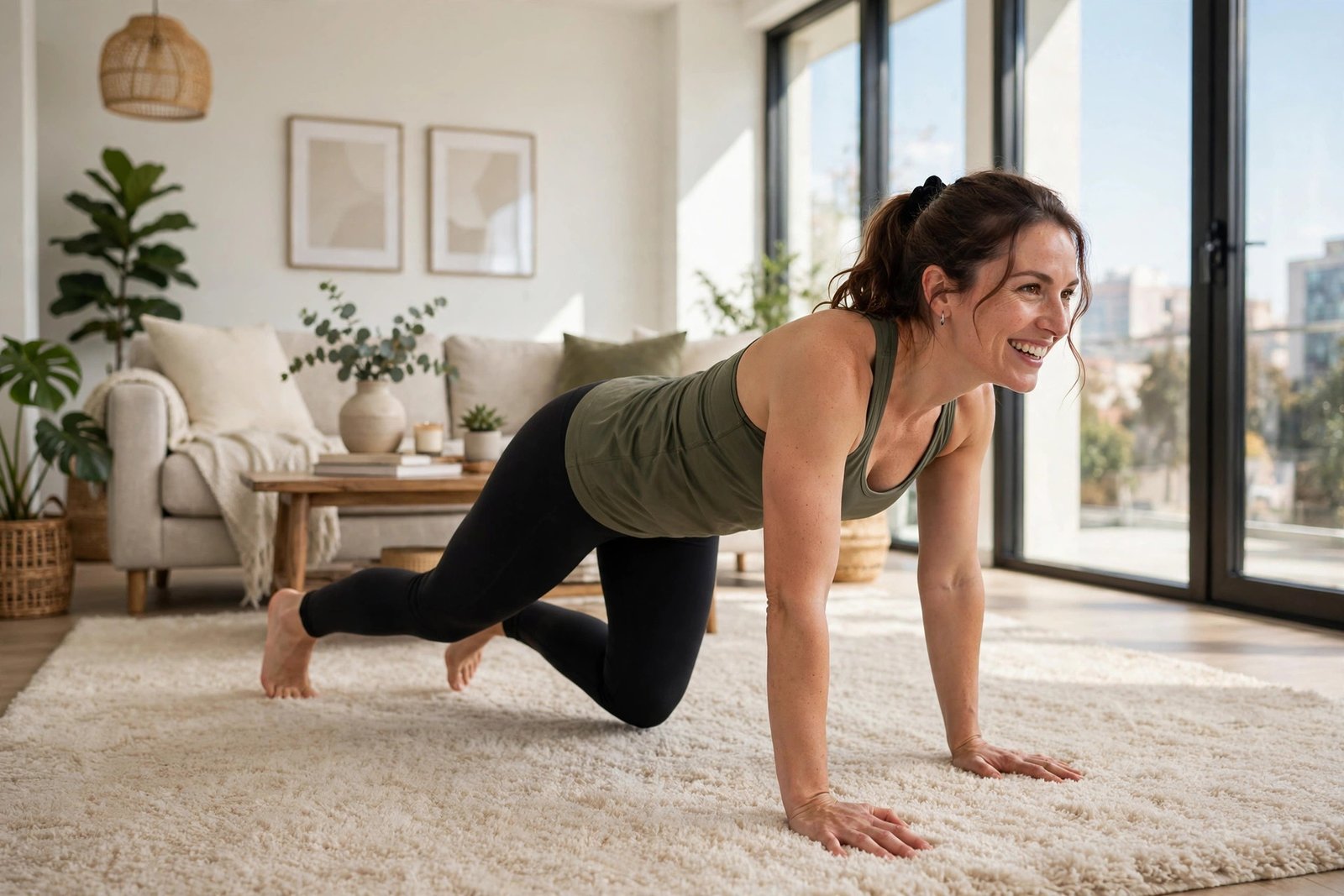
Primal movement exercises for beginners are the simplest way to bring back the kind of movement your body was built for. Instead of machines or complicated routines, you move the way nature intended. In other words, you crawl, squat, reach, and hop like an animal.
If that sounds strange, it will feel surprisingly natural after a few minutes. In fact, most people start smiling within the first round. This guide will show you exactly how to begin with a playful, animal-inspired circuit you can do in your living room.
Best of all, you need no equipment and no gym membership. Moreover, you just need a little floor space and the willingness to look a little silly. As a result, your joints, muscles, and mood will thank you.
What Are Primal Movement Exercises for Beginners?
Primal movement exercises for beginners are simple, animal-inspired moves performed as a fun bodyweight circuit. Think bear crawls across your living room floor. Then add crab walks, frog hops, and a gorilla shuffle.
The idea is simple. Humans evolved to squat, crawl, climb, and lunge. Modern life, however, keeps us in chairs for most of the day. As a result, our hips tighten, our cores weaken, and our coordination fades.
Primal movement exercises for beginners rebuild those lost patterns. Indeed, each move asks your whole body to work together. Your shoulders, core, hips, and legs all contribute at the same time.
One important note: this circuit is the playful, generic version of animal-inspired training. It is not the branded Animal Flow system. If you later want the structured discipline with its own flow sequences, you can read our guide to animal flow exercises for beginners. For now, though, let’s keep things simple and fun.
Why Primal Movement Exercises for Beginners Actually Work

Primal movement exercises for beginners work because they train your whole body at once. A bear crawl is basically a moving plank. Therefore, your core stays switched on for the entire set.
At the same time, crawling loads your shoulders in a joint-friendly way. This builds shoulder stability. Consequently, it helps prevent the nagging aches that desk workers often get. In addition, the alternating arm-and-leg pattern sharpens coordination in a way that machines never will.
Your hips benefit from primal movement exercises for beginners too. Deep squat positions, like the gorilla shuffle, open the hips and ankles. Consequently, everyday actions like picking things up or sitting down feel easier over time.
There is also a mental side to primal movement exercises for beginners. Indeed, these moves are playful, and playfulness matters. When exercise feels like fun, you are more likely to do it again. As a result, consistency becomes almost automatic.
Research on quadrupedal movement supports this. For example, trainers report that crawling builds core strength, improves mobility, and challenges balance at the same time. You can read more about the science in this quadrupedal movement training guide and this overview of the benefits of crawling for adults.
Finally, this style of training is gentle on your schedule. A full circuit takes about 15 minutes. Moreover, you can do it in a small space, barefoot, in your pajamas if you like. Indeed, the best workout is the one you actually do. This one makes that easy.
How to Warm Up for Your Primal Workout
Before you start crawling, give your body two minutes of preparation. First, march in place for 30 seconds to raise your heart rate. Also, do 10 slow bodyweight squats.
Second, get on all fours and do 10 cat-cow stretches. Round your back on the exhale, then arch it gently on the inhale. This wakes up your spine.
Finally, make 10 slow circles with each wrist and ankle. In fact, your wrists carry real load during crawls, so do not skip them. If you want more warm-up ideas, check out our movement training basics guide.
The 5 Primal Movement Exercises for Beginners to Try at Home
Here are five moves that form the perfect starter circuit. Each one targets different muscles. However, all of them teach your body to move as one unit. Start with the first move and work your way down.

1. The Bear Crawl
The bear crawl is the foundation of the whole circuit. First, start on all fours with your hands under your shoulders. Then lift your knees about an inch off the floor.
Keep your back flat, like a tabletop. Now move your right hand and left foot forward together. Then switch: left hand, right foot. Also, take small, controlled steps.
Crawl forward for about 10 steps, then crawl backward to your start. If your wrists get tired, drop your knees for a few seconds. Indeed, there is no shame in resting.
Beginner tip: keep your hips low. For example, most people lift their hips too high, which turns the move into a stretch instead of a strength exercise. Imagine you are balancing a cup of coffee on your lower back.
2. The Crab Walk
The crab walk flips you over and works the back of your body. Sit on the floor with your knees bent and hands behind you. Press through your hands and feet to lift your hips.
Now walk sideways or forward for 10 steps, then come back. Also, keep your chest open and your hips as high as comfortable. Indeed, your triceps and shoulders will burn, and that is the point.
If the full version feels hard, keep your hips lower to the ground. This reduces the load on your shoulders. Similarly, shorter distances count fully for beginners.
3. The Gorilla Shuffle
The gorilla shuffle opens your hips beautifully. First, stand with your feet wider than your shoulders. Then drop into a deep squat, with your heels as flat as possible.
Place your knuckles or fingertips on the floor in front of you. Then shuffle forward in the squat, taking small steps. Go for 10 steps forward, then 10 steps back. Additionally, you can rest between the forward and backward sets.
If you cannot get into a deep squat yet, hold onto a sturdy chair or doorframe. This is completely fine. In fact, assisted squats build the same hip mobility over time.
4. Frog Hops
Frog hops add a little cardio to your circuit. First, get into a deep squat with your hands on the floor. Then hop forward a short distance, landing softly back in the squat.
Focus on quiet landings. Indeed, soft knees absorb the impact and protect your joints. Do 8 hops, then stand up and shake out your legs.
Not ready to hop? Simply walk your squat forward instead. You still get the hip and leg work. Moreover, you can add the hop in a week or two when you feel stronger.
5. The Ape Reach
The ape reach is a wonderful full-body stretch disguised as play. First, stand tall, then fold forward and walk your hands out to a plank position. Also walk your hands back toward your feet.
From there, stay in your deep squat and reach one arm up toward the ceiling. Hold for two breaths, feeling the twist through your spine. Then switch arms. Indeed, this gentle twist feels wonderful after the crawling moves.
Repeat the sequence 5 times. This move links upper body, core, and hips in one flowing pattern. Consequently, it is a perfect finisher for your circuit.
Putting It Together: Your 15-Minute Circuit
Now let’s turn these moves into a real workout. The circuit is simple. The circuit is simple: first, do each move for 30 seconds, then rest for 30 seconds.
Here is the order:
- Bear crawl: 30 seconds forward and back
- Rest: 30 seconds
- Crab walk: 30 seconds
- Rest: 30 seconds
- Gorilla shuffle: 30 seconds
- Rest: 30 seconds
- Frog hops: 30 seconds
- Rest: 30 seconds
- Ape reach: 30 seconds
That is one full round, taking about 7 to 8 minutes. If you are new, start with one or two rounds. Additionally, as you get stronger, work up to three rounds with shorter rests.
Quality always beats quantity. Indeed, slow and controlled beats fast and sloppy. However, stop any move if you feel sharp pain, and simply rest longer between rounds.
Try this circuit two or three times per week. On other days, a gentle session like our mobility exercises for beginners routine makes a perfect active-recovery partner. In addition, walking on off days keeps you moving.
Common Mistakes to Avoid
First, do not rush. Speed hides poor form and steals the benefits. Therefore, move slowly enough that every step feels deliberate.
Second, do not hold your breath. Breathing keeps your core engaged and your muscles fueled. For example, exhale on the effort and inhale as you reset.
Third, do not ignore wrist discomfort. Crawling puts new demands on your wrists. Therefore, build up gradually, and do the wrist warm-up every time.
Fourth, do not skip the rest periods. The rests are part of the workout. Indeed, they let your form stay sharp for the next round.
Finally, do not compare yourself to videos online. Those athletes have practiced for years. Your only job is to be a little better than last time.
How Often Should You Do Primal Movement?

Two to three sessions per week is the sweet spot for most people. This gives your body time to recover while still building skill. In addition, the moves are low-impact, so recovery is usually quick.
If you love it, you can do a short 5-minute round daily as a warm-up. For instance, many people use a quick bear crawl set before lifting or running. It wakes up the whole body fast.
However, listen to your body. Sore wrists or shoulders mean you should take an extra rest day. Consistency over months matters far more than intensity in any single session.
Frequently Asked Questions
Are primal movement exercises for beginners safe?
Yes, they are safe for most healthy adults when done with good form. However, start slowly and use the modifications listed above. Also, stop if anything hurts. If you have a wrist, shoulder, or knee injury, check with a professional first.
How long until I see results?
Most people feel a difference within two weeks. For example, your coordination often improves within just a few sessions. Additionally, visible strength and mobility gains usually follow after four to six weeks of regular practice.
Do I need any equipment?
No equipment is needed at all. However, a yoga mat or soft rug makes floor work more comfortable. That is genuinely the entire shopping list.
Can older adults do these moves?
Yes, with smart modifications. Older adults can use the assisted gorilla shuffle with a chair, for instance. They can also do bear crawls with knees on the ground instead of hovering. The key is to start where you are.
Is this the same as Animal Flow?
No. This circuit uses generic animal-inspired moves for playful home training. In contrast, Animal Flow is a separate branded system with its own specific flows and terminology. If you are curious about that discipline, see our animal flow exercises for beginners guide for the dedicated breakdown.
Will this help me lose weight?
It can help as part of an active lifestyle. For example, the circuit raises your heart rate and builds muscle, both of which support fat loss. For best results, combine it with walking and balanced eating.
Conclusion
Primal movement exercises for beginners prove that fitness does not have to be complicated. Indeed, you do not need a gym, a coach, or fancy gear. You just need your body and a patch of floor.
Start with one round of the circuit this week. Every playful session builds strength, coordination, and confidence that carries into daily life. Focus on smooth, controlled moves and steady breathing. Additionally, add a round or shorten your rests as you improve.
Remember why you started: to move better and feel stronger in daily life. These playful animal moves deliver exactly that. Therefore, clear some space, get down on all fours, and have fun with it. In fact, ten minutes today beats a perfect workout you never start. Your body will remember how.
