


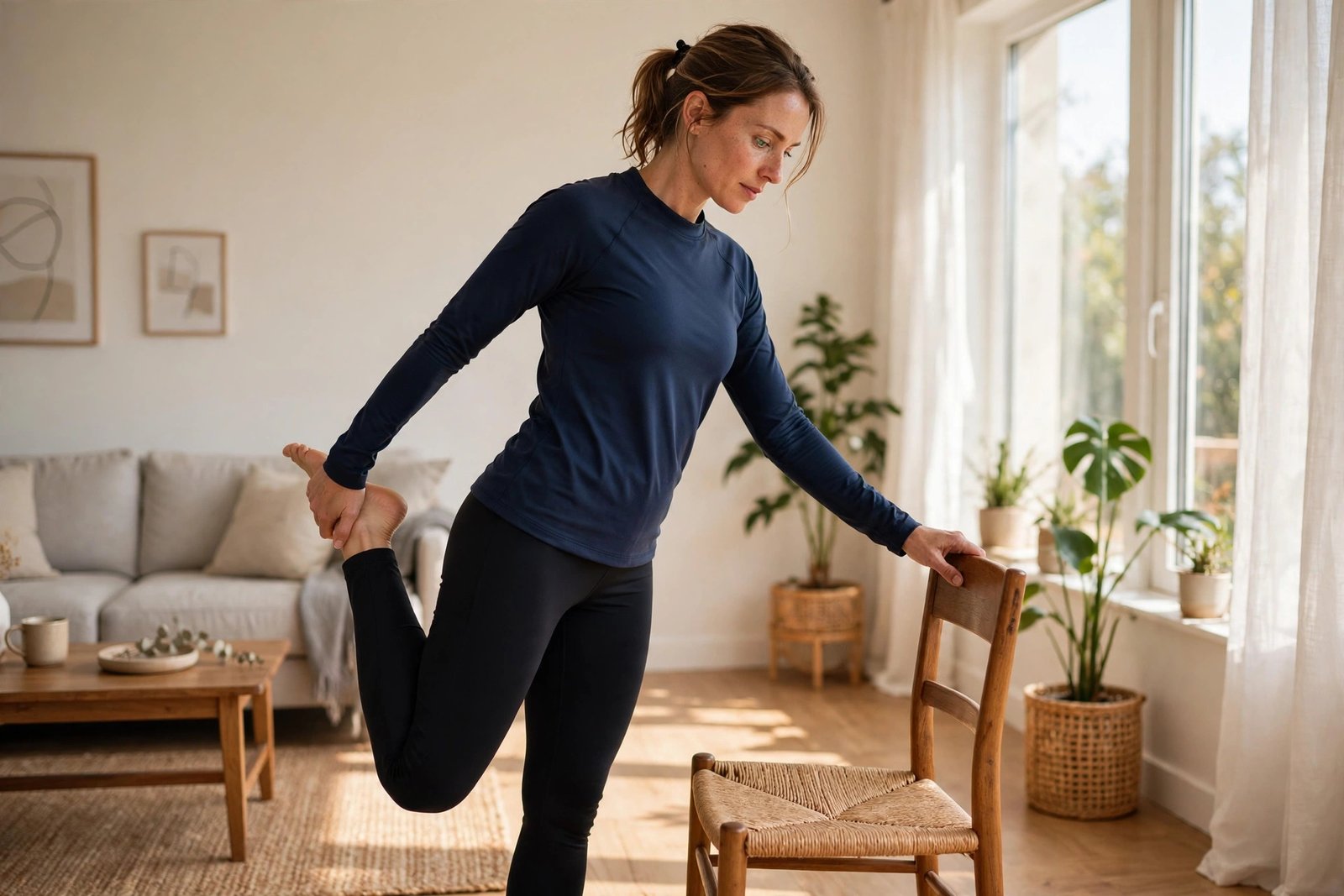
The standing quadriceps stretch is one of the simplest ways to ease tightness at the front of your thighs. It takes less than a minute per leg, needs no equipment, and fits easily into any routine. Best of all, you can do it at home with a wall or chair nearby.
Tight quads are incredibly common, especially for runners, cyclists, and desk workers. For example, sitting for hours keeps the quadriceps in a shortened position all day long. In fact, even active people develop tight quads when they skip stretching after exercise.
What Is the Standing Quadriceps Stretch?
The standing quadriceps stretch is a classic static stretch for the front of the thigh. You stand on one leg, bend the other knee, and gently draw your heel toward your glutes. As a result, the quadriceps lengthen and relax under light, steady tension.
Unlike floor stretches, this one keeps you upright and moving. Therefore, it doubles as a light balance drill for your standing leg. Additionally, it requires zero floor space, so it works in small apartments, offices, and gyms alike.
This stretch mainly targets the rectus femoris and the vastus muscles of the thigh. In addition, it gently opens the front of the hip on the stretching side. Meanwhile, the standing leg gets a quiet workout just keeping you steady.
Why Tight Quads Deserve Your Attention
Your quadriceps work hard every time you stand, walk, climb stairs, or squat. Over time, repeated use without stretching can leave them feeling stiff and short. Consequently, that tightness can pull on your knees and tilt your pelvis forward.
Desk workers are especially prone to this problem. Sitting keeps the hips flexed and the quads compressed for hours at a time. Similarly, runners and cyclists build strong quads that gradually lose flexibility without regular stretching.
Short, tight quads can also change how you move. For instance, they may limit your stride when walking or make stairs feel harder than they should. On the other hand, loose, happy quads help your knees track smoothly and your posture stay tall.
If walking is your main form of exercise, the quads play a big role there too. Our guide on whether walking tones your legs explains what walking does, and does not, do for your leg muscles. In fact, many walkers are surprised by how much quad care their routine really needs.
How to Do the Standing Quadriceps Stretch
Good form matters more than pulling your heel as close as possible. First, find a clear spot next to a wall, sturdy chair, or countertop. Stand tall with your feet hip-width apart and place one hand lightly on your support.
Shift your weight onto the leg closest to the support. Then bend the opposite knee and bring your heel up behind you. Reach back with your free hand and hold your ankle or the top of your foot.
Standing Quadriceps Stretch Step-by-Step
- Set your base. Stand tall beside your wall or chair and rest one hand on it. First, ground your standing foot and feel your weight spread evenly through it.
- Bend the working knee. Bend your free knee and draw your heel toward your glute. Hold your ankle or foot with the hand on the same side.
- Align your knees. Keep both knees pointing down and close together. Avoid letting the bent knee drift out to the side or forward.
- Tuck your pelvis slightly. Gently squeeze your glute on the stretching side and tuck your tailbone under. In addition, draw your belly button lightly toward your spine to protect your lower back.
- Breathe and hold. Take slow, deep breaths and hold the stretch for 20 to 30 seconds. As a result, the muscle relaxes a little more with each exhale.
- Release and switch. Lower your foot slowly, shake out the leg, and repeat on the other side. Finally, compare how each side feels.
The American Council on Exercise describes supported standing stretches as a safe way to improve flexibility at home. Their stretching exercise library is a helpful reference if you want more guided options.
Wall-Supported Version
The wall-supported version is the easiest way to learn this stretch. Stand an arm’s length from a wall and place your palm flat against it at shoulder height. Then follow the same steps, using the wall to steady yourself.
This option is excellent for beginners and anyone with shaky balance. In fact, removing the balance challenge lets you focus entirely on the stretch itself. Additionally, the wall is always the same height, so your setup stays consistent every time.
A hospital exercise guide from OU Health recommends the same approach for a thigh stretch. Hold something sturdy, grasp your ankle, and pull gently without arching your back. You can read their thigh (quad) stretch instructions for another trusted walkthrough.
Chair-Supported Version
A sturdy chair works just as well as a wall. Place it in front of you and rest your hand lightly on the chair back. For example, a dining chair or kitchen counter gives you the perfect height for a relaxed grip.
Keep the chair pressed against something solid so it cannot slide away. Additionally, avoid rolling office chairs for this stretch. In contrast, a heavy wooden chair stays put and gives you real confidence.
Many people prefer the chair version because it feels less formal than facing a wall. Meanwhile, you can easily switch sides by turning around. Just take a moment to reposition the chair before your second set.

Knee Comfort: How to Make Your Standing Quadriceps Stretch Pain-Free
Knee discomfort is the most common complaint with this stretch. However, a little adjustment usually solves it. The stretch should be felt in the front of your thigh, never as a sharp pinch inside the knee.
First, reduce how far you pull your heel. A gentle stretch still counts, even if your heel stays well away from your glute. In fact, forcing the range is the top reason knees protest during this move.
Second, try holding your pant leg or ankle instead of your toes. Pulling on the toes can add unwanted pressure behind the kneecap. Similarly, a small cushion of slack in the ankle makes the whole position feel calmer.
Third, keep the movement slow and smooth. Ease into the stretch over a few seconds instead of yanking your foot up. Additionally, if your knee feels cranky at any point, back off right away and try a smaller range.
Some people do better with a towel looped around the foot instead of gripping the ankle. For instance, this works well if reaching behind you feels awkward. Moreover, the towel lets you control the pull more precisely.
When to Skip or Stop the Stretch
Stop immediately if you feel sharp or shooting pain in the knee. Also, skip this stretch while recovering from a knee injury or surgery unless your doctor clears it. In that case, a gentler option like a seated stretch may suit you better.
Mild muscle tension in the thigh is normal and expected. On the other hand, joint pain is never something to push through. When in doubt, check with a physical therapist before continuing.

Common Standing Quadriceps Stretch Mistakes
Most mistakes with the standing quadriceps stretch come from trying too hard. First, people often arch the lower back to pull the heel closer. This shifts the stretch away from the quads and loads the spine instead.
Second, many lifters and runners let the bent knee drift forward. When the knee pushes ahead of the standing leg, the stretch loses its power. In addition, the hip flexor gets overstretched while the quad barely works.
Third, bouncing at the end of the range is a classic error. Bouncing can irritate the knee joint and the quad tendon. Instead, hold still and breathe deeply through the stretch.
Fourth, holding your breath is more common than you might think. Tension builds quickly when you forget to breathe. As a result, the muscle guards instead of relaxing, and the stretch feels harder than it should.
Finally, rushing the hold shortchanges the whole exercise. A five-second pull does almost nothing for lasting flexibility. Therefore, set a timer or count slow breaths to make sure you hold long enough.
Standing Quadriceps Stretch Variations for Every Level
Once the basic version feels comfortable, you can adjust the challenge. For example, advanced exercisers can try the stretch without any support. This turns it into a serious balance drill on top of a flexibility move.
A gentler variation uses a strap or towel around the foot. This helps if your shoulders or grip make reaching your ankle difficult. In addition, it lets you fine-tune the intensity with small hand movements.
Another option is the half-kneeling quad stretch on a soft surface. However, that version changes the position entirely, so treat it as a complement rather than a replacement. Similarly, a prone (face-down) quad stretch can work well for people who struggle with balance.
For a deeper stretch, gently press your hips slightly forward while holding the position. Additionally, you can squeeze the glute of the stretching leg a little harder. These small tweaks increase the lengthening without pulling the heel closer.
If you want a full lower-body routine around this move, read our guide to static stretching exercises. It shows how to structure holds, sets, and rest for the best results.

How Long and How Often Should You Stretch?
Hold each side for 20 to 30 seconds and repeat two to three times. In addition, stretch after workouts or in the evening when your muscles are warm. Research generally supports holding static stretches in this range for flexibility gains.
Daily stretching is fine for most healthy adults. However, keep the intensity gentle if you stretch every day. As a result, your muscles stay supple without getting irritated.
Three to five days per week is a great target for most people. Meanwhile, athletes training hard may benefit from stretching quads after every lower-body session. Finally, listen to your body and back off if soreness lingers into the next day.
Pair This Stretch With Hip Flexor Work
The quads and hip flexors are close neighbors that tighten together. Sitting shortens both, so stretching only one leaves half the problem unsolved. Therefore, pairing this stretch with hip flexor work gives you a more complete release.
A simple combo is the standing quadriceps stretch followed by a half-kneeling hip flexor stretch. First, finish both sides of the quad stretch. Then drop into a gentle lunge position to open the front of the hip.
Our hip mobility exercises guide includes several beginner-friendly options that pair perfectly with this routine. In fact, combining the two takes less than ten minutes and covers the whole front of the lower body.
Frequently Asked Questions
Can I do the standing quadriceps stretch every day?
Yes, daily stretching is safe for most people. Keep each hold gentle and stop if anything feels sharp or wrong. In addition, vary your routine across the week so no single muscle gets overworked.
Is the standing quadriceps stretch safe for sensitive knees?
It can be, with the right modifications. Use a wall for support, pull less aggressively, and hold your ankle instead of your toes. However, skip it during an active knee injury flare-up and ask your doctor or physical therapist first.
Should I stretch my quads before or after a workout?
Save this static stretch for after your workout or on rest days. Before exercise, choose dynamic moves like leg swings instead. As a result, your muscles get warm-up movement first and deep stretching when they are warm.
Why can’t I feel the stretch in my quads?
You may be arching your back or letting the knee drift forward. First, reset your posture and tuck your pelvis slightly. Additionally, try squeezing the glute on the stretching side, which often brings the sensation right into the thigh.
What if I can’t reach my foot behind me?
That is completely normal when you are starting out. Use a towel or strap looped around your foot to close the gap. Meanwhile, keep practicing, and your range will improve steadily over a few weeks.
Conclusion
The standing quadriceps stretch is a small habit with a big payoff. It takes minutes, needs no equipment, and keeps the front of your thighs feeling loose and happy. In addition, the wall and chair options make it accessible no matter your balance or fitness level.
Start with gentle holds, protect your knees, and pair it with hip flexor work for the full benefit. Finally, stay consistent, and your legs will thank you on every walk, run, and staircase. Your future self will be glad you started today.
