

Running feels free until your calves start talking back. If your lower legs tighten up after every run, a simple calf stretch for runners routine can change how your miles feel. In fact, most running calf trouble comes from one basic issue. Your calves absorb the impact of every single stride, yet they rarely get the recovery attention they deserve. This guide stays strictly runner-specific. You will learn the difference between your gastrocnemius and soleus. You will also get two wall stretches that target each muscle, plus step drops you can do right after a run. Moreover, no fancy equipment is needed. Finally, you will get a simple weekly plan so you always know exactly when to stretch.
Why a Calf Stretch for Runners Is Non-Negotiable
Your calves do an enormous amount of work on every run. They load up like springs with each footstrike. They also release that energy to push you forward. However, that repeated loading makes them stiff and tired over time.
When calf muscles tighten, your ankle range of motion shrinks. As a result, your stride shortens and your form starts to break down late in a run. Tight calves can also pull on the Achilles tendon and overload the plantar fascia.
That is why a dedicated calf stretch for runners matters more than a quick general stretch after exercise. You are not just stretching to feel nice. Instead, you are restoring the ankle motion your stride depends on and giving your calves a chance to recover between sessions.
Gastrocnemius vs Soleus: What This Calf Stretch for Runners Guide Targets
Your calf is actually two main muscles stacked together. Understanding them makes your stretching far more effective. First, let us look at each one.
The Gastrocnemius: Your Power Muscle
The gastrocnemius is the large, visible muscle that forms the upper calf. It crosses both the knee and the ankle joint. Therefore, it fires hardest when your knee is straight, such as during toe-off in your stride.
Runners feel tightness here after fast workouts and hill sessions. In contrast to deeper soreness, gastroc tightness often feels like a sharp pull just below the back of the knee. You will target this muscle with a straight-knee wall stretch.
The Soleus: Your Endurance Muscle
The soleus sits underneath the gastrocnemius and only crosses the ankle joint. Meanwhile, it works hardest when your knee is slightly bent, which is exactly how your knee looks at mid-stance during running.
The soleus handles huge loads on long, easy runs. As a result, it is often the true culprit behind that deep, achy calf fatigue on mile eight or nine. You will target this muscle with a bent-knee wall stretch.
Consequently, skipping one of these muscles is a common reason runners keep feeling tight. For example, many runners only stretch with a straight knee and wonder why the deep ache never leaves. This calf stretch for runners routine covers both, so nothing gets missed.

The Standing Wall Calf Stretch for Runners: Gastrocnemius Version
This is the classic straight-knee wall stretch, done the runner’s way. It directly targets the gastrocnemius. First, do it after your run, when your muscles are warm.
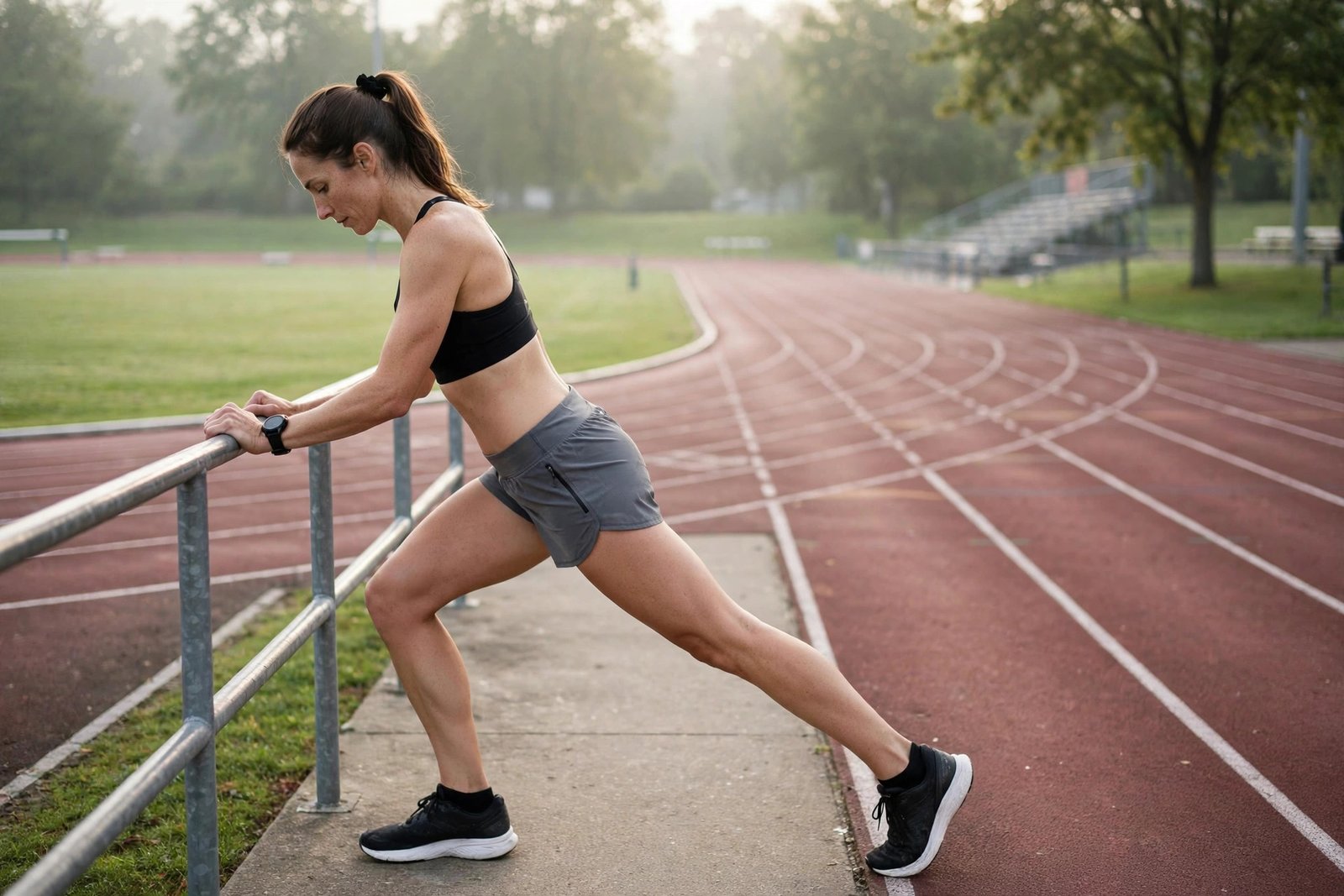
Stand facing a wall, fence, or tree and place both hands on it at shoulder height. Step one foot back about two to three feet and press that heel firmly toward the ground. Keep the back knee completely straight and point the toes of the back foot directly forward.
Now lean your hips gently toward the wall until you feel a strong but comfortable pull in the upper part of your back calf. Also, hold the stretch for 30 seconds while you breathe slowly. Finally, switch legs and repeat.
For best results, do two rounds per leg after every run. In addition, keep your back heel down the entire time. If the heel lifts, the stretch loses most of its effect.
Common mistakes are easy to fix. First, do not let your back foot turn outward, because that shifts the stretch away from the calf. Second, avoid bouncing, since bouncing can irritate the Achilles tendon. A steady, calm hold works much better.
The Bent-Knee Wall Calf Stretch for Runners: Soleus Version
This variation looks almost the same, but one small change shifts the stretch to the deeper soleus. It is the move most runners are missing. Perform it right after the straight-knee version.
Take the same wall position as before, with your hands on the wall and one foot stepped back. This time, bend the back knee slightly and sink your hips down a few inches. Press the back heel toward the ground as before.
Indeed, you should feel the stretch move lower and deeper in the calf. That shift means you have found the soleus. Hold for 30 seconds per leg and breathe deeply throughout.
Consequently, pairing both wall stretches gives you complete calf coverage in about four minutes. Many runners report that adding this bent-knee version is what finally ends their post-run calf ache. Give it two weeks of consistent practice and judge for yourself.

Step Drops: The Deepest Calf Stretch for Runners After a Run
Step drops, also called heel drops, deliver the deepest calf stretch of this routine. They use your body weight to lengthen both calf muscles at once. You can do them on any curb, step, or track bleacher after your run.
Stand with the balls of your feet on the edge of a step and hold a railing or wall for balance. Let both heels sink slowly below the level of the step. You will feel a deep stretch through the entire calf.
Hold the bottom position for 20 to 30 seconds. Then rise up onto your toes, pause briefly, and lower again. Repeat this slow lowering three to five times per set.
To bias the stretch toward the gastrocnemius, keep your knees straight during the drop. To shift it toward the soleus, bend your knees slightly and sink deeper. In fact, alternating between straight and bent knees turns one simple move into a complete calf stretch for runners.
Safety comes first with this exercise. Always use a handhold, because fatigue after a run can make your balance wobbly. In addition, start with a low step if you are new to the movement. There is no need to chase a dramatic drop on day one.
When to Do Your Calf Stretch for Runners Routine in a Training Week
Timing matters almost as much as technique. Do the full routine after every run, when your calves are warm and receptive. The whole sequence takes under ten minutes.
For example, on easy run days, one round of each stretch is enough. Your calves are not deeply fatigued, so a maintenance dose keeps them supple. In contrast, on hard workout days, such as intervals or tempo runs, do two full rounds instead.
After long runs, treat your calves to extra care. Do two rounds, then add a second short session of step drops later in the evening. Similarly, hill training days deserve the full treatment, since uphill running loads the calves heavily.
On rest days, light stretching is optional but welcome. A single gentle round of the wall stretches keeps blood flowing without stressing the tissue. However, skip the deep step drops on full rest days if your calves feel sore.
Over the course of a training week, consistency beats intensity. A short post-run routine done five times beats one heroic stretching session on Sunday. Therefore, keep the routine simple enough that you will actually do it. This habit also matches widely recommended practice: the NHS post-run stretching guidance encourages a short stretch after every run as part of healthy training.
If you want to pair this with your broader recovery work, our ankle mobility routine fits naturally alongside these stretches. Healthy ankles and supple calves support each other on every stride.

Common Mistakes Runners Make When Stretching Their Calves
Even good stretches fail when the details are wrong. The first mistake is stretching cold, before the run. Static calf stretches belong after your run, not before it. Before running, use dynamic moves instead, as our warm-up guide explains.
The second mistake is rushing the hold. A five-second stretch does almost nothing for tissue length. Hold each position for a full 30 seconds to give the muscle time to relax.
The third mistake is stretching through sharp pain. A strong pull is normal, but sharp or stabbing pain is a warning sign. If you feel it, stop immediately and consider seeing a professional.
Finally, many runners stretch only the leg that hurts. Always stretch both calves equally. On the other hand, if one side is noticeably tighter, give that side one extra round rather than skipping the other side entirely.
How Soon Will This Calf Stretch for Runners Routine Pay Off
Many runners ask how long they must stretch before feeling a difference. In most cases, you will notice easier first steps after about one week of consistent post-run stretching. However, deeper changes in flexibility usually take three to four weeks.
The reason is simple. Your muscles adapt gradually to repeated, gentle lengthening. Therefore, daily consistency matters far more than any single long session. As a result, runners who stretch after every run progress much faster than those who stretch once a week.
Track your progress with a simple test. First, try a deep squat with your heels flat on the ground. Then retest the same squat after three weeks of the routine. In addition, notice how your calves feel during the final miles of your long run.
If your tightness keeps improving, stay the course. On the other hand, if one calf stays stubbornly tight after a month, that leg may need extra attention. Give the tighter side one additional round of each stretch after every run.
Finally, remember that stretching supports your training but does not replace rest. Sore calves that never recover may signal that your weekly mileage jumped too fast. In that case, ease back on volume while keeping the stretches in place.
Calf Stretch for Runners: Frequently Asked Questions
Should I stretch my calves before or after running?
Therefore, stretch after running. In fact, static calf stretches work best on warm muscles, so the post-run window is ideal. Before a run, choose dynamic movements like leg swings and walking lunges instead. This order protects your muscles and improves your form.
How long should each calf stretch be held?
Hold each stretch for 20 to 30 seconds. Research and coaching practice both point to this range as the sweet spot for flexibility gains. Repeating for two rounds gives even better results on hard training days.
Why do my calves stay tight even though I stretch?
You are probably only stretching one of the two calf muscles. Most runners stretch the gastrocnemius with a straight knee and never target the soleus. Adding the bent-knee wall stretch and step drops usually solves the problem within a couple of weeks.
Can tight calves cause Achilles pain in runners?
Yes, tight calves are one of the most common contributors to Achilles irritation in runners. When the calf cannot lengthen properly, the Achilles tendon absorbs extra stress with every stride. Regular post-run stretching reduces that load significantly.
Are step drops safe for beginner runners?
Yes, when done carefully. For instance, use a low step, hold a railing for balance, and keep the movement slow and controlled. Beginners should start with one set of three slow drops per leg. As your strength builds, you can add more sets.
How often should runners stretch their calves each week?
After every run is the simple rule. For most runners, that means four to six short sessions per week. Each session takes under ten minutes, so the time cost is tiny compared with the payoff in comfort and stride quality.
Conclusion
Your calves carry you through every mile, so they deserve a few minutes of care after each run. A focused calf stretch for runners routine does not need to be complicated. Two wall stretches and a set of step drops cover both the gastrocnemius and the soleus in under ten minutes.
Start after your next run. Be consistent for two weeks and notice how your legs feel on the following runs. In addition, remember that small habits compound: the runners who stay healthy are usually the ones who respect recovery. For a complete lower-body approach, explore our mobility exercises for athletes guide as well. Your future miles will thank you.
