


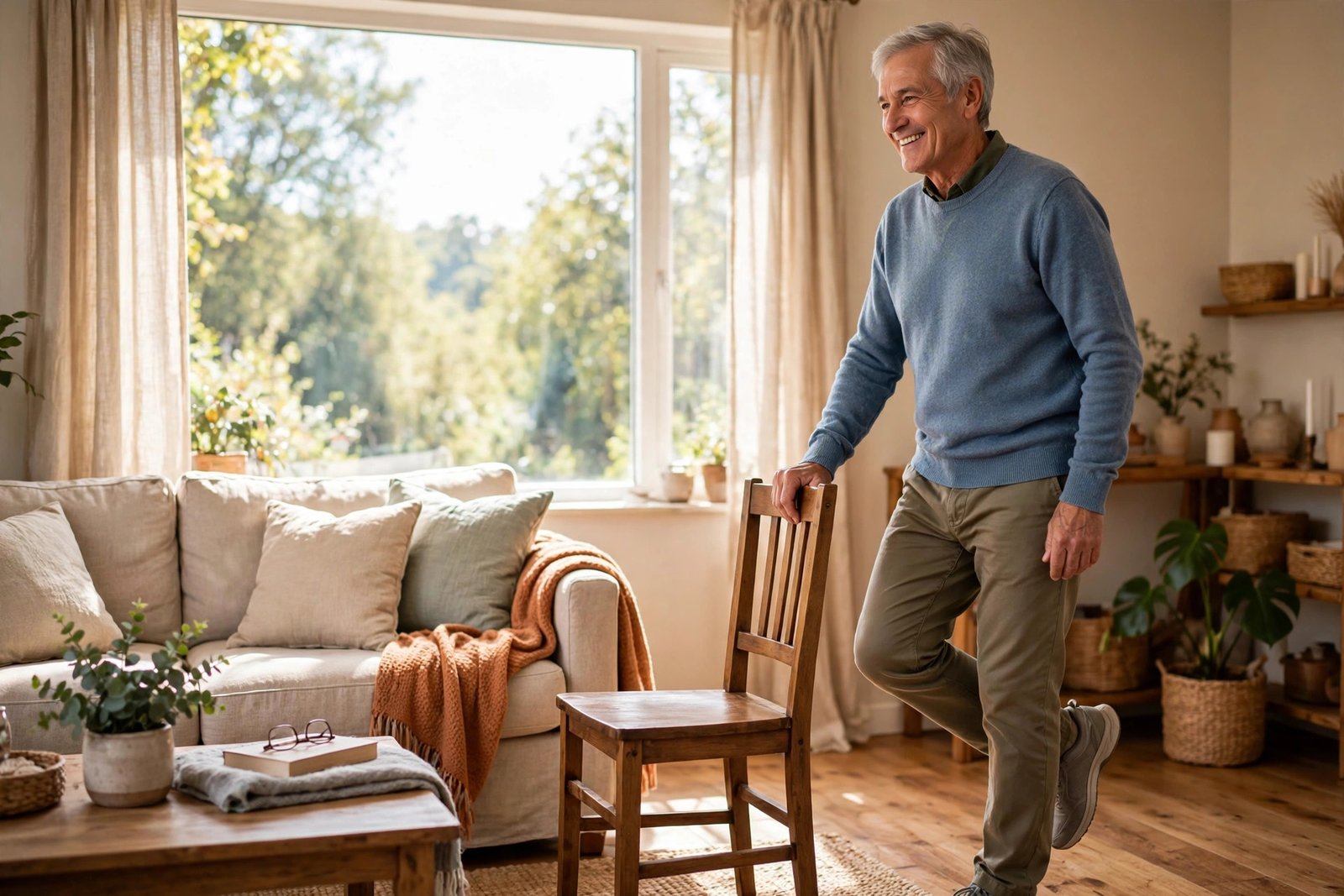
If getting up from a chair or walking across a room feels a little less steady than it used to, you are not alone. In fact, balance naturally declines with age. That is exactly why gentle balance exercises for seniors are one of the best ways to stay safe, active, and independent.
The good news is that balance is a skill, not a gift. Therefore, you can train it at any age with simple, safe movements done right at home. In this guide, you will learn a chair-supported routine that builds steadier balance step by step.
Safety first: This routine is gentle, but please check with your doctor before starting any new exercise program. Additionally, stop right away and sit down if you feel dizzy, lightheaded, or unsteady at any point. For every standing move in this article, always keep a sturdy chair within arm’s reach.
Why Balance Gets Harder After 60 (And Why It Matters)
Balance depends on three systems working together: your eyes, your inner ears, and the tiny sensors in your muscles and joints. As we age, however, each of these systems slows down a little. As a result, your body reacts more slowly when you trip, turn quickly, or step on an uneven surface.
This matters because falls are a leading cause of injury among older adults. According to the CDC, about one in four Americans aged 65 and older falls each year, so fall prevention is a serious and practical goal. For more facts on this topic, you can read the CDC’s overview of older adult falls.
Here is the encouraging part, though: research shows that regular balance training can lower your risk of falling. Indeed, even a few minutes a day can sharpen your reaction time and strengthen the muscles that keep you upright. In short, a little daily practice pays off in real confidence.
This is why balance exercises for seniors work so well. They retrain the communication between your eyes, ears, and muscles. As a result, your reactions get faster and your steps get steadier.
Safety Rules for Balance Exercises for Seniors
Before we start, let’s set up a safe practice space. First, choose a sturdy chair that will not slide, such as a heavy dining chair pushed against a wall. Next, clear the floor of rugs, cords, and clutter so your feet have a clear path.
Second, wear supportive, closed-toe shoes with non-slip soles. Bare feet or socks on a smooth floor, in contrast, can be slippery and risky. Moreover, skip the routine on days when you feel faint, ill, or very tired.
Third, keep one hand near your chair support during every standing exercise. Similarly, stand on a firm surface rather than a soft carpet when you practice heel-to-toe walks. Finally, if you have a medical condition, balance disorder, or a recent surgery, ask your doctor or physical therapist which moves are safe for you.
The CDC’s STEADI program offers helpful fall-prevention resources for older adults that you may also find useful. Most importantly, never push through pain or dizziness. Safety always comes before progress.
The Routine: 5 Chair-Supported Moves That Build Steady Balance
This routine takes about 10 to 15 minutes. Start with a two-minute warm-up: march gently in place behind your chair, and roll your shoulders a few times. Then move through the five exercises below in order. Each of these balance exercises for seniors uses a chair for support, so you can practice with total confidence.
Move 1: Chair-Supported Single-Leg Stand
The single-leg stand is the classic balance builder, and the chair makes it completely safe. First, stand behind your sturdy chair with both feet flat on the floor. Then place both hands lightly on the chair back.
Next, shift your weight onto your left foot and lift your right foot a few inches off the floor. Hold this position for 5 to 10 seconds while you breathe normally. Afterwards, lower your foot and repeat on the other side.
Aim for 3 holds per leg. If that feels easy, try using just one hand on the chair. Over time, you can briefly lift your fingertips off the chair, but always keep the chair within reach.
Like all balance exercises for seniors in this routine, this move is meant to feel easy and safe. Therefore, never be shy about using both hands on the chair.

Move 2: Heel-to-Toe Walk Along a Wall or Chair
This move trains the balance you need when walking on narrow or uneven paths. First, stand near a wall or place two sturdy chairs in a line beside you. Then position one foot directly in front of the other so your heel touches your toes.
Next, take a small step forward, placing your heel right against your front toes again. Keep your fingertips brushing the wall or chair for safety. Meanwhile, look straight ahead rather than down at your feet.
Walk 10 to 12 steps in one direction, then turn around carefully and walk back. If you wobble, simply pause and regain your balance before continuing. As a result of daily practice, these balance exercises for seniors will soon feel like second nature.
Move 3: Sit-to-Stand From a Sturdy Chair
Standing up from a chair without help is one of the most important daily skills for independence. Therefore, this exercise doubles as strength and balance training. First, sit near the front edge of a sturdy, armless chair with your feet flat and hip-width apart.
Next, lean your chest slightly forward and press through your heels to stand up. Try to use your hands as little as possible, but keep them hovering near the chair just in case. Then sit back down slowly with control.
Repeat this 8 to 10 times. If it feels hard at first, that is completely normal. In fact, leg strength builds quickly, and most people notice improvement within two or three weeks.
Many trainers call the sit-to-stand the single most useful of all balance exercises for seniors. It rebuilds the leg power you use every single day.

Move 4: Gentle Chair Marching
Chair marching wakes up your hip muscles, which play a big role in keeping you steady. First, stand tall behind your chair with both hands on the chair back. Then lift your right knee to a comfortable height, like a slow march.
Next, lower it and lift your left knee in the same way. Continue alternating for 30 to 60 seconds. Additionally, focus on standing tall and keeping your hips level as you march.
For an extra challenge, try holding each knee up for two full seconds. However, stay within a comfortable range and stop if your hips feel tired. In addition, you can do this move seated if standing feels too demanding at first.
Among balance exercises for seniors, chair marching is one of the gentlest ways to strengthen the hips. Stronger hips mean steadier steps on stairs, curbs, and uneven sidewalks.
Move 5: Side Leg Raises With Chair Support
Strong outer hips help you catch yourself when you step sideways or get bumped. First, stand beside your chair with your inside hand resting on the chair back. Then lift your outside leg slowly out to the side, about 6 to 12 inches.
Next, pause for a second at the top and lower the leg slowly back down. Repeat 8 to 10 times, then turn around and switch legs. Meanwhile, keep your toes pointing forward and your body upright.
Finally, breathe out as you lift and breathe in as you lower. This completes the five-move routine. Over time, these small moves add up to noticeably steadier days.

How Often Should Seniors Do Balance Exercises?
For the best results, aim for at least three sessions per week. However, short daily practice works even better if your schedule allows it. These balance exercises for seniors take only about ten minutes per session, so they fit easily into a morning or evening routine. In fact, consistency matters far more than length: 10 minutes daily beats one long session a week.
Pair your balance routine with gentle strength work for even better results. For example, our guide to weight bearing exercises at home shows simple moves that build the leg strength balance depends on. Similarly, ankle mobility exercises can improve the ankle flexibility that keeps you steady on stairs.
If you are building a daily habit, our beginner daily mobility routine fits nicely alongside this balance work. Start with whichever routine you enjoy most, and add the second one after two weeks. As a result, movement becomes a habit rather than a chore.
How to Progress Your Balance Exercises for Seniors Safely
Once these basic balance exercises for seniors feel comfortable, you can make the routine slightly harder. First, reduce your hand support: go from two hands on the chair to one hand, then to just fingertips. Next, close your eyes for a few seconds during the single-leg stand while a hand hovers near the chair.
Second, increase your hold times gradually. For instance, move from 10-second single-leg holds to 15, then 20 seconds. Additionally, try the heel-to-toe walk without touching the chair, but only when a wall is still within reach.
On the other hand, never rush progression. A good rule is to master one level for a full week before trying the next. In contrast to rushing, slow and steady progress keeps your confidence high and your risk low. Consequently, you will stick with the routine much longer.
Common Mistakes That Raise Your Fall Risk
First, many people hold their breath during balance moves, which can cause dizziness. Instead, breathe slowly and steadily through every exercise. Second, avoid practicing in socks on smooth floors; supportive shoes make a real difference.
Third, do not use a wobbly chair, a chair with wheels, or a folding chair. These can tip or slide when you lean on them. Moreover, avoid practicing when you are tired or after taking medication that makes you drowsy.
Finally, do not skip the warm-up. Cold, stiff muscles react more slowly, so two minutes of gentle marching prepares your body well. Indeed, most balance slips happen when people rush or skip the basics.
Frequently Asked Questions
Can balance exercises for seniors really prevent falls?
Yes. Research consistently shows that balance and strength training lowers fall rates among older adults. Therefore, this routine targets the exact skills involved in catching yourself during a stumble. Combined with a safe home setup, regular practice makes a meaningful difference.
Do I need any special equipment?
No. All you need is a sturdy chair and a clear patch of floor. In fact, that simplicity is the whole point: no gym, no gadgets, no cost. As long as your chair is heavy and stable, you are ready to begin.
What should I do if I feel dizzy during an exercise?
Stop immediately and sit down. Then take slow, deep breaths until the feeling passes completely. If dizziness happens often, please talk to your doctor before continuing, since it can signal an issue worth checking.
Are these exercises safe for seniors with arthritis or joint replacements?
These moves are gentle and low-impact, so many people with arthritis do them comfortably. However, everyone is different, so check with your doctor or physical therapist first. Additionally, keep all movements pain-free and within a comfortable range.
How long will it take to notice better balance?
Most people feel a little steadier within two to three weeks of regular practice. Larger improvements typically follow after six to eight weeks. In short, stick with it, and your body will reward your patience.
Conclusion: Start Today, One Steady Step at a Time
Balance is not something you lose forever after 60. On the contrary, it is a skill you can rebuild with a few minutes of gentle practice each day. These balance exercises for seniors are your safe starting point, and every session builds on the last.
Remember the three safety pillars: use a sturdy chair, check with your doctor first, and stop if you feel dizzy. With those in place, every session makes your steps a little steadier and your days a little more confident.
So find your chair, clear a little space, and begin with just one move today. Your future self, walking confidently and independently, will thank you for it.
