

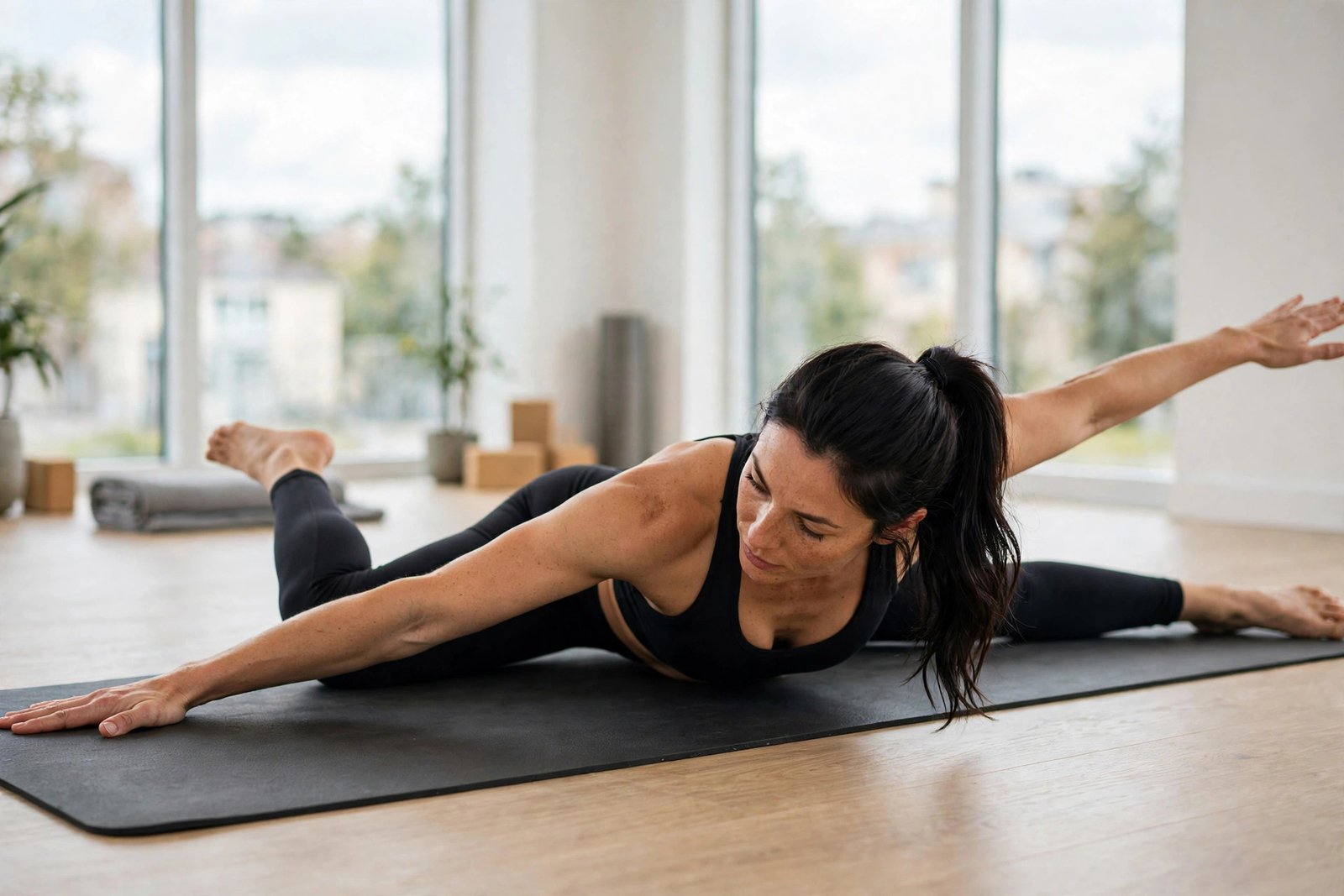
The scorpion stretch is one of those floor drills that looks impressive but feels surprisingly simple once you try it. You lie face down, spread your arms wide, and swing one leg across your body like the curved tail of a scorpion. In less than a minute, your lower back, hips, and chest all get a deep, refreshing stretch.
Best of all, you need nothing but a little floor space. In addition, the move scales easily. For example, beginners can take a tiny swing, while advanced movers can go for the full arc. This beginner-friendly guide breaks the scorpion stretch into simple steps, shows you what to avoid, and teaches you to breathe your way into a deeper release.
How to Do the Scorpion Stretch: Step-by-Step
First, find a comfortable spot on the floor. A yoga mat or soft carpet works best because hard floors can bruise your hip bones. Also, wear loose clothing so nothing restricts your swing.
Also, take your time with each step below. Indeed, slow movement is the whole secret of this drill. When you rush, your muscles tense up and the stretch disappears.
Step 1: Get Into the Starting Position
First, lie face down on your mat. Extend your arms straight out to the sides so your body forms a T shape. Rest your forehead on the floor, or turn your head gently to one side. In addition, drop your shoulders away from your ears. Consequently, your neck stays relaxed and the whole move feels easier.
Step 2: Lift and Swing One Leg
Second, press your left arm and chest firmly into the floor. These two contact points act as an anchor. In fact, without them the twist has no leverage. Then lift your right leg, bend the knee slightly, and swing it slowly across your body toward your left hand. Your hips will rotate off the floor, and that rotation is exactly what creates the stretch.
Step 3: Hold and Breathe
When you feel a gentle stretch across your lower back and the front of your hip, pause there. Hold the position for 20 to 30 seconds. Meanwhile, keep your shoulders heavy and still. Inhale deeply through your nose, then exhale slowly through your mouth. In fact, each long exhale lets you sink a little deeper into the pose. Moreover, steady breathing calms your nervous system, so your muscles release instead of resisting.

If you are a visual learner, the American Council on Exercise offers a clear step-by-step scorpion exercise demonstration you can follow along with. Watching the form once makes the written cues above click instantly.
Step 4: Return Slowly and Switch Sides
Finally, swing your leg back to the center with control. Lower it gently to the floor. In addition, shake out any tension before starting the next side. Then repeat the whole sequence on the other side. However, do not rush the switch. Moving slowly protects your spine and keeps the stretch smooth and even.
Scorpion Stretch Benefits: Why This Move Is Worth Learning
You might wonder why one floor drill deserves a place in your routine. The answer is simple: this one drill works several tight areas at once. Therefore, it gives you a lot of value for very little time.
First, it improves spinal rotation. Most of us spend the day facing forward; as a result, our spines rarely twist. Without regular rotation, the mid-back stiffens over time. This drill gently reintroduces rotation, and consequently your whole spine feels freer.
Second, it opens the hip flexors and quadriceps of the swinging leg. If you sit at a desk all day, those muscles shorten and pull your pelvis forward. In addition, the move stretches the chest and the front of the shoulder on the same side. That is great news if your shoulders round forward at a keyboard.
Third, it doubles as a warm-up or a cool-down. Before a workout, a few easy swings wake up your hips and back. After a workout, the longer holds help your muscles relax. Similarly, runners and dancers use it to prepare for deeper hip work like splits training. In fact, it pairs beautifully with our front splits stretch guide when you want to open your hips even further.
Common Scorpion Stretch Mistakes to Avoid
This drill is beginner-friendly, but small mistakes can steal its benefits. Fortunately, each one is easy to fix. Here are the most common errors I see.
Holding your breath. Indeed, the most common mistake with this drill is forgetting to breathe. When you hold your breath, your core braces and your muscles tighten. Instead, keep your breathing slow and rhythmic through the whole hold.
Swinging with momentum. This drill is not a leg-swing contest. If you fling your leg across, momentum does the work instead of your muscles. In contrast, a slow and controlled swing builds real mobility. Think smooth and heavy, like your leg is moving through water.
Lifting the anchor shoulder. Your chest and the arm opposite the swinging leg should stay glued to the floor. If that shoulder peels up, you lose the spinal rotation you came for. On the other hand, keeping it down forces the twist into your spine, which is where it belongs.
Going too deep too soon. Your foot does not need to touch the opposite hand on day one. Indeed, chasing depth usually backfires. A smaller range with good form beats a big swing with a lifted shoulder every time. As your body adapts, the range will grow on its own.
Ignoring sharp pain. A deep stretch should feel intense but never sharp or pinching. If you feel pain in your lower back or SI joint, back off immediately. In addition, consider swapping in a gentler spinal twist like the thread the needle stretch until the area calms down.
Scorpion Stretch Variations for Beginners and Advanced Movers
One of the best things about this drill is how adjustable it is. Whether you are stiff or bendy, there is a version that fits. Choose the level that matches how you feel today.
Gentle Beginner Version
If the full move feels like too much, start smaller. Bend the swinging knee to 90 degrees and lift the leg only a few inches off the floor. Rest your forehead on your stacked hands for comfort. Meanwhile, keep the swing tiny. You should feel a mild twist, nothing dramatic. This version also works perfectly as a daily back loosener.
Classic Full Version
The classic version uses a longer leg with only a soft bend in the knee. Swing the leg across in a wide arc until you feel a strong but comfortable stretch. Hold for 30 seconds per side and repeat twice. This is the standard version most people practice.

Advanced Deep Hold
Ready for more? Try straightening the swinging leg fully and reaching your toes as far across as possible. Hold for 45 to 60 seconds while breathing deeply. In addition, you can add a second round after a short rest. Advanced movers also pair this drill with a backbend stretch session to balance spinal flexion and extension. However, save this version for days when your back feels warm and happy, not first thing on a stiff morning.
How Often Should You Do the Scorpion Stretch?
You can practice the scorpion stretch daily because it is gentle enough for everyday use. However, more is not always better. The sweet spot for most people is three to five times per week.
If you sit for long hours, a quick round in the evening works wonders. It undoes the stiffness that builds up at a desk. On training days, use it as part of your warm-up with short holds of 10 to 15 seconds per side. After workouts, slow down and hold each side for 30 seconds or more.
On rest days, pair this drill with gentle spinal waves. The American Council on Exercise demonstrates the cat-cow exercise step by step, and it complements this drill perfectly. Together, the two moves cover both rotation and flexion-extension for a happy spine.
Consistency matters more than intensity. A two-minute daily habit will improve your spinal mobility faster than one heroic session per week. Moreover, pairing it with other mobility work multiplies the effect. For example, mid-back drills like thoracic openers target the stiffest part of the spine, which makes every scorpion swing feel smoother.

Scorpion Stretch FAQs
Is the scorpion stretch safe for my back?
For most healthy people, yes. The scorpion stretch is a controlled, bodyweight movement with no impact. However, if you have a herniated disc, spinal stenosis, or recent back surgery, check with your doctor or physical therapist first. When in doubt, start with the gentle beginner version above.
What muscles does this stretch target?
It mainly targets the hip flexors, quadriceps, and obliques of the swinging leg, plus the spinal rotators and chest. In addition, the anchor-side shoulder gets a gentle stretch. That combination is why it feels so good after a long day of sitting.
Can beginners do the scorpion stretch?
Absolutely. Beginners should simply use a smaller range of motion and a bent knee. In fact, the drill is one of the friendliest ways to start training spinal rotation. Just keep the movement slow and stop well before any pain.
How long should I hold the scorpion stretch?
Hold each side for 20 to 30 seconds while you are learning. As you get comfortable, you can extend the holds to 45 or 60 seconds. For warm-ups, shorter 10-second holds work better because they wake up the muscles without relaxing them too much.
Should I do the scorpion stretch before or after a workout?
You can do both, with one small tweak. Before a workout, keep the swings dynamic and the holds short. After a workout, slow everything down and hold longer. Consequently, the same drill serves two different purposes.
Conclusion: The Scorpion Stretch Is Simpler Than It Looks
The scorpion stretch looks like an advanced gymnastics move, but it is really just lying down and swinging a leg. Do not let the dramatic name intimidate you. Start small, breathe slowly, and let your body set the pace.
Add it to your routine three to five times per week; as a result, your back and hips will thank you. In fact, many people notice easier twisting, less stiffness, and deeper squats within a few weeks. The scorpion stretch rewards consistency, so keep showing up. Your spine will feel the difference.
