


If you have ever asked yourself, “why are my hips so tight,” you are far from alone. Millions of people feel that familiar pull at the front of their hips when they stand up after a long day at a desk.
First, the good news: for most people, this tightness is not a sign of something serious. In fact, it is usually your body doing exactly what you have asked it to do. You sit for hours, so your hips adapt to sitting. The trick is learning how to undo that adaptation each day.
In this guide, we will walk through the real reasons behind your tight hips with empathy and zero judgment. If you’ve ever sat wondering “why are my hips so tight” after a long workday, this is for you. After that, you will get simple desk-friendly moves and a gentle 10-minute evening routine. As a result, your hips can start feeling looser within days, not months.
Why Are My Hips So Tight? Blame Your Chair
The single biggest reason your hips feel tight is sitting. Most of us sit between eight and ten hours a day, and that adds up fast. Understanding “why are my hips so tight” starts with looking at your chair. For instance, your body simply molds itself around whatever position you hold most often.
Think of it like a piece of clay. Hold it folded for hours, and it keeps that shape. Your hip muscles work the same way. Therefore, your chair is shaping your hips whether you notice it or not.
Your Hip Flexors Get Stuck in Short Mode
The main culprits are your hip flexors. These muscles run along the front of your hip and connect your thigh to your lower spine. When you sit, they stay in a shortened position for hours at a time.
Over time, they adapt to this length. Then, when you finally stand up, they resist stretching back out. As a result, you feel that tight, pulling sensation across the front of your hips.
This is the core answer to “why are my hips so tight.” Your muscles have learned that sitting is normal, so they resist anything different. In addition, the longer you sit without breaks, the stronger that resistance becomes.
Your Glutes Forget Their Job
Meanwhile, your glutes do the opposite. When you sit, your butt muscles are stretched out and mostly switched off. Consequently, they can become weak and slow to fire when you move.
This creates a tug-of-war in your pelvis. Your tight hip flexors pull the front down, while your sleepy glutes fail to support the back. Indeed, this imbalance is why so many desk workers also notice lower back ache alongside tight hips.
The fix is not just stretching, however. It is also gently waking your glutes back up. We will show you how in the routine below.

Why Are My Hips So Tight Even Though You Stretch?
You might stretch a few times a week and still feel stiff. That is frustrating, and it is completely understandable. However, a quick stretch cannot always undo ten hours of sitting.
Frequency beats intensity here. For example, five one-minute movement breaks during your workday often do more than one long weekend stretch session. Your body responds best to regular reminders, not occasional heroic efforts.
Stress Holds Your Hips Hostage
Surprisingly, stress can tighten your hips too. When you feel tense, your body stores that tension in the hip area. In fact, many people carry their stress in the pelvic floor and hip flexors.
Long, shallow desk-breathing makes this worse. On the other hand, slow deep breaths help your hip muscles release. So a tight, anxious day can leave your hips feeling extra stiff by evening. This hidden stress link is one more answer to “why are my hips so tight.”
Your Posture Might Be Working Against You
The way you sit matters as much as how long you sit. Slouching tucks your pelvis and shortens your hip flexors even further. Similarly, crossing your legs all day keeps one hip locked in the same pattern.
Small changes add up, though. For instance, sitting tall with both feet flat lets your hips rest in a more neutral position. Additionally, a pillow or rolled towel behind your lower back can help you hold that position longer.
Weak Muscles Masquerade as Tight Ones
Sometimes a hip feels tight when it is actually weak. Your brain reads the weakness as stiffness and guards the area. Consequently, stretching alone gives only brief relief.
This is why a mix of gentle stretching and light strengthening works best. For example, bridges and slow standing leg swings wake the muscles up while also loosening them. As a result, the relief tends to last much longer.
If you want a fuller workout-style guide, our post on hip mobility exercises for stiff hips covers the next level of moves. That guide is perfect once your hips start opening up. For now, let us focus on the sitting-all-day problem itself.
5 Desk-Friendly Fixes You Can Do Today
You do not need a gym, a mat, or even a change of clothes. These tiny fixes fit into any workday. In addition, each one takes less than a minute.
1. The Stand-and-Reset (every hour)
Stand up once every hour and simply walk for one minute. This one habit may be the most powerful fix of all. Indeed, it breaks the long shortening cycle your hip flexors fall into.
Set a quiet timer on your phone. Then, when it buzzes, stand, stretch your arms overhead, and take a short walk. Similarly, you can pair it with refilling your water bottle.
2. Seated Figure-Four (30 seconds per side)
Sit tall in your chair and place your right ankle on your left knee. Gently lean forward until you feel a mild stretch in your outer right hip. Hold for thirty seconds, then switch sides.
This move targets the deep outer hip muscles that get grumpy from sitting. Moreover, nobody at your desk will even notice you are doing it. It looks like you are just sitting thoughtfully.
3. Standing Hip Flexor Lean (45 seconds per side)
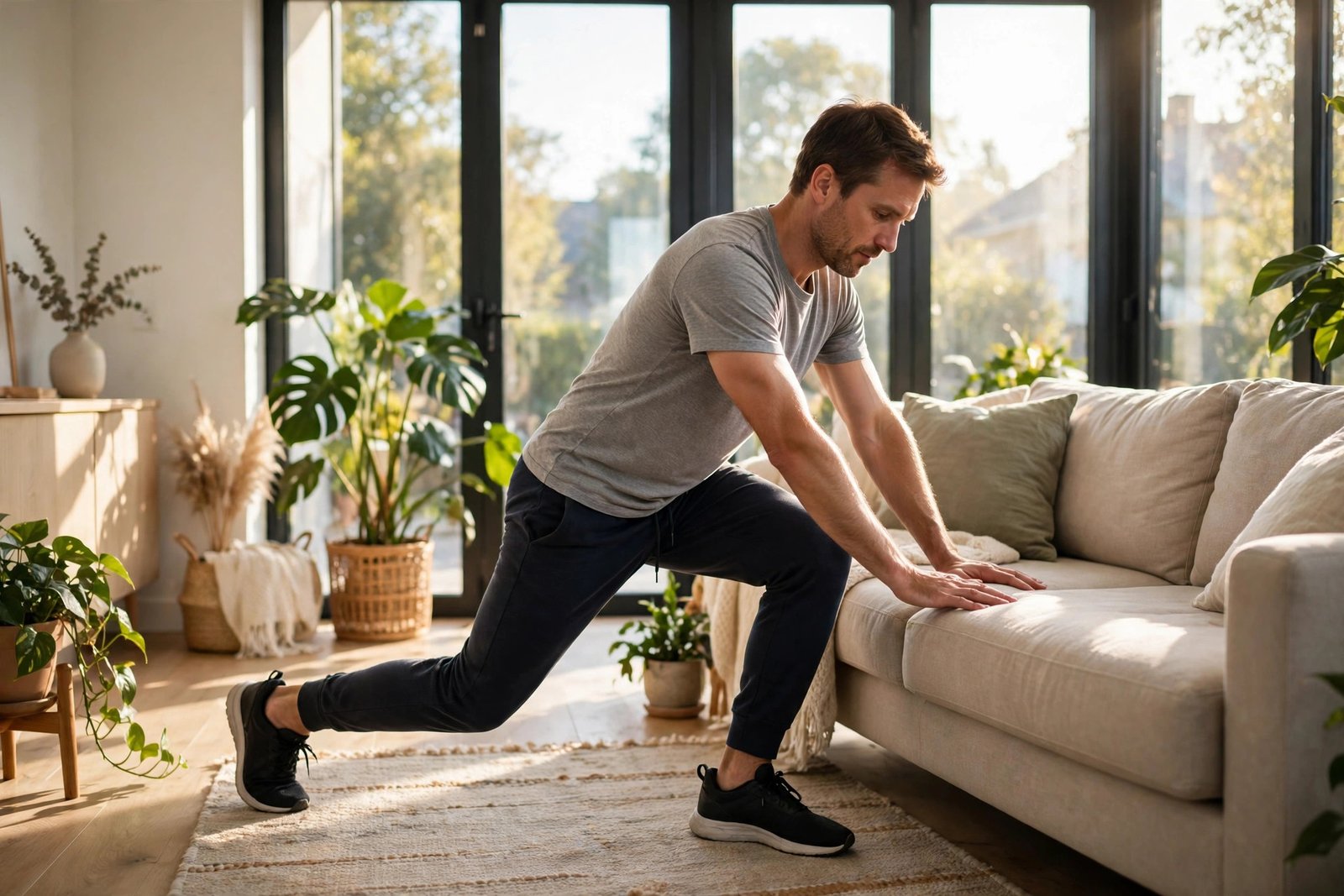
Stand next to your desk and step your right foot forward into a small lunge. Keep your torso tall and gently tuck your tailbone under. You should feel a stretch at the front of your left hip.
Hold it for forty-five seconds while breathing slowly. Then switch sides. This is the same stretch shown in our featured photo, and it directly targets the sitting-shortened muscles.
4. Glute Squeezes at Your Desk
Sit tall and squeeze both glutes firmly for five seconds, then release. Repeat ten times. It sounds too simple. However, it works surprisingly well.
These squeezes remind your glutes how to fire. Over time, this balances out the tight hip flexors. In addition, it gently lifts your posture, which helps your back too.
5. The Two-Minute Walk After Lunch
After you eat, take a short two-minute walk instead of going straight back to your chair. Your hips love this gentle reset. Plus, the light movement helps digestion.
However, stacking two or three of these fixes will give you much faster relief. Together, they answer “why are my hips so tight” with movement throughout the day, not just one big stretch.

Fixing Why Are My Hips So Tight: Your 10-Minute Evening Reset
Your workday creates the tightness, so your evening is the perfect time to undo it. This gentle routine takes only ten minutes. It is the practical answer to “why are my hips so tight” that your chair created during the day. Do it while dinner cooks or your show buffers.
Move slowly through each step and breathe deeply. You should feel a mild stretch, never sharp pain. If anything hurts, skip it and move on.
Minute 1 to 3: Half-Kneeling Hip Flexor Stretch
Kneel on your right knee with your left foot flat in front. Tuck your tailbone slightly under and shift your weight forward until you feel a stretch at the front of your right hip. Hold for ninety seconds, then switch sides.
This is the single best stretch for sitters. It directly lengthens the muscles your chair shortened all day. In fact, many people feel noticeably looser after just one round.
Minute 4 to 5: Butterfly Stretch
Sit on the floor and press the soles of your feet together. Let your knees fall open gently and lean forward a little. Hold for two minutes, breathing slowly into your hips.
The butterfly opens the inner thighs and groin, which also tighten from sitting. Our detailed guide on the benefits of the butterfly stretch explains exactly why this simple pose helps so much. Consequently, it has earned a permanent spot in this routine.
Minute 6 to 7: Pigeon or Figure-Four on the Floor
Lie on your back and cross your right ankle over your left knee. Pull the left thigh gently toward your chest until you feel a deep stretch in your right outer hip. Hold for one minute per side.
This targets the piriformis and deep hip rotators. These small muscles get very cranky from long sitting. As a result, this move often brings the biggest “ahh” feeling of the whole routine.
Minute 8 to 9: Glute Bridges
Stay on your back with knees bent and feet flat. Press through your heels and lift your hips toward the ceiling. Squeeze your glutes at the top, then lower slowly. Do two sets of ten.
Bridges wake up your sleepy glutes and strengthen them over time. This helps fix the tight-front, weak-back imbalance we discussed earlier. Moreover, stronger glutes make every future stretch more effective.
Minute 10: Happy Baby and Deep Breaths
Finish by lying on your back and holding your feet or shins, knees bent toward your armpits. Rock gently side to side. In addition, take five slow, deep breaths into your belly.
This pose releases the pelvic floor and lower back along with the hips. The deep breathing also helps your nervous system relax. Therefore, you end the routine feeling calm as well as loose.

When Tight Hips Might Need a Professional
Most sitting-related hip tightness improves with movement. However, some signs deserve professional attention. Trust your body and do not push through warning signals.
See a doctor or physical therapist if you notice any of the following. First, sharp or stabbing pain in the hip or groin. Second, tightness that never improves after two to three weeks of gentle movement. Third, clicking, catching, or locking in the joint.
In addition, seek advice if the tightness came on suddenly after an injury. If your question has shifted from “why are my hips so tight” to “why do my hips hurt,” see a professional soon. Indeed, that shift is a clear sign to get checked. Healthline’s overview of tight hips, their symptoms, and causes explains when tightness might signal something more. Similarly, their guide to hip flexor strain helps you tell simple stiffness apart from an actual strain. There is no shame in getting expert help; in fact, it is the smartest move.
Frequently Asked Questions
Why are my hips so tight in the morning?
Morning stiffness usually comes from hours of stillness overnight. Your hip flexors shorten while you sleep, much like they do in your chair. Consequently, the first steps of the day can feel creaky.
A few minutes of gentle movement wakes them up fast. For instance, try slow hip circles or the butterfly stretch before breakfast. Our morning flexibility routine for tight hips and back was built exactly for this. As a result, many readers tell us their mornings feel dramatically better within a week.
Can sitting all day permanently damage my hips?
For most people, no. Your hips are resilient and respond quickly to movement. Even after years of desk work, regular stretching and walking usually restore comfort.
However, ignoring the tightness for years can lead to compensations elsewhere, like back or knee pain. Therefore, it is always better to start moving now, no matter how long you have been sitting. It is truly never too late.
How long does it take to loosen tight hips?
Many people feel some relief within the first week of daily movement. Deeper, lasting change usually takes three to six weeks of consistency. The key word is consistency, not intensity.
Short daily sessions beat occasional long ones. So five to ten minutes every day will get you there faster than an hour once a week. As your hips loosen, that nagging “why are my hips so tight” feeling fades into the background. Be patient with your body; it is learning a new pattern.
Should I stretch my hips every day?
Yes, gentle daily movement is ideal. Light stretching and mobility work are safe for most people each day. Just keep the intensity moderate and never force a stretch.
If a muscle feels sore rather than just tight, give it a rest day. On the other hand, gentle walking and easy movement are almost always fine. Listen to your body first.
Why are my hips so tight on only one side?
One-sided tightness is very common and usually comes from habit. You might always cross the same leg, carry a bag on one shoulder, or sleep on one side. These small asymmetries add up over time.
Try noticing your habits and balancing them out. In addition, you can spend a little extra stretch time on the tighter side. If the difference is large or painful, a physical therapist can check for underlying issues.
Conclusion
So, why are my hips so tight? For most of us, the answer is simple: we sit too much and move too little. Your hip flexors have adapted to your chair, and your glutes have gone quiet. That is not a flaw; it is just how bodies work.
The empowering part is that you can reverse it. Stand up hourly, sprinkle in a few desk stretches, and give your hips ten gentle minutes each evening. Over weeks, these small habits add up to a big change.
Your hips carried you everywhere before the desk job, and they will carry you happily again. Start tonight with the evening reset, and notice how different your mornings feel. Finally, remember that every small step counts, so be kind to yourself along the way. After all, the very fact that you asked “why are my hips so tight” means you are ready to fix it.
