

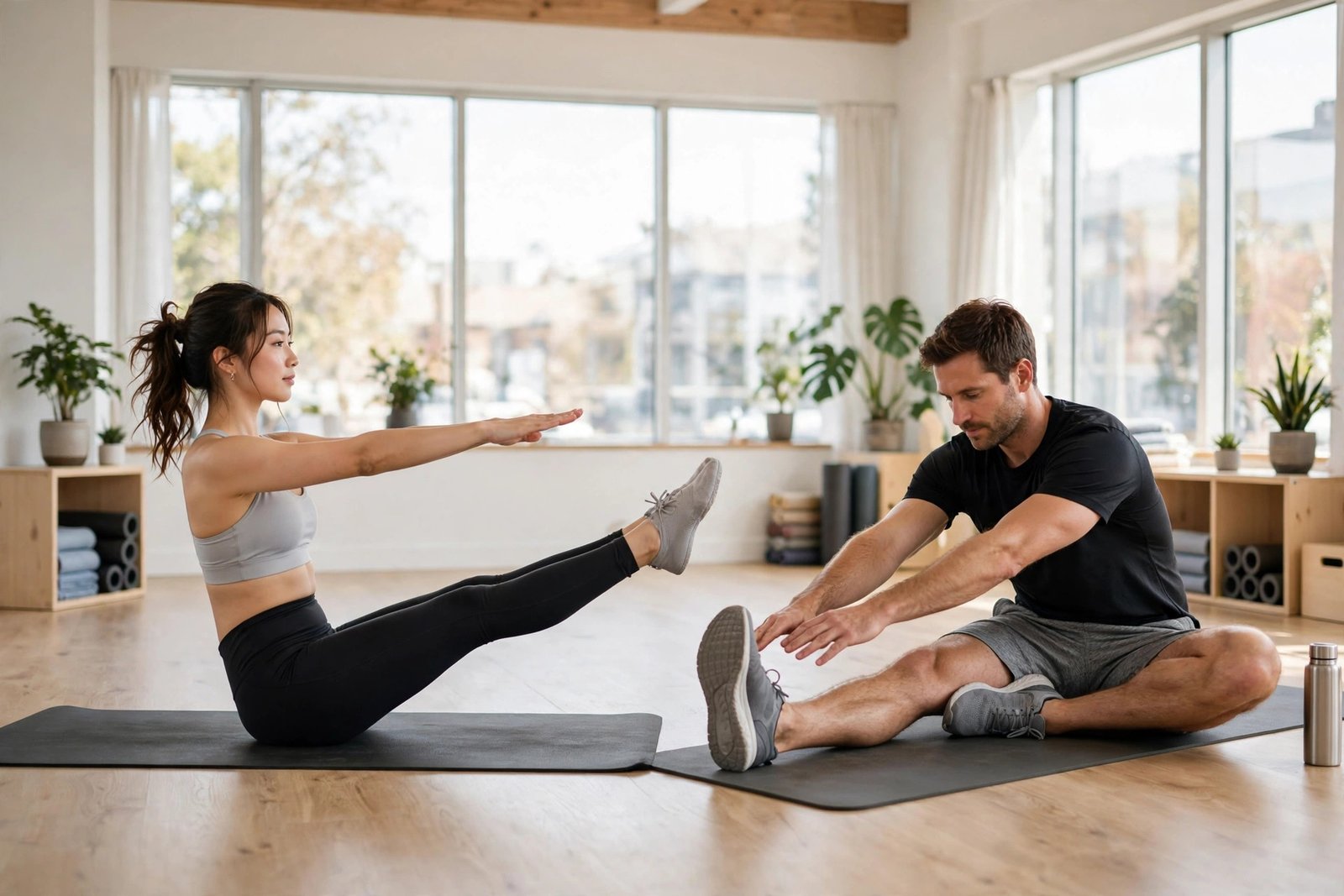
If you are deciding between pilates vs stretching, you are not alone. Many people wonder which one will help them move better, feel stronger, and stay injury-free. The short answer is that both work; however, they work in different ways.
Understanding those differences will help you pick the right starting point. Pilates builds strength while it lengthens your muscles. Stretching, on the other hand, targets your muscles more directly and gently.
In other words, one trains your body to move with control. The other helps your tissues relax and lengthen. In this guide, we will compare the two side by side.
You will learn what each one does, who benefits most, and how to combine them. By the end, you will know exactly where to begin.
Let us start with the basics. First, it helps to understand what Pilates really is. Many people think it is just core work, but it is much more than that. If you are new to structured movement, our movement training basics guide is a helpful place to start.
Before we dive in, here is one quick note. In fact, the pilates vs stretching question comes up because the two look similar from the outside. Both use a mat, and both are low impact. However, what happens inside your muscles is quite different.
What Pilates Actually Does for Your Body
Pilates is a full-body method that trains strength, control, and mobility at the same time. It was created by Joseph Pilates in the early 1900s. Originally, it helped dancers and athletes recover from injuries.
Every Pilates movement starts with your core. That includes your abs, lower back, hips, and pelvic floor. From there, the work spreads out to the rest of your body.
Strength That Lengthens
One big idea in Pilates is eccentric control. That means your muscles stay active while they lengthen. For example, in a Pilates roll-down, your abs work hard as your spine curls forward slowly.
As a result, you build strength through a full range of motion. Your muscles get longer and stronger at the same time. This is different from lifting heavy weights through short, stiff ranges.
In addition, Pilates trains your small stabilizing muscles. These tiny helpers protect your joints during everyday movement. Consequently, many people notice better posture within a few weeks.
Another key point is how Pilates treats flexibility. It does not chase extreme range of motion. Instead, it builds usable strength inside the range you already have.
For instance, the Pilates hundred trains your abs while your legs hover. Your core works hard the entire time. Consequently, the pilates vs stretching comparison often comes down to this: one builds strength through motion, the other builds length through stillness.
Control and Body Awareness
Pilates also sharpens your mind-body connection. You move slowly and breathe with purpose. In fact, most sessions feel like moving meditation.
You learn where your body is in space. Meanwhile, you practice engaging the right muscles at the right time. Over time, this control carries over into walking, lifting, and even sitting at your desk.
However, Pilates is not a relaxing practice. It is real work. Your muscles will shake, and you will feel challenged in new ways.
The good news is that the challenge is scalable. Beginners use simple mat exercises with clear cues. Advanced students add springs, bands, or the reformer for more resistance.
What Stretching Actually Does for Your Body
Stretching targets your muscles more directly. When you hold a stretch, you ask one muscle group to lengthen. There is no extra load, and there is no complex coordination to learn.
Static stretches, where you hold a position for 20 to 60 seconds, are the most common type. You can do them anywhere, with no equipment at all. For example, a seated hamstring stretch needs only a few feet of floor space.
In addition, dynamic stretches take joints through gentle, controlled ranges. These work well before a workout. For instance, leg swings warm up your hips before a walk or run.
Stretching mainly improves your range of motion and eases tightness. It tells your nervous system that it is safe to relax. As a result, you often feel looser and calmer right away.
However, stretching alone does not build much strength. It lengthens muscles but rarely challenges them under load. Therefore, very flexible people can still feel weak or unstable in certain positions.
Harvard Health Publishing explains that stretching keeps muscles flexible, strong, and healthy, and that this flexibility maintains a healthy range of motion in the joints. You can read their overview of the importance of stretching for more detail.
For a deeper look at the different types and how to do them safely, check out our guide to stretching exercises. It covers the basics you need before building a routine.
Pilates vs Stretching: The Key Differences

Now that you know what each method does, let us compare them directly. Pilates strengthens while it lengthens. Stretching lengthens without adding much strength.
In contrast to stretching, Pilates trains your muscles under light resistance. Your body weight, springs, or bands create that resistance. Meanwhile, stretching uses only your body position and gravity.
Similarly, both improve flexibility over time. Pilates does it through active control. Stretching does it through passive holds. The end result can look similar, but the journey is different.
Here is a quick side-by-side look:
- Main goal: Pilates builds strength, mobility, and control. Stretching builds length, range of motion, and relaxation.
- How it works: Pilates loads muscles while they lengthen. Stretching holds muscles in lengthened positions.
- Equipment: Pilates uses a mat, and sometimes a reformer or bands. Stretching needs no equipment at all.
- Learning curve: Pilates has a higher learning curve because form matters. Stretching is easy to start on day one.
- Session length: Pilates sessions usually run 30 to 60 minutes. Stretching can take as little as 5 to 20 minutes.
- How it feels: Pilates usually leaves you energized and a little tired. Stretching usually leaves you calm and loose.
In the pilates vs stretching debate, people often ask which one burns more calories. Pilates usually wins because it keeps more muscles working. However, neither one is primarily a fat-loss tool.
Another difference is cost and access. Stretching is free and needs no teacher. Pilates is best learned from a qualified instructor, at least at first. Group classes and online programs, however, have made it more affordable.
On the other hand, if you only have ten minutes, stretching is the realistic choice. Meanwhile, a full Pilates class demands more time and focus. Therefore, your schedule may settle the pilates vs stretching question for you on busy days.
Pilates vs Stretching: Who Benefits Most from Each
So who should choose Pilates? It is ideal if you want strength and mobility together. Desk workers with weak cores and rounded posture, for instance, often love it.
In addition, Pilates helps people rebuilding after minor back issues. The focus on core stability supports the spine. However, always check with your doctor first if you are injured.
Athletes also benefit a great deal. Pilates builds the stable base that powerful movement needs. As a result, many runners and lifters add one or two sessions per week.

Stretching, on the other hand, is best for people who feel tight and stiff. If your hamstrings or hip flexors always feel short, a daily stretch routine can change your life. It is simple, quick, and very forgiving.
Older adults often prefer stretching because it is gentle and simple. It keeps joints moving without any impact. Indeed, many seniors use it as their main daily practice.
Similarly, people with stressful jobs use stretching to unwind. A short evening routine can lower tension after a long day. For example, ten quiet minutes of stretching before bed helps many people sleep better.
Beginners to all exercise can start with stretching safely. It requires no skill and very little time. Therefore, if you are completely new to movement, stretching is the easier first step.
Moreover, the best choice can change over time. For example, you might start with stretching and add Pilates later. Indeed, many people follow exactly that path.
When people ask about pilates vs stretching for beginners, the honest answer depends on the person. If you want fast, simple relief from stiffness, start with stretching. If you want to build a stronger, more capable body, start with Pilates.
If you want simple holds you can do at home, our guide to static stretching exercises walks you through the essentials step by step.
How to Combine Pilates vs Stretching in Your Week
Here is the good news: you do not have to choose just one. In fact, combining them gives you the best of both worlds. Strength plus length is a powerful mix.
A simple weekly plan might look like this. First, do two or three Pilates sessions of 30 to 45 minutes. Second, add short stretching sessions on the other days.
For example, you could do Pilates on Monday, Wednesday, and Friday. Then stretch gently on Tuesday, Thursday, and Sunday. Finally, take Saturday fully off to rest and recover.
Alternatively, you can stretch right after Pilates. A five-minute cool-down stretch after each session helps you recover. In addition, it feels wonderful.

The American Council on Exercise outlines the benefits of Pilates, including improved core strength, posture, and flexibility. Pairing those benefits with daily stretching covers nearly every base.
However, avoid deep static stretching right before intense exercise. It can temporarily reduce power. Instead, save long holds for after your workout or for rest days.
Listen to your body as you build this habit. Some weeks you will crave more stretching. Other weeks you will want the challenge of Pilates. Both instincts are worth honoring.
Consistency matters more than perfection. Three short sessions you actually do beat one perfect session you skip. Therefore, keep your plan simple enough to repeat.
In addition, this mix prevents boredom. Similarly, it keeps your body guessing in a good way. As a result, many people stick with a combined pilates vs stretching routine longer than with either one alone.
FAQ
Is Pilates better than stretching for flexibility?
It depends on what kind of flexibility you want. First, Pilates builds active flexibility, which means you can control your new range of motion. Stretching builds passive flexibility, which means you can reach further with help or momentum.
For everyday life, active flexibility is often more useful. Therefore, if your goal is to move well and stay strong, Pilates may give you more. However, stretching is faster and simpler for easing daily tightness.
Can stretching replace Pilates?
Not really, because stretching does not build strength. It is excellent for tightness and relaxation. However, it cannot give you the core strength and control that Pilates builds.
On the other hand, Pilates alone may not be enough if you are very stiff. A short stretching routine fills that gap nicely. Most people get the best results from both.
How many times per week should I do pilates vs stretching?
Most people do well with two to three Pilates sessions per week. Stretching can be done daily, even for just five to ten minutes. It is gentle enough for everyday practice.
In addition, you can stretch after every Pilates session as a cool-down. This simple habit keeps your routine balanced without adding much time.
Is Pilates or stretching better for back pain?
Both can help, but for different reasons. Pilates strengthens the core muscles that support your spine. Stretching eases the tight hip flexors and hamstrings that often pull on the lower back.
Many people with mild back discomfort benefit from a mix of both. However, see a doctor or physical therapist first if your pain is sharp, severe, or long-lasting.
Do I need equipment to start either one?
No. Mat Pilates needs only a mat and some floor space. Stretching needs even less. You can begin both at home today.
As you progress, simple props can help. A resistance band adds challenge to Pilates. A strap or towel can deepen a stretch. But neither is required to start.
Conclusion
In the end, pilates vs stretching is not really a battle. They are two tools that solve different problems. Pilates strengthens your muscles while it lengthens them. Stretching targets your muscles directly to ease tightness and restore range of motion.
Choose Pilates if you want strength, control, and better posture. Choose stretching if you want a simple way to feel looser and calmer. Or better yet, combine both and let them cover each other’s gaps.
Start small this week. Try one short Pilates session and a few minutes of daily stretching. Your body will tell you what it needs next, and every session is a step toward moving better.
Finally, remember that the best routine is the one you enjoy. Indeed, enjoyment is what keeps you coming back. Whether you lean toward pilates vs stretching or embrace both, you are already moving in the right direction.
