


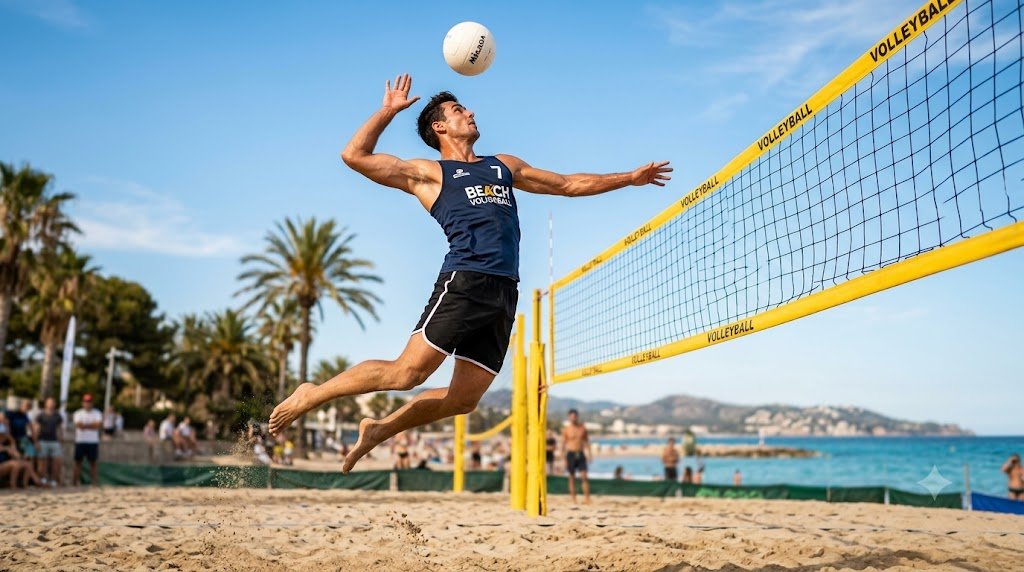
I have coached beach volleyball players for years, from total beginners to competitive league players. I see the same problem again and again. Someone shows up to the sand, full of energy, ready to play like they do indoors. Ten minutes in, their legs are burning, their timing is off, and they cannot figure out why nothing feels right. That frustration is normal. Sand training is not the same as indoor training, and most guides online do not explain why. They hand you a list of drills with no order, no plan, and no context, so you end up training hard but not training smart.
This beach volleyball training guide fixes that. It gives you the plan I actually use with players: what to do, in what order, and why each piece matters. It covers drills, strength work, mental focus, and recovery, all built around how the sand changes the game.
What’s In This Guide
- What Makes Beach Volleyball Training Different
- Beach Volleyball Basics You Need First
- A Complete Beach Volleyball Training Program
- Skill-Specific Drills
- Strength and Conditioning
- Agility, Footwork, and Speed Training
- Plyometrics for a Higher Vertical Jump
- Game-Based Training
- Partner Communication and Chemistry
- Mental Training
- Training in Heat, Wind, and Sand
- Injury Prevention and Recovery
- Nutrition and Hydration
- Transitioning From Indoor to Beach
- Advice for Parents and Coaches
- FAQs
Key Takeaways
- Sand training needs its own plan — indoor fitness does not transfer directly.
- Follow a phased plan: off-season base building, then in-season maintenance.
- Train five core skills separately: passing, setting, hitting, serving, and blocking.
- Strength, agility, and plyometrics all matter — sand demands more from each.
- Mental training and partner communication are as important as physical skill.
- Rest, nutrition, and injury prevention protect your progress long term.
Who This Guide Is For
- Beginners who are new to beach volleyball and want a clear starting plan.
- Intermediate players training on their own without a coach or team.
- Former indoor players adjusting to the two-person, sand-based game.
- Parents supporting a junior player’s training.
- Coaches looking to adapt this plan for group sessions.
What Makes Beach Volleyball Training Different
Sand changes everything. Every step takes more effort. Your legs work harder just to move.

There are only two players per side. You cannot hide on the court. You must pass, set, hit, block, and serve. Every skill matters for every player.
Weather also plays a role. Wind can push your serve off course. Sun can blind you during a set. Heat can drain your energy fast. A good training plan prepares you for all of this.
Beach Volleyball Basics You Need First
Before you start training, know the setup. The court is 16 by 8 meters. That is smaller than an indoor court. Games go to 21 points for the first two sets. The third set goes to 15 points.
Each set must be won by 2 points. If the score reaches 20-20, play keeps going until one team leads by 2. Teams also switch sides every 7 points in sets 1 and 2, and every 5 points in set 3. This rule keeps sun and wind fair for both teams.
You need the right gear too:
- A beach volleyball. It is bigger, lighter, and softer than an indoor ball.
- Sand socks. These protect your feet from hot sand.
- Sun protection. Use sunscreen, a hat, and sunglasses.
- Loose, breathable clothing. This helps you move and stay cool.

Once you have the basics, you can build a real training plan.
A Complete Beach Volleyball Training Program
Most training guides give you random drills. This section gives you a real plan. It has two phases: off-season and in-season.
Off-Season Base Training (Weeks 1-4)
This phase builds your base. Train four days a week.
- Day 1: Strength training (lower body and core)
- Day 2: Skill drills (passing and setting)
- Day 3: Agility and footwork
- Day 4: Skill drills (hitting and serving)
Keep sessions to 60-75 minutes. Rest on the other three days. Light stretching is fine on rest days.
In-Season Training (Tournament Weeks)
During the season, your goal shifts. You want to stay sharp, not tired. Cut volume but keep intensity high.
- Day 1: Short strength session (30 minutes, lighter loads)
- Day 2: Game-based drills with your partner
- Day 3: Rest or light footwork
- Day 4: Full practice match
- Weekend: Tournament or league play
This keeps your body fresh for game day. It also keeps your skills sharp.
Sample Weekly Schedule (Off-Season)
| Day | Focus | Time |
|---|---|---|
| Monday | Strength (lower body and core) | 60 min |
| Tuesday | Passing and setting drills | 60 min |
| Wednesday | Agility and footwork | 45 min |
| Thursday | Hitting and serving drills | 60 min |
| Friday | Rest or light stretching | – |
| Saturday | Rest | – |
| Sunday | Rest | – |
Skill-Specific Drills for Beach Volleyball
Each skill needs its own practice time. Focus on one or two skills per session.

Passing and Serve Receive
Good passing starts with your feet. Move to the ball early. Get low. Keep your platform flat.
Drill: Have a partner toss the ball to different spots. Practice moving your feet first, then passing. Do 10 reps on each side.
Setting
A good set gives your partner a clean shot. Use soft hands. Aim for the same spot every time.
Drill: Set against a wall 20 times in a row. Then set to a partner from different angles.
Attacking and Hitting
Power matters, but placement wins points. Practice hitting to open spots, not just hard shots.
Drill: Set up cones on the court. Practice hitting the ball into each zone.
Serving
A strong serve puts pressure on the other team. Practice both float serves and jump serves.
Drill: Serve at a target 10 times. Track how many you land. Try to beat your score each week.
Blocking and Defense
In beach volleyball, you block and dig by yourself. Watch the hitter’s shoulder and arm. This tells you where the ball is going.
Drill: Have a partner hit at you from different spots. Practice reading their arm swing before they hit.
Strength and Conditioning for Beach Volleyball
Strength training builds power for jumps and hits. It also protects you from injury.
Focus on these areas:
- Legs: Squats, lunges, and step-ups
- Core: Planks, side planks, and Russian twists
- Shoulders: Light band work for stability
Train strength two to three times a week. Always warm up first. Never train through sharp pain.
Here are sample sets and reps to start with:
- Squats: 3 sets of 10-12 reps
- Lunges: 3 sets of 12-15 reps per leg
- Step-ups: 3 sets of 10 reps per leg
- Planks: 3 sets of 30-45 seconds
- Side planks: 3 sets of 20-30 seconds per side
- Russian twists: 3 sets of 20 total reps
Agility, Footwork, and Speed Training
Sand makes speed harder to build. Your muscles work overtime with every step. Agility drills help you move fast and stay balanced.
Try these drills:
- Ladder drills: Quick steps through an agility ladder
- Cone drills: Sprint between cones in a zigzag pattern
- Lateral shuffles: Move side to side low to the ground
Do agility work two times a week. Keep sessions short, around 15-20 minutes.
Plyometrics for a Higher Vertical Jump
Plyometrics build explosive power. This helps you jump higher for spikes and blocks.
Sand absorbs your energy when you jump. This means you need extra power to get the same height as on hard courts.

Try these exercises:
- Box jumps: Jump onto a low box, then step down
- Squat jumps: Jump straight up from a squat position
- Broad jumps: Jump forward as far as you can
Start with low reps. Add more only when your form stays solid.
Safety Note: This guide is for general training purposes only. If you have an existing injury, chronic pain, or a medical condition, talk to a doctor or physical therapist before starting any new training plan.
Game-Based Training: Learn Through Play
Drills teach skills. Games teach decisions. Both matter for real improvement.
Game-based training uses small, game-like scenarios. This helps you read the game, not just repeat a motion.
Try these formats:
- Mini-games: Play 2-on-2 to a low score, like 5 points
- Constraint games: Add a rule, like “you must attack the open zone”
- Live reps: Practice reacting to a real hit, not a toss
This type of training builds instinct. You learn to read your opponent’s body before they hit.

Why Game-Based Training Works
Isolated drills teach you a motion. Game-based training teaches you to react. In a real point, the ball never comes the same way twice. Playing small, game-like reps trains your brain to make quick choices, not just repeat a movement.
Partner Communication and Chemistry Drills
Beach volleyball is a two-person game. Good communication wins close games.
Practice calling the ball early. Use short, clear words like “mine” or “yours.” Talk before the serve, not after the ball is in the air.
Drill: Play a full game where you must call every touch out loud. This builds a habit fast.
Hand Signals for Defense
Many teams use hand signals before the serve. The blocker signals which shot they plan to block or defend. This lets the defender behind them know where to cover. Practice a simple signal system with your partner before you add it to a real game.
Mental Training for Beach Volleyball
Your mind affects your game as much as your body. A calm mind makes better choices under pressure.
Try these mental tools:
- Visualization: Picture yourself making a good pass or a clean hit
- Breathing: Take one slow breath before each serve
- Reset routines: Have a short habit after every point, win or lose
Practice these tools during training. They work better in games when they feel familiar.

Review Your Own Video
Record a few points during practice. Watch your footwork, your contact point, and your shot choices. Look for one thing to fix, not everything at once. Compare your clips over time to see real progress.
Training in Heat, Wind, and Sand Conditions
Weather changes how you play. Training in these conditions builds real-world skill.
Wind: Practice serving into the wind and with the wind. Notice how the ball curves differently.
Heat: Train during the hottest part of the day sometimes. This builds tolerance for tournament conditions.
Sand depth: Play on both hard-packed and soft sand. Your footwork must adjust to both.
Injury Prevention and Recovery
Beach volleyball puts stress on your shoulders, knees, and lower back. Smart training keeps you healthy.
Follow these steps:
- Warm up before every session
- Stretch your shoulders and hips daily
- Rest at least one full day each week
- Ice sore joints after hard sessions
- See a doctor or physical therapist for ongoing pain

Never train through sharp or sudden pain. Rest is part of training, not a break from it.
Nutrition and Hydration for Training
Beach volleyball burns more energy than indoor play. Sand training adds extra effort with every step.
Drink water before, during, and after training. On hot days, add an electrolyte drink too.
Eat a mix of carbs and protein before training. This gives you steady energy. After training, eat protein to help your muscles recover.
For example, eat a banana with peanut butter or toast with eggs 60-90 minutes before training. After training, try a protein shake, yogurt, or chicken with rice within an hour.

Transitioning From Indoor to Beach Volleyball
Many players start indoors, then move to sand. The skills overlap, but the game feels different.
Key changes to expect:
- You have only one partner, not five teammates
- You must play every position, not just one
- The ball moves slower in the air
- Your feet work much harder in sand
Give yourself a few weeks to adjust. Focus on footwork first. The rest will follow.
Training Advice for Parents and Coaches
This guide works for solo and self-coached players. If you are a parent or a coach, a few small adjustments help.
For Parents of Junior Players
If your child is training for beach volleyball, keep the volume lower than an adult plan. Two to three sessions a week is enough for most young players. Watch for signs of overuse, like ongoing soreness or fatigue. Rest days matter more for growing bodies.
For Coaches Running Group Sessions
This plan is built for one or two players, but it adapts to groups. Split players into pairs and rotate them through stations. Use one court for skill drills and another for game-based play. Keep instructions short so players spend more time moving than listening.
Common Questions About Beach Volleyball Training
What skill level is this training guide for?
This guide works for beginners and intermediate players. Adjust the volume and intensity to match your level.
How much equipment do I need?
Not much. A ball, a partner, and access to a court are enough to start.
Can I train at home without sand?
Yes. Strength, agility, and ball-handling drills all work well at home. You still need sand time to build sand-specific footwork.
How much time should I train each week?
Aim for four to five sessions a week. Each session should last 45-75 minutes.
How long does it take to see results?
Most players notice change in four to six weeks of steady training. Skills take longer to master than fitness does.
Final Thoughts
I have watched players go from gassed and frustrated after five minutes on the sand to competing with confidence in a single season. The difference was never talent. It was a plan they actually followed, week after week. This beach volleyball training guide gives you that plan, not just a list of drills. Build your base first, add skill work, strength, and agility, then train your mind, not just your body, and respect rest and recovery.
I have seen this exact approach work for beginners and for players stepping up to real competition. Stick with it for a few weeks, and you will feel the difference in your legs, your timing, and your confidence on the sand.
