


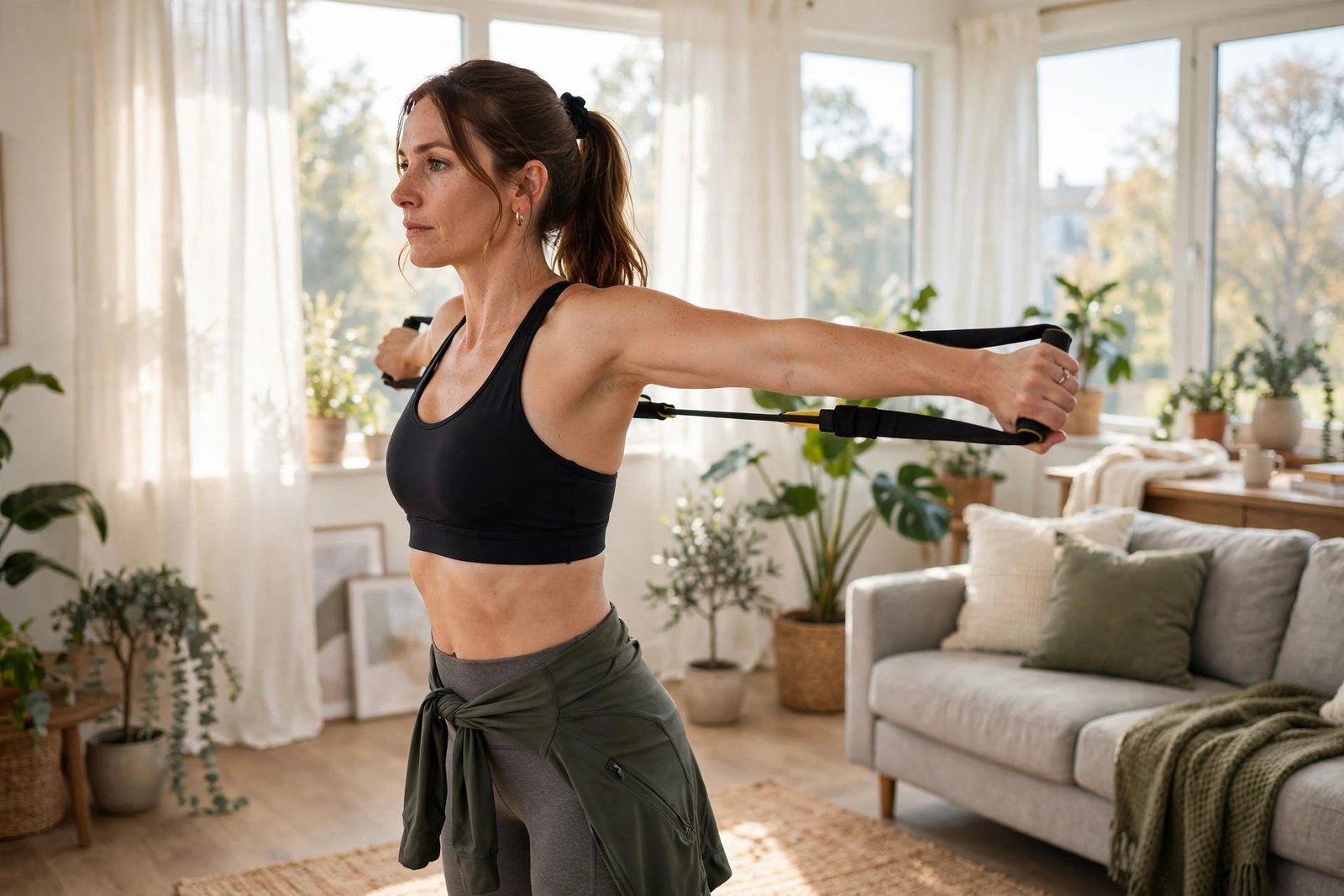
Resistance band stretches for flexibility are one of the simplest upgrades you can make to your stretching routine. For instance, a single lightweight band gives your muscles something gentle to push against, and that extra feedback helps you stretch deeper without forcing anything. In this guide, you will first learn why bands work so well. Then you will see how to choose the right one, and finally try a full-body routine you can start today.
First, the good news: you do not need any gym experience to get started. Moreover, you do not even need much space, because almost every move below fits into a corner of your living room. If you already follow our guide to flexibility exercises without equipment, think of this routine as its equipment-based sibling. The band simply adds a little assistance, so tight areas like the hamstrings, chest, and shoulders open up a bit more.
Why Resistance Band Stretches for Flexibility Work So Well
Resistance band stretches for flexibility work differently from bodyweight stretching alone. When you loop a band around your foot or hold it behind your back, it creates light, steady tension through the whole movement. As a result, your muscles relax into the stretch more easily instead of fighting it. That is the main reason bands feel so good on stiff hips and shoulders.
Bands also let you adjust the intensity second by second. For example, you can move your grip a few inches to make a stretch easier or harder. In addition, the band acts like a spotter, supporting your limbs so you can hold positions longer with less effort. The NHS includes flexibility work as part of a balanced weekly activity plan, and band-assisted moves fit that advice perfectly. For more ideas, see the NHS flexibility exercises guide.
Another big win is portability. Unlike a foam roller or a bench, a band folds into your pocket. Therefore, you can take your stretching habit on trips, to the office, or into the backyard. Indeed, consistency matters more than intensity for flexibility, and a tool you actually use beats a perfect tool you skip. With resistance band stretches for flexibility, staying consistent becomes the easy part.
Picking the Right Resistance Band for Stretching
You will see two main styles of bands in stores, and both can work well. However, they feel different in the hand, so it helps to know what you are buying. In fact, a quick trip down the fitness aisle is all it takes to find a good option.
Loop bands vs. tube bands with handles
Flat loop bands are wide strips of latex joined into a circle. They are comfortable to wrap around your feet and thighs, and they do not roll or pinch. On the other hand, tube bands with handles feel more like gym equipment and are easy to grip for upper-body moves. Either style works for stretching; therefore, choose the one that feels best in your hands.
If you plan to do mostly lower-body stretches, a loop band is usually the simpler choice. Meanwhile, tube bands shine for chest, shoulder, and back stretches where you need a firm grip. Additionally, many people end up owning one of each within a few months.
What resistance level should you start with?
Start with a light or extra-light band, especially if you are new to stretching. A lighter band gives you gentle feedback without pulling you out of position. As a result, you can focus on your breathing and form instead of wrestling the band.
You will know it is time for a heavier band when the light one barely stretches during your routine. Moreover, you can double up a light band by folding it in half for a little extra tension. There is no rush, though. Indeed, flexibility responds best to patient, regular practice. Choosing the right band makes resistance band stretches for flexibility more comfortable from day one.
A Quick Safety Checklist Before You Begin
Band stretching is very safe, but a few simple habits keep it that way. First, check your band for nicks, tears, or sticky spots before each session. A damaged band can snap, so replace it the moment you see wear.
Second, anchor bands carefully when a move needs one. Loop the band around a closed door hinge or a sturdy post, and test the anchor with a gentle pull first. In addition, never stretch a band toward your face or eyes. Keep your movements slow and controlled, and stop if you feel sharp pain rather than a mild stretch.
Finally, warm up for two to three minutes before your first stretch. March in place or do gentle arm circles until your muscles feel awake. Consequently, your first real stretch will feel smoother and safer. These small habits keep your resistance band stretches for flexibility safe and effective.
10 Resistance Band Stretches for Flexibility, Head to Toe
This collection of resistance band stretches for flexibility covers your whole body in about 15 to 20 minutes. Hold each stretch for 20 to 30 seconds per side, and breathe slowly throughout. Remember, you should feel a comfortable pull, never pain.
1. Band-assisted chest opener
Hold a band behind your back with both hands, arms straight and palms facing down. Gently squeeze your shoulder blades together and lift your hands a few inches. In fact, you will feel the front of your chest and shoulders open up right away. This move is perfect after a long day at a desk, and it reverses the hunched posture most of us live in.
2. Band pull-apart
Hold the band in front of you at shoulder height with arms straight. Pull the band apart by squeezing your shoulder blades until your hands are out to the sides. Then return slowly to the start. This stretch strengthens the upper back while opening the chest, so it improves posture from both directions at once.

3. Overhead lat stretch
Hold the band overhead with your hands about shoulder-width apart. Keeping your arms straight, gently lean to one side until you feel a stretch along your ribs and side body. Hold for 20 to 30 seconds, and finally switch sides. This move loosens the lats and the muscles between your ribs, which helps your breathing feel freer too.
4. Seated hamstring stretch
The seated hamstring stretch is one of the most popular resistance band stretches for flexibility, and for good reason. Sit on the floor with one leg straight and loop the band around the ball of your foot. Gently pull the band toward you while keeping your back straight and your knee soft. You will feel a deep, even stretch down the back of your thigh. In addition, the band lets you keep good posture instead of rounding your back to reach your toes.
5. Standing calf stretch
Loop the band around the ball of one foot and hold both ends. Step the other foot back and press your front heel toward the floor. Lean gently forward until you feel the calf stretch. Tight calves limit ankle movement; consequently, this simple stretch supports better squats and walking form too.

6. Banded quad stretch
First, stand tall and loop the band around one ankle, holding the other end over your shoulder. Gently pull your heel toward your glute while keeping your knees close together. Hold onto a wall for balance if you need to. This stretch opens the front of the thigh and the hip flexor, two areas that get very tight from sitting.
7. Lying glute and hip stretch
Among resistance band stretches for flexibility, this one is a favorite for desk workers. Lie on your back and loop the band around one foot. First, bring your knee toward your chest, then gently guide the leg across your body. You will feel the stretch deep in the outer hip and glute. This is a wonderful release for anyone with a tight lower back, since the hips and the back are closely connected.
8. Hip flexor lunge stretch
Kneel in a lunge position with the band looped around your back foot and anchored under your front foot. Gently press your hips forward and down. In addition, the band adds a light pull that deepens the stretch through the front of the hip. Hold your torso tall, and meanwhile imagine your tailbone dropping toward the floor.
9. Side-lying hip opener
Lie on your side with the band looped just above your knees. First, keeping your feet together, open your top knee like a clamshell. Then lift the top leg a few inches and hold. This move wakes up the small muscles around the hip, which improves balance. Similarly, it keeps the knees tracking properly when you walk or climb stairs.
10. Deep squat band stretch
First, anchor the band at chest height on a sturdy post and hold it with both hands. Sink into a deep squat, and meanwhile use the band for balance as your heels stay grounded. Finally, let your chest lift and keep your knees tracking over your toes. As a result, this stretch builds comfortable squat depth over time. That carries over into everyday movements like sitting down and standing up.
Making Resistance Band Stretches for Flexibility a Weekly Habit
The best routine is the one you repeat, so keep your band where you will see it. For example, drape it over the couch arm or hang it on your bedroom door. Out of sight usually means out of mind, and a visible band is a gentle daily reminder.
Aim for three to five sessions per week to start. Each session can be the full 10-move routine or just your three tightest areas on busy days. In addition, you can pair the routine with an existing habit, like stretching right after your morning coffee. The NHS notes that muscle-strengthening and flexibility activities both count toward a healthy week, so these sessions pull double duty. The NHS strength exercises guide has more ideas if you want them.
Track your progress with simple markers. Notice how far you can reach, how your shoulders feel at your desk, or how easy it is to sit cross-legged. Small improvements add up fast, and seeing them keeps you motivated. If you want more structure, our full-body flexibility routine pairs well with these band moves on alternate days. To make resistance band stretches for flexibility a lasting habit, attach them to something you already do daily.

Mistakes That Steal Your Progress
The most common mistake is pulling too hard, too soon. A band makes it tempting to yank yourself deeper, but aggressive stretching triggers a protective tightening response. Instead, ease in until you feel a mild pull, then breathe and let the muscle release on its own.
Another mistake is rushing through the routine. Flexibility gains come from time under a gentle stretch, so honor the 20 to 30 second holds. On the other hand, holding your breath works against you, because tense breathing keeps muscles guarded. Slow, steady breaths tell your nervous system it is safe to let go.
Finally, do not skip the areas that feel fine. Many people stretch only what hurts and ignore the rest. However, the body works as a chain, and a stiff ankle can quietly limit the hip above it. A balanced routine of resistance band stretches for flexibility avoids these hidden weak links.
Frequently Asked Questions
Can resistance band stretches replace regular static stretching?
Indeed, they can absolutely be your main stretching method. Resistance band stretches for flexibility use the same positions as static stretching, with added assistance and feedback. In fact, many people stretch more consistently with a band because the moves feel more engaging.
How often should I do resistance band stretches?
Three to five times per week is a great starting point. You can do them daily if the stretches feel gentle, since light band work does not beat up the body the way hard workouts do. Just listen to your body and back off if anything feels sore rather than pleasantly loose.
I am a complete beginner. Are these safe for me?
Yes, band stretching is one of the most beginner-friendly ways to improve flexibility. First, start with a light band, keep every stretch gentle, and stop if you feel sharp pain. If you are brand new to all of this, our stretching exercises at home guide is a gentle place to begin alongside this routine.
Will these stretches help me work toward the splits?
They will definitely help, because the splits demand open hamstrings, hip flexors, and glutes. For example, the seated hamstring stretch, hip flexor lunge, and lying glute stretch in this routine target exactly those areas. For a dedicated plan, combine this routine with progressive splits training a few times per week.
Conclusion
Resistance band stretches for flexibility give you more stretch with less struggle. Indeed, one inexpensive band, a few square feet of floor, and fifteen minutes are genuinely enough to loosen your whole body. Start with the light band, move gently, and repeat the routine a few times each week.
Within a month, you will likely notice easier mornings, looser shoulders, and hips that complain less after sitting. That is the quiet power of consistent, assisted stretching. Finally, grab your band, press play on your favorite music, and enjoy the process of becoming more flexible one session at a time.
