

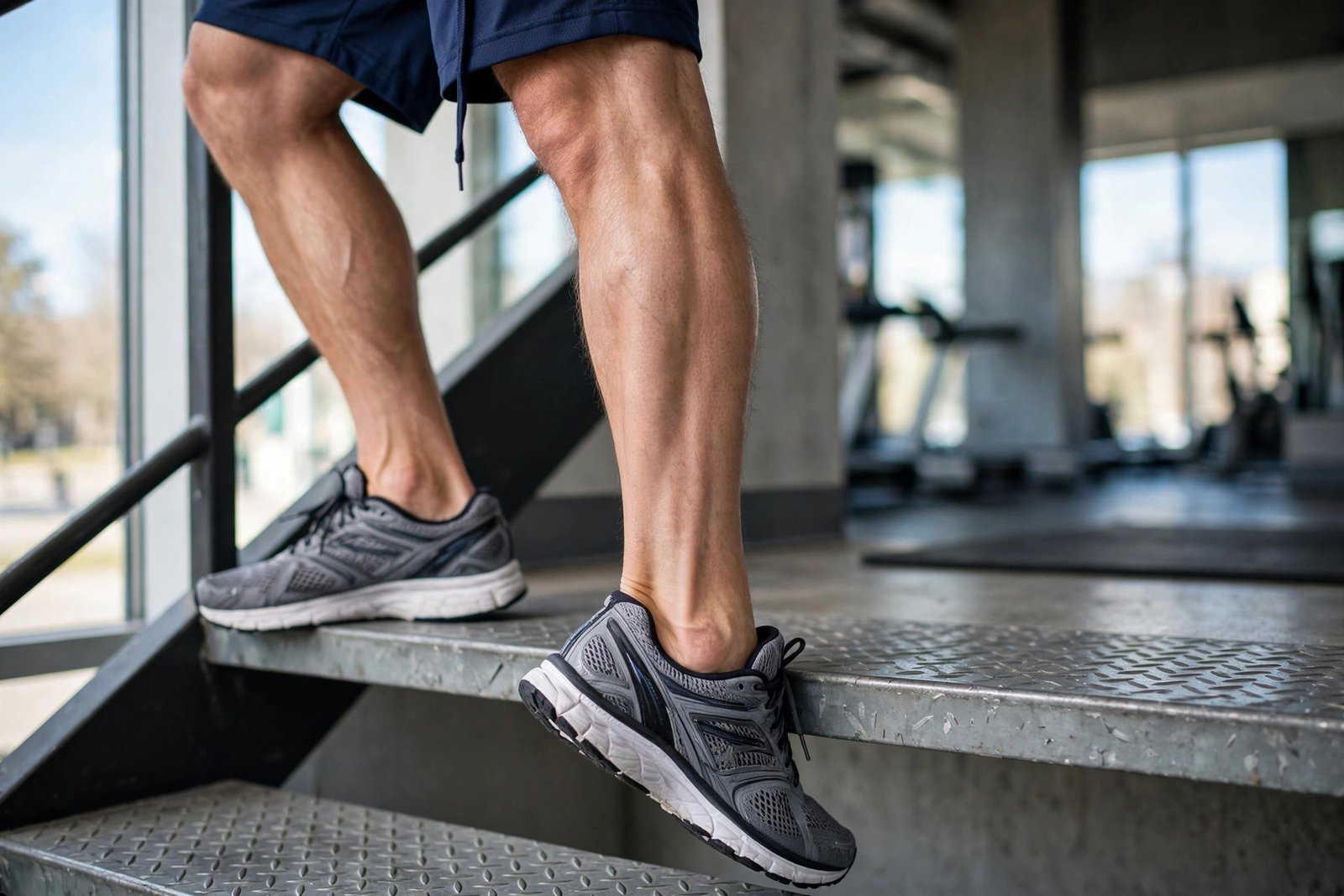
In fact, your calves do far more than fill out your jeans. Every step, stair climb, and squat depends on calf mobility — yet the lower leg is one of the most neglected areas in most people’s routines. If your heels lift when you squat or your calves feel like rocks, these calf mobility exercises are for you.
Unlike simple calf stretches, mobility work trains your calves and ankles to move well under control. In fact, that means better squat depth, smoother walking and running, and fewer of those nagging Achilles and shin complaints. You only need about ten minutes and a wall. In addition, these calf mobility exercises work best when you do them slowly and with full attention.
Below you will find ten targeted drills, a ready-made routine, and answers to the most common questions. Then, let us unlock those lower legs. Also, add these calf mobility exercises to your weekly schedule and your joints will thank you.
Why Calf Mobility Exercises Matter More Than You Think
In fact, the calf complex — mainly the gastrocnemius and soleus muscles — controls how your ankle moves. When calves are stiff, your ankle cannot bend far enough forward (a movement called dorsiflexion). Your body then borrows motion from somewhere else: your knees cave in, your arches collapse, or your lower back overworks. In fact, the beauty of these calf mobility exercises is that you can do them anywhere, anytime.
Poor ankle mobility shows up in surprising places. Squats feel unstable, lunges feel pinchy in the front of the ankle, and runners develop shin splints or Achilles irritation. In fact, many people blame their knees or hips when the real bottleneck sits a few inches above the heel. Also, start with five minutes of these calf mobility exercises and build up as you get stronger.
The fix is refreshingly simple. Regular calf mobility exercises restore the ankle’s natural range and teach the surrounding muscles to control it. In fact, the NHS ankle exercise guidance emphasizes exactly this kind of consistent, gentle range-of-motion work.
Gastrocnemius vs. Soleus: Know Your Calves
In fact, your “calf” is actually two muscles stacked together. In fact, the gastrocnemius is the visible, diamond-shaped muscle on top. It crosses behind the knee, so it gets stretched when your knee is straight. In fact, the soleus lies underneath it, flatter and deeper, and it does its work when your knee is bent. Consistency beats intensity with these calf mobility exercises every single time.
This distinction matters because each muscle needs a slightly different stretch. Straight-knee stretches target the gastrocnemius; bent-knee stretches reach the soleus. A complete routine addresses both — otherwise half your calf stays tight while the other half improves.
Both muscles merge into the Achilles tendon, which is why calf mobility also protects that famously injury-prone tendon. Healthy, mobile calves share load evenly instead of dumping it all on the tendon.
10 Calf Mobility Exercises
Work through these drills two to four times per week. Also, hold stretches for 20 to 30 seconds, and perform mobility drills for 8 to 12 slow repetitions per side.

1. Wall Calf Stretch (Straight Knee)
Face a wall with your hands on it. Then, step one foot back about two feet, keeping that heel pressed into the floor and the knee straight. Lean gently forward until you feel a stretch high in the calf.
This targets the gastrocnemius. Hold 30 seconds per leg. Also, keep your back foot pointing straight ahead — letting it turn out cheats the stretch.
2. Bent-Knee Soleus Stretch
Use the same wall setup, but this time bend your back knee slightly while keeping the heel down. In fact, the stretch should shift lower, toward the Achilles area. That is your soleus talking.
Hold 30 seconds per leg. In fact, most people are shocked how tight this deeper muscle feels. Be patient with it — the soleus responds beautifully to regular attention.
3. Knee-to-Wall Ankle Test
Place your foot about four inches from a wall, then try to touch your knee to the wall without lifting your heel. Then, move your foot back an inch at a time until you find your limit. Measure the farthest distance where your heel stays down.
In addition, this doubles as a test and a drill. Retest monthly — watching that distance grow is wonderfully motivating. Limited range here is the classic sign you need this routine.
4. Eccentric Heel Drops
Also, stand on a step with the balls of your feet on the edge. Rise up on both feet, then shift your weight to one foot and lower the heel slowly below step level over three to five seconds. Then, use both feet to rise again.
Also, do two sets of ten per leg. In fact, the slow lowering phase builds strength through length, which is what keeps new mobility from disappearing. This is the gold-standard drill for happy Achilles tendons.
5. Seated Towel Calf Stretch
Then, sit with legs extended and loop a towel around the ball of one foot. Gently pull the toes toward you until you feel a stretch in the calf. Also, keep your knee straight but not forced.
Then, hold 30 seconds, three rounds per leg. Indeed, this is a gentle option for rest days or for anyone whose calves cramp easily with standing stretches.
6. Full-Range Standing Calf Raises
Mobility is not just stretching — it is strength through the full range. Stand on a step, lower your heels below the edge for a deep stretch, then rise as high as possible onto your toes. Pause at the top.
Perform three sets of twelve. Then, move slowly and own both ends of the range. Strong calves control the ankle joint far better than merely flexible ones.
7. Ankle Circles (CARs)
Also, sit with one foot hovering off the floor. Slowly draw the biggest circle you can with your big toe — ten clockwise, ten counterclockwise. Also, move only at the ankle, keeping the leg still.
Controlled articular rotations bathe the joint in synovial fluid and map out your available range. In addition, they are the perfect daily maintenance drill and take under a minute per foot.
8. Downward Dog Pedal
From a downward dog position, alternately bend one knee while pressing the opposite heel toward the floor. Pedal slowly, ten presses per side, feeling each calf lengthen in turn.
In addition, this dynamic drill is excellent before workouts. In addition, it warms the calves with movement and links calf mobility to hamstring and shoulder mobility in one flowing shape.
9. Foam Roller Calf Release
Also, sit with the roller under one calf, hands behind you. Also, roll slowly from ankle to just below the knee. When you hit a tender spot, pause and gently rotate your foot side to side for 20 seconds.
Then, spend one to two minutes per leg. Rolling calms guarded tissue so your stretches reach deeper. Also, do this before the stretching drills for the best effect.
10. Split Squat Ankle Drill
Take a staggered stance and lower into a split squat, letting your front knee travel forward over your toes while the heel stays planted. In addition, this trains ankle mobility under real load.
Also, do three sets of eight per side. In addition, it bridges the gap between passive stretching and real-world movement like stairs, lunges, and squats.
Build a 10-Minute Calf Mobility Routine
Here is how to combine the drills into one efficient session. Also, do it after workouts or on rest days, two to four times weekly.

Release (2 minutes). Foam roll each calf for one minute. Find the two or three sorest spots and breathe through them.
Stretch (4 minutes). Wall calf stretch (straight knee), 30 seconds per leg. Bent-knee soleus stretch, 30 seconds per leg. Seated towel stretch if you want a gentler finish.
Strengthen (4 minutes). Eccentric heel drops, two sets of ten per leg. Full-range calf raises, one set of twelve. Finally, finish with ankle circles, ten each direction per foot.
Retest your knee-to-wall distance every month. In fact, most people gain an inch or more within six weeks. Additionally, for a broader lower-leg program, pair this with our ankle mobility exercises and the ankle mobility routine.
Common Mistakes to Avoid
The biggest mistake is bouncing. Ballistic bouncing on a stretched calf can irritate the Achilles tendon. Every stretch here should be slow and controlled — ease in, hold, breathe.

Another common error is letting the heel lift during stretches. If your heel pops up, you have gone too far or the angle is wrong. Back off until the heel stays grounded; that is where the real stretch happens.
People also stretch only the gastrocnemius and ignore the soleus. If you only ever do straight-knee stretches, half the job is undone. Always include at least one bent-knee drill.
Finally, do not expect overnight miracles. Calf tissue is dense and stubborn. In fact, the ACE exercise library reminds us that consistent, progressive practice beats occasional heroic efforts. Ten focused minutes, several times a week, wins.
Frequently Asked Questions
How often should I do calf mobility exercises?
Two to four times per week is ideal. Light daily ankle circles are fine every day. Also, avoid aggressive deep stretching on consecutive days if your calves feel sore.
Why do my calves feel tight all the time?
Chronic tightness often comes from footwear (heels or unsupportive flats), prolonged standing, or running without mobility work. Weak foot muscles can also make calves overwork. If tightness never improves, a physical therapist can assess the cause.
Can calf mobility help my squat?
Absolutely. Limited ankle dorsiflexion is one of the top reasons heels lift and torsos tip forward in squats. Improving it by even half an inch can transform your squat mechanics.
Should calves be stretched before running?
Then, do dynamic drills like the downward dog pedal and ankle circles before running. Save the long static holds for afterward — static stretching right before intense running can temporarily reduce calf power.
What is the difference between gastrocnemius and soleus tightness?
Gastrocnemius tightness shows up with a straight knee (classic wall stretch); soleus tightness appears with a bent knee. Test both positions to find which muscle is limiting you, then emphasize that stretch.
Are heel drops safe for Achilles issues?
Eccentric heel drops are widely used in Achilles rehab, but start gently and stop if you feel sharp pain. If you have a diagnosed tendon injury, follow your clinician’s protocol rather than a general routine. Our mobility by body part guide can help you balance the rest of your program.
How long until I see results?
In fact, most people feel easier movement within two to three weeks. Measurable gains on the knee-to-wall test typically appear in four to eight weeks of consistent work.
Conclusion
In fact, your calves carry you through every single day — they deserve more than being ignored until they ache. Ten focused minutes of calf mobility exercises, a few times a week, restores ankle range, smooths out your squat and stride, and keeps the Achilles happy.
Then, start with the knee-to-wall test, run the routine for a month, and retest. In fact, that growing number is proof that small, consistent work beats intensity every time. Your lower legs will thank you with every step.
