



Fifteen minutes is where mobility work stops being maintenance and starts being transformation. In addition, this 15 minute mobility routine gives every major joint the deep, unhurried attention it deserves. Hips, spine, shoulders, and ankles — in one complete, flowing session.
If five minutes keeps you going and ten minutes keeps you healthy, fifteen minutes is what actually expands what your body can do. It is the length coaches use for dedicated flexibility blocks, and the length where stubborn areas finally start to yield. Stay consistent with this 15 minute mobility routine and the results will compound week after week.
Below is the full session: five three-minute blocks, the reasoning behind each, who benefits most, and how to anchor it into your week. Clear a quarter hour — your body is about to thank you. In fact, the real magic of a 15 minute mobility routine shows up after two to three weeks of steady practice.
Why a 15 Minute Mobility Routine Changes the Game
In fact, the difference between ten and fifteen minutes is not just 50 percent more time — it is a qualitative shift. In fact, ten minutes covers everything briefly; fifteen minutes lets you linger where your body needs it most. Lingering is where deep tissue adaptation happens. Even on busy days, a shorter version of this 15 minute mobility routine beats skipping it entirely.
Physiologically, connective tissue responds to sustained, relaxed loading. The first minute of a stretch mostly calms the nervous system; the real lengthening happens in minutes two and three. Fifteen-minute sessions give multiple areas that full three-minute window. Most people feel the benefits of a 15 minute mobility routine within the first ten days.
In fact, there is a mental shift too. Knowing you have fifteen unhurried minutes lets you drop the rushing mindset that keeps muscles guarded. Relaxation is a prerequisite for flexibility gains, and unhurried time is how you buy it. Also, make this 15 minute mobility routine a non-negotiable part of your day, like brushing your teeth.
The Structure: Five Blocks of Three Minutes
In fact, the session divides into five three-minute blocks, each dedicated to one region: posterior chain, deep hips, spine, shoulders, and integration. Three minutes per block is the sweet spot — long enough for tissue to release, short enough to stay engaged.
Also, move slowly within each block and transition smoothly between them. Indeed, this is a practice, not a workout: you should finish feeling restored and open, never exhausted.
Do it three to five times per week for real change, or daily if you are chasing a specific goal like deeper squats or pain-free shoulders.
The 15 Minute Mobility Routine
Set a timer with three-minute intervals, or simply flow through — the order matters more than exact timing.
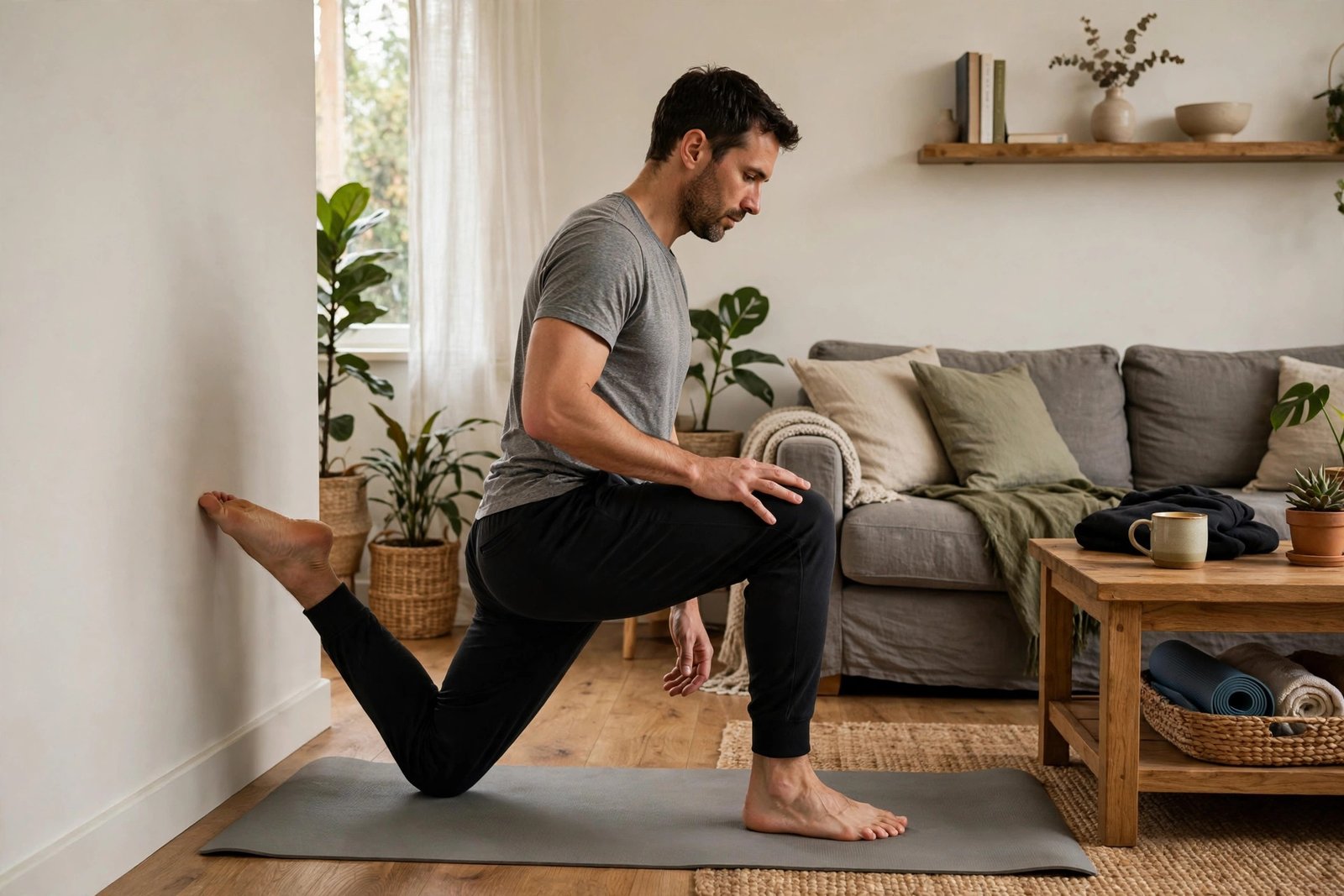
Block 1 (0–3 min): Posterior Chain
Then, start with the back line of the body. Do a deep standing forward fold for one minute, gently swaying. Then a kneeling couch stretch — back knee against a wall, front foot planted — 45 seconds per side. This opens the hip flexors and quads while the hamstrings release. Also, finish the block with ten slow inchworm walkouts.
Block 2 (3–6 min): Deep Hips
The hips get a full block because they reward it most. Also, begin with 90/90 hip switches for one minute, rotating smoothly side to side. Then pigeon pose, one minute per side, using a cushion under the hip if needed. Focus on breathing into the stretch rather than forcing depth — the hips open on exhale.
Block 3 (6–9 min): Spine
On all fours: cat-cow for one minute, syncing breath to movement. Then thread-the-needle holds, 30 seconds per side. Finally, finish with scorpions — lying face down, swinging one leg across the body — five slow reps per side. Your entire spine, from neck to low back, gets mobilized in every plane.
Block 4 (9–12 min): Shoulders and Thoracic
Also, stand for shoulder dislocates with a towel or band: ten slow passes. Follow with wall slides — back flat against a wall, arms sliding up and down — for one minute. Then thoracic bridges: seated, hands behind you, lift your hips and open your chest, five slow reps. Desk-bound shoulders will feel dramatically different.
Block 5 (12–15 min): Integration Flow
Tie it together: downward dog to cobra, five rounds. Also, step into a lunge with rotation, three per side. Finally, finish with ankle circles (ten per foot) and five slow breaths standing tall. End by noticing how you feel compared to fifteen minutes ago — that contrast is your progress.
For deeper dives into any region, our mobility by body part guide and full body mobility routine are natural next reads.
Who Benefits Most From a 15 Minute Mobility Routine
Desk workers with chronic hip and shoulder tightness — fifteen minutes directly reverses a full day of sitting. Lifters and runners who need more than a quick warm-up to keep joints happy under load.

Older adults protecting independence — this duration builds the strength-through-range that prevents falls and keeps daily tasks easy. Yogis and martial artists chasing specific positions like deeper squats or splits will find fifteen minutes the minimum effective dose for real gains.
Honestly, though, anyone with a body benefits. If you have fifteen minutes and a floor, you have everything this routine requires. In fact, the NHS notes that this kind of regular moderate activity is among the highest-value habits for long-term health.
Making It a Weekly Anchor
In fact, the most powerful way to use this routine is as a weekly anchor: two or three fifteen-minute sessions on fixed days, supplemented by shorter daily work. In fact, the anchors drive adaptation; the short sessions maintain it.

In fact, a proven template: fifteen minutes on Monday, Wednesday, and Friday, plus five minutes on the other days. Total weekly investment is under an hour — less than a single TV episode — for a genuinely transformed way of moving.
Track one benchmark monthly: deep squat depth, overhead reach, or the knee-to-wall test. Watching numbers improve is the motivation that carries you through month three and beyond. Healthline’s fitness resources offer more on structuring sustainable routines.
Pair the anchors with our daily mobility routine on off days and you have a complete weekly system that covers every base.
Deep-Dive: Getting More From Each Block
In fact, the five blocks are simple by design — but each one rewards attention to detail. Here is how to squeeze more from every three minutes.
Posterior chain: In the forward fold, bend your knees generously at first and straighten them a fraction more each week. In the couch stretch, squeeze the glute of the back leg — that contraction is what lets the hip flexor release. In fact, most people skip the squeeze and get half the benefit.
Deep hips: During 90/90 switches, keep your chest tall and resist leaning. In fact, the upright torso is what makes the rotation come from the hip rather than the spine. In pigeon, place a timer where you can see it; the first 30 seconds are just negotiation, the real opening starts after.
Spine: Move the cat-cow with your breath, not on autopilot. Inhale into cow, exhale into cat, and make each round slightly bigger than the last. For scorpions, keep the chest pinned to the floor; the stretch should live in the thoracic spine and obliques, not the low back.
Shoulders: During dislocates, use the widest grip that still challenges you, narrowing it over weeks as mobility improves. In wall slides, press your lower back flat against the wall — if it arches, you have lost the point of the drill.
Integration: Treat the final flow as a moving meditation. Slow it to half speed, match movement to breath, and notice which transitions feel sticky — those are tomorrow’s focus areas.
Frequently Asked Questions
Is 15 minutes enough for real flexibility gains?
Yes — it is widely considered the minimum effective dose for meaningful change. In fact, the key is the three-minute blocks, which give tissue time to genuinely release rather than just warm up.
How often should I do the full 15 minutes?
Three to five times weekly drives real progress. Daily is fine too, though most people do better mixing two to three full sessions with shorter maintenance on other days.
Can beginners handle this routine?
Yes, with modifications: use supports, reduce ranges, and rest whenever needed. In fact, the structure works at any level — only the intensity changes. Then, start gentle and let the routine grow with you.
Should I do this before or after workouts?
It also works as a thorough warm-up (move briskly) or a deep recovery session (move slowly, hold longer). In fact, many people do a shortened version before training and the full version on rest days.
What if I only have 15 minutes twice a week?
Twice weekly still produces solid results, especially paired with five-minute daily maintenance. Consistency of the anchor sessions matters more than their frequency beyond twice weekly.
Will this help my squat depth?
Very likely — the hip, ankle, and thoracic blocks directly target the three most common squat limiters. In fact, most people see measurable depth improvement within six to eight weeks.
How is this different from yoga?
There is overlap, but this routine is mobility-first: joint preparation and controlled range rather than flowing sequences or spiritual practice. For instance, think of it as the athletic cousin of a gentle yoga class.
Do I need any equipment for this routine?
No. Every block uses bodyweight only, which is intentional — it removes every excuse and makes the routine travel-friendly. If you want to progress later, a single resistance band or yoga block can deepen a few stretches, but neither is required to get the full benefit.
Conclusion
In fact, a 15 minute mobility routine is where casual stretching becomes a genuine practice. Fifteen unhurried minutes, five focused blocks, every major joint — a complete session that leaves you moving like a better version of yourself.
Anchor it two or three times a week, maintain with shorter sessions between, and watch what happens over two months. In fact, your body is more adaptable than you think. Fifteen minutes is all it asks.
