


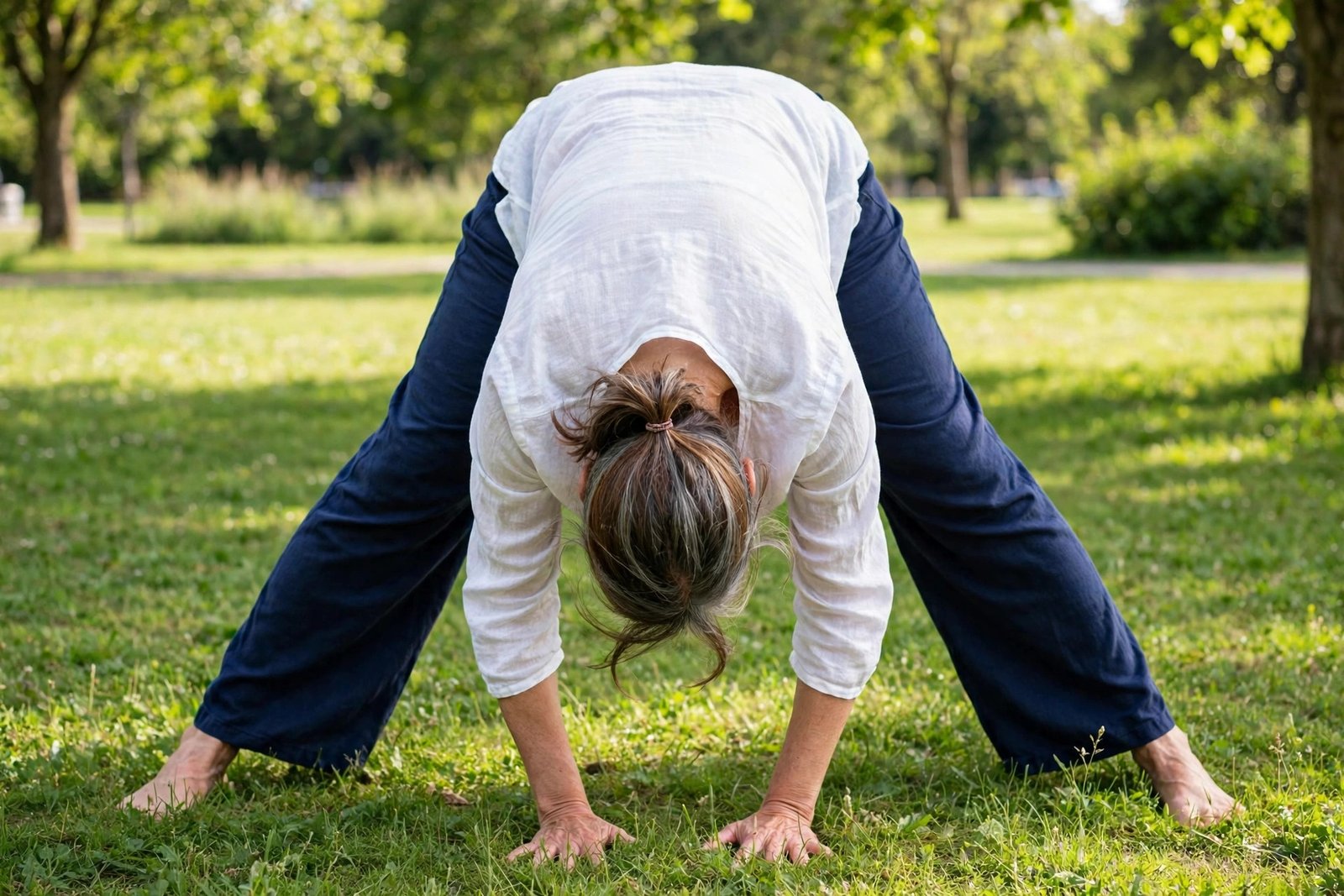
If you spend most of your day sitting, your hamstrings and inner thighs are probably tighter than you realize. In fact, the standing straddle stretch is one of the simplest ways to open them up. You need no equipment, no floor space, and no special flexibility to start — just you and a few feet of room.
Also known as the wide-legged forward fold, this stretch works the hamstrings, adductors (inner thighs), and calves while gently lengthening the spine. In addition, it takes less than two minutes. It fits neatly into any warm-up or cool-down, and it works for complete beginners and advanced movers alike.
But most people rush through it. In addition, they round their backs, bounce at the bottom, or lock their knees straight — and miss most of the benefit. In this guide, you will learn the exact form, the mistakes that steal your results, and smart variations that meet you at your current level.
What Is the Standing Straddle Stretch?
In fact, the standing straddle stretch is a standing forward fold performed with your feet set wide apart. You hinge at the hips, fold your torso toward the floor, and let gravity lengthen the back of your legs. In yoga, the same position is called Prasarita Padottanasana, or the wide-legged forward fold.
Unlike the seated version, you do not need to sit on the floor or push your legs open with your arms. In fact, your body weight and the wide stance create the stretch for you. In fact, that makes it a great choice for people with tight hips who find seated stretches uncomfortable.
It also differs from the wall straddle stretch, where you lie on your back with your legs up a wall and let gravity spread them. In addition, this article focuses only on the standing version: stance, fold, hold, and rise.
Benefits of the Standing Straddle Stretch
Opens the Hamstrings
In fact, the hamstrings are the main target of this stretch. When you fold forward with a wide stance, the back of each leg lengthens under its own weight. Over time, this improves your hip hinge — the same movement pattern you use in deadlifts, kettlebell swings, and picking things up off the floor.
Stretches the Inner Thighs and Groin
In fact, a narrow forward fold barely touches the adductors. Widening your stance brings them into play. In addition, these inner-thigh muscles tighten from sitting all day, and loosening them improves side-to-side movement and reduces the pulling sensation many people feel at the top of their legs.
Eases Lower Back Tension
Hanging gently in the fold lets your spine decompress. In fact, the muscles along your lower back release their grip as gravity draws your torso downward. In fact, many people find this position brings quick relief after long hours at a desk.
Improves Posture and Balance
A proper fold asks your legs to stay active while your torso relaxes. In fact, that combination builds awareness of your balance and foot pressure. Practicing it regularly can carry over to a taller, more stable standing posture.
It also teaches you to keep your weight centered instead of collapsing forward. In fact, that small skill transfers to squats, deadlifts, and even simple things like bending down to tie your shoes.
Supports Middle Split Progress
If a full middle split is one of your goals, the standing straddle stretch is a perfect companion drill. In addition, it trains the same inner-thigh and hamstring length you need on the floor, but with less pressure on the hips. Also, pair it with our middle split stretch guide for a complete approach.
How to Do the Standing Straddle Stretch
Follow these steps in order. Then, move slowly, and never force the range.
- Set your stance. Stand tall with your feet about three to four feet apart. Roughly the width of your mat or a little wider than shoulder width times two. Turn your toes slightly inward and press the outer edges of your feet into the floor.
- Engage your legs. Lift your kneecaps by gently tightening your quadriceps. Keep a soft, micro-bend in the knees so they do not lock. Squeeze your inner thighs toward each other without moving your feet.
- Lengthen first. Place your hands on your hips. Inhale, lift your chest, and draw your shoulders back. Imagine someone gently pulling the crown of your head toward the ceiling.
- Hinge at the hips. Exhale and fold forward from the hip creases, not the waist. Keep your spine long as you descend. Stop and place your hands on the floor (or a block) under your shoulders as soon as your back wants to round.
- Settle into the fold. Let your head hang heavy and relax your neck. Walk your hands slightly back between your feet if that is comfortable. Breathe deeply for 20 to 30 seconds.
- Rise with control. Place your hands back on your hips, engage your core, and inhale as you lift your torso. Keep the back flat as you come up, then step your feet together.

Common Mistakes to Avoid
Rounding the Back
In fact, the most common mistake is rounding the spine to get the head closer to the floor. Depth means nothing if your back collapses. In fact, a long, flat back with hands on blocks delivers a deeper hamstring stretch than a rounded back with hands on the floor. Also, stop the fold the moment your spine starts to round.
Locking the Knees
Locked knees transfer all the tension into your joints and the back of the knee, which can strain the ligaments there. Then, keep a slight bend in the knees. In addition, this shifts the stretch into the muscle belly of the hamstrings, where it belongs.
Bouncing at the Bottom
Bouncing triggers the stretch reflex — your muscles contract to protect themselves instead of relaxing. Each bounce also risks pulling a hamstring or groin. Sink slowly into the fold and hold still. Then, let your breath do the deepening, not momentum.
Letting the Weight Sink Into the Heels
When your weight drifts into your heels, the hamstrings go slack and the stretch fades. Also, press evenly through the whole foot, with slightly more pressure toward the balls of the feet. This also keeps the back of the legs engaged and the stretch active.
Forcing the Feet Too Wide
In fact, a wider stance is not automatically better. If your feet are so far apart that you lose balance or your hips feel pinched, you have gone too far. Then, start with a moderate stance and widen it over weeks, not minutes.
Holding Your Breath
People often hold their breath when they feel a strong stretch. That raises tension everywhere. Breathe slowly through your nose. Also, try to make each exhale a little longer than the inhale, and feel your torso soften with every breath out.
Variations and Progressions
Easier Variation: Hands on Blocks
If your hands cannot reach the floor, place a yoga block (or a sturdy stack of books) under each hand. This keeps your spine long while your flexibility builds. Also, bend your knees more generously if needed. In fact, the stretch should feel like a strong pull, never pain.

Deeper Variation: Hands to Ankles or Floor
Once you can place your palms flat on the floor with a straight spine, walk your hands back so they rest behind your feet. For the deepest version, grip your ankles and draw your chest toward the floor. Also, keep the weight on your legs, not your arms — the hands are anchors, not handles.
Shoulder-Opening Variation: Hands Clasped Behind the Back
Interlace your fingers behind your back before you fold. As you hinge forward, let your arms fall toward the floor overhead. In addition, this adds a chest and shoulder stretch to the leg work. Only try this if your shoulders feel comfortable in the position.
Dynamic Variation: Rocking Forward Fold
Instead of holding still, gently rock your weight forward and back across the soles of your feet for about 30 seconds. Also, notice how the stretch shifts between the hamstrings and the calves. In addition, this version works well as a warm-up before leg workouts or split training.
How to Add the Standing Straddle Stretch to Your Routine
You do not need a long session to benefit from this stretch. Two or three sets of 20 to 30 seconds after a workout is plenty. If you are working toward the splits, do it daily as part of your how to do the splits practice — it primes the exact muscles you need.
Before training, use the dynamic rocking variation as part of your warm-up. After training, hold the static version to help your legs recover. On rest days, a single gentle round in the morning can loosen the overnight stiffness in your back and hamstrings.
Then, pair the standing version with seated or floor-based straddle work for the best results. Each position loads the muscles from a slightly different angle, and the combination builds flexibility faster than any single stretch alone.

Frequently Asked Questions
How wide should my feet be for a standing straddle stretch?
Also, start with your feet about three to four feet apart, or roughly twice shoulder width. In fact, your ideal width depends on your height and flexibility. Choose the widest stance you can hold with balance and a long spine — no wider.
Should I keep my legs straight or bent?
Also, keep a soft micro-bend in your knees. Fully locked knees stress the joints and reduce the quality of the stretch. Slightly bent knees shift the work into the hamstring muscles, which is exactly what you want.
How long should I hold the stretch?
Also, hold for 20 to 30 seconds per set, and repeat two or three times. Breathe deeply throughout. Additionally, for a relaxation-focused session, you can hold for up to a minute once you are warm.
Is the standing straddle stretch good for beginners?
Yes. It is one of the most beginner-friendly straddle positions because you do not need to sit on the floor or force your legs open. Then, start with hands on blocks and a moderate stance, and progress from there.
Can it help me get my middle splits?
Absolutely. In addition, it trains the hamstrings, adductors, and hip hinge you need for the middle split. Also, combine it with dedicated floor work like our middle split stretch routine for faster progress.
Can I do the standing straddle stretch every day?
Yes, it is gentle enough for daily practice as long as you stay within a comfortable range. In fact, daily consistency builds flexibility faster than one long session per week. Also, keep the intensity moderate on rest days and save the deepest holds for after workouts.
Is it safe if I have lower back pain?
In addition, it can help with mild stiffness, but skip or modify it if you have a disc issue, acute back pain, or a diagnosed condition. Then, keep your spine long, bend your knees, and use blocks to reduce the load. When in doubt, check with a qualified professional. Experts at ACE Fitness also include this pose in their recommended cool-down yoga poses. Their guide on performing forward folds safely is worth a read.
Conclusion
In fact, the standing straddle stretch is simple, but simple does not mean easy. In fact, the difference between a good fold and a wasted one comes down to form: hinge at the hips, keep your back long, and respect your current range.
Then, start with short holds a few times per week. Also, use blocks when you need them, skip the bouncing, and breathe through every rep. Over the coming weeks, your hamstrings will loosen, your inner thighs will open, and movements that once felt stiff will start to feel easy.
In fact, your body adapts to what you practice. Then, give it this two-minute practice, and it will pay you back in every step, lift, and stretch you do.
