


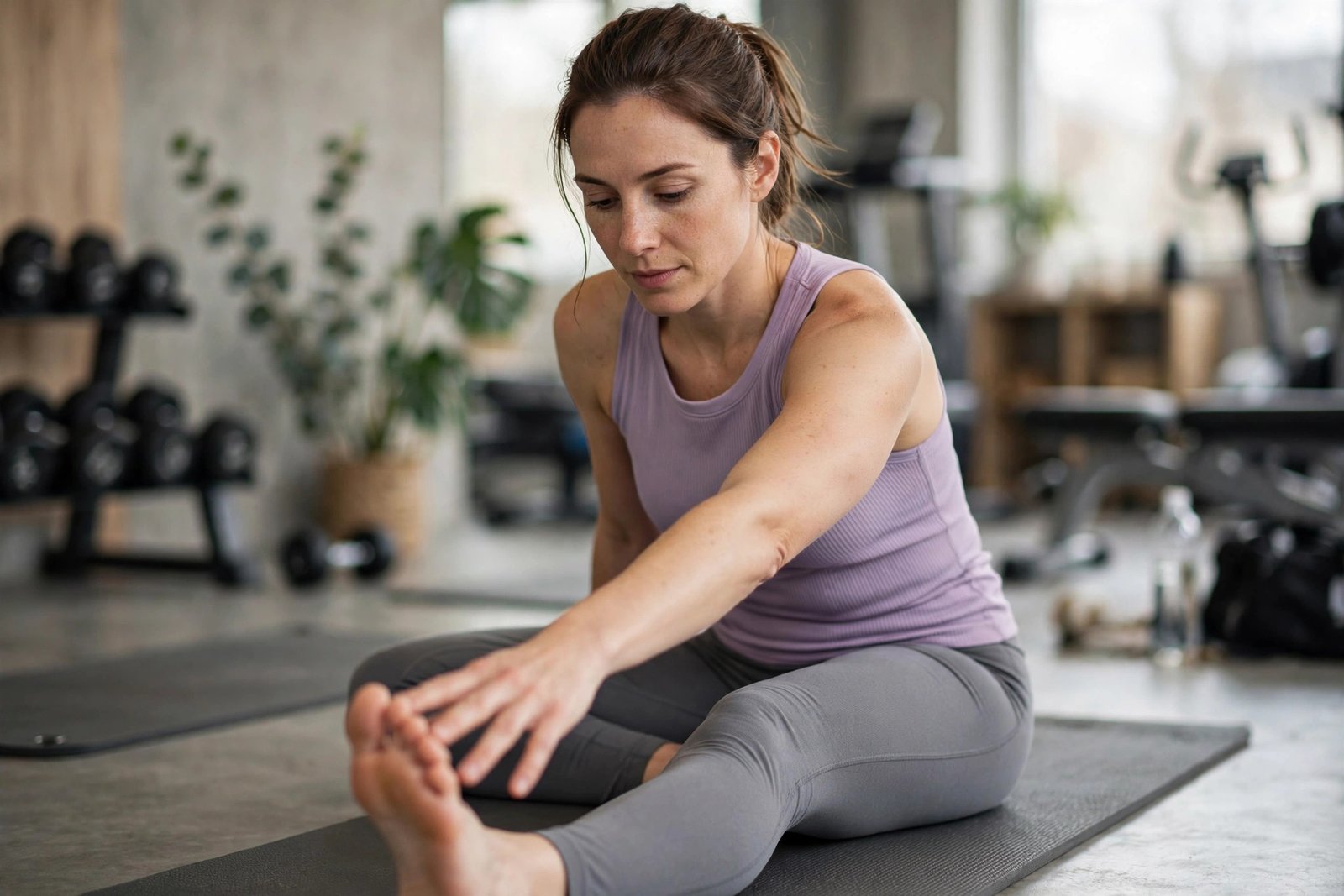
You just finished a great workout. In fact, your heart is still pounding, your muscles feel warm and worked. In fact, your mind is already on the shower, the drive home, or the rest of your day. Before you move on, give your body ten minutes of stretching after workout — the simplest way to cool down well.
It is also tempting to call it done the moment the last rep ends. But the few minutes right after exercise are a golden window for your body, and stretching after workout sessions is one of the simplest ways to use it well.
In this guide, you will learn why post-workout stretching matters, which stretches give you the most benefit, and a simple 10-minute cool-down sequence you can follow after every training session. Also, no equipment needed, and no experience required. In fact, ten minutes of stretching after workout is the simplest recovery tool you own.
Why Stretching After Workout Matters
When you train, your muscles contract hard and repeatedly. In addition, they finish the session shorter, tighter, and warmer than when you started. In fact, a few minutes of gentle stretching helps them transition back to their resting length. Make stretching after workout a habit and soreness becomes far more manageable.
For instance, think of it as a thank-you to your body for the work it just did. Here is what those few minutes can do for you. In fact, the best time for stretching after workout is within thirty minutes of finishing.
It Helps You Cool Down Gradually
After exercise, your heart rate, breathing rate, and blood pressure are all elevated. Stopping suddenly can leave you feeling dizzy or lightheaded, especially after an intense session. In fact, consistent stretching after workout helps you bounce back faster.
In addition, slow, relaxed stretches give your cardiovascular system time to ease back to normal. Moving gently from one stretch to the next keeps blood flowing while your body winds down. It is also a much kinder landing than going from full effort straight to the couch. In fact, ten minutes of stretching after workout is the simplest recovery tool you own.
It May Ease Soreness and Stiffness
Let us be honest: no stretch can magically erase next-day soreness. Research on whether stretching prevents delayed-onset muscle soreness is mixed. Also, make stretching after workout a habit and soreness becomes far more manageable.
That said, most people find that post-workout stretching leaves them feeling less stiff and more comfortable the next day. Gently lengthening worked muscles can ease that locked-up feeling and help you move more freely in the hours after training. In fact, the best time for stretching after workout is within thirty minutes of finishing.
It Is the Best Time to Build Flexibility
In fact, your muscles are warm, pliable, and full of blood flow right after a workout. In fact, that makes this the ideal moment to work on your range of motion. Consistent stretching after workout helps you bounce back faster.
In fact, a stretch that feels stiff and unyielding in the morning can feel smooth and deep after training. If you stretch consistently after workouts, those small gains add up into real, lasting flexibility over weeks and months. In fact, ten minutes of stretching after workout delivers more recovery than any expensive supplement.
It Helps You Mentally Wind Down
Workouts rev you up. Slow stretches paired with deep breathing do the opposite: they activate your body’s rest-and-recover mode. Moreover, stretching after workout helps you wind down mentally, not just physically.
Those quiet minutes on the mat can lower stress, clear your head, and help you shift back into the rest of your day feeling calm instead of wired. In fact, many people find their cool down becomes the most peaceful part of their training. Indeed, stretching after workout is one habit your future self will thank you for.
How Stretching After Workout Differs From Pre-Workout Stretching
In fact, this is a common point of confusion, so let us clear it up. Before a workout, you want dynamic stretching — controlled movements like leg swings and arm circles that warm your muscles up. As a result, you will cool down gradually instead of crashing.
After a workout, you want static stretching — slow, held stretches where you settle into a position and breathe. In fact, your muscles are already warm, so holding a stretch is safe and effective. In addition, your body gets a clear signal that the hard work is over.
Mixing these up is one of the most common training mistakes. If you want a full breakdown of what to do before you train, read our guide to stretching before your workout.
The Best Stretches for After a Workout
In fact, a good cool down covers the major muscle groups you just trained. Below are simple, effective static stretches organized by body area. Then, hold each one for 20 to 30 seconds per side, and breathe slowly and deeply throughout.
Never force a stretch into pain. You are looking for a feeling of gentle tension — about a 4 or 5 out of 10 on the intensity scale. If something hurts sharply, back off.
Lower Body Stretches
Your legs do the heavy lifting in most workouts, so give them the most attention.
- Standing quad stretch: Stand tall and hold a wall or chair for balance. Bend one knee and pull your foot gently toward your glute. Keep your knees close together and your torso upright.
- Standing hamstring stretch: Place one heel on a low step or the floor in front of you with your leg straight. Hinge at your hips and lean forward slightly until you feel a stretch behind your thigh.
- Calf stretch: Face a wall and step one foot back, keeping that leg straight and your heel pressed into the floor. Lean forward gently until you feel the stretch in your calf.
- Half-kneeling hip flexor stretch: Kneel on one knee with the other foot flat in front. Tuck your pelvis slightly and shift your weight forward until you feel a stretch at the front of your back hip.
- Figure-four glute stretch: Lie on your back, cross one ankle over the opposite knee, and gently pull the bottom leg toward your chest. You will feel this deep in your glute and outer hip.
Upper Body Stretches
After lifting, pushing, or pulling, your chest, shoulders, and arms deserve attention too.
- Cross-body shoulder stretch: Bring one arm across your chest and use the other hand to gently press it closer. Keep your shoulder relaxed and down.
- Overhead triceps stretch: Reach one arm overhead, bend the elbow so your hand drops behind your head, and gently press the elbow with your other hand.
- Chest opener: Stand in an open space, clasp your hands behind your back, and lift them slightly while opening your chest and squeezing your shoulder blades together.
- Child’s pose: Kneel on the floor, sit your hips back toward your heels, and reach your arms forward on the mat. This gently stretches your back, shoulders, and lats.

If you want to explore more holds like these, check out our full guide to static stretching exercises for recovery and flexibility.
A Simple 10-Minute Cool-Down Stretching Sequence
Knowing individual stretches is one thing. Having a ready-made sequence you can follow on autopilot is even better. In addition, this routine covers your whole body in about ten minutes and works as a complete stretching cool down after any workout.
Move slowly from one stretch to the next. Do not rush — the whole point of a cool down is to slow your body down gradually.
- Ease your heart rate down (1 minute). March slowly in place or walk around the room. Take slow, deep breaths through your nose until your breathing feels controlled.
- Standing quad stretch (30 seconds each side). Hold a wall for balance if you need it. Keep your torso tall and your knees together.
- Standing hamstring stretch (30 seconds each side). Heel on a low step, leg straight, hinge forward from the hips with a flat back.
- Calf stretch (30 seconds each side). One leg back, heel down, lean gently into the wall.
- Half-kneeling hip flexor stretch (30 seconds each side). Tuck your pelvis and shift forward until you feel the front of your hip open up.
- Figure-four glute stretch (30 seconds each side). On your back, ankle over knee, pull the bottom leg in gently.
- Cross-body shoulder stretch (30 seconds each side). Keep the shoulder of the stretching arm relaxed and away from your ear.
- Overhead triceps stretch (30 seconds each side). Elbow pointing up, hand behind your head, gentle pressure on the elbow.
- Chest opener (30 seconds). Hands clasped behind your back, lift and open your chest wide.
- Child’s pose (1 minute). Finish on the floor. Breathe deeply and let your whole body relax into the mat.

Short on time? You can also shrink this to a 5-minute version by doing just the lower-body stretches (steps 2 through 6). Something is always better than nothing.
How Long Should You Stretch After a Workout?
For most people, 5 to 15 minutes is the sweet spot. In fact, ten minutes covers a full-body cool down without eating into your day.
Also, hold each stretch for 20 to 30 seconds. Indeed, that is enough time for the muscle to relax into the stretch. Going longer is fine if a spot feels especially tight, but there is no need to hold any single stretch for several minutes.
One round through your main muscle groups is usually enough. If a particular area feels very tight, repeat it once more rather than stretching everything twice. Guidance from the American Council on Exercise on cool-down exercise supports keeping the cool down gradual and relaxed.
Common Stretching After Workout Mistakes to Avoid
Post-workout stretching is simple, but a few common mistakes can make it less effective — or even risky.
- Skipping it entirely. This is the biggest one. The cool down is part of the workout, not an optional extra.
- Bouncing in the stretch. Ballistic bouncing can trigger a reflex that tightens the muscle and raises injury risk. Ease in and hold still instead.
- Stretching into pain. Discomfort is fine; sharp or shooting pain is not. Back off until the stretch feels like gentle tension.
- Holding your breath. Deep, steady breathing helps muscles relax into the stretch. If you catch yourself holding your breath, soften and exhale.
- Rushing through in sixty seconds. A hurried cool down barely counts. Give each stretch its full 20 to 30 seconds.
- Only stretching what feels good. It is natural to favor easy stretches, but balance matters. Give tight, stubborn areas the attention they need.
- Doing deep static stretches on cold muscles. After your workout your muscles are warm, which is exactly why this is the right time for static holds. Just save deep static stretching for after you are warmed up, not before.

Easy Tips to Make Post-Workout Stretching a Habit
Knowing what to do is only half the battle. Here are a few tricks that help people actually stick with their cool down:
- Keep a mat where you train. If the mat is already out, you are far more likely to use it.
- Pair it with a ritual. Start a favorite cool-down playlist or podcast the moment your workout ends. Your brain will learn that the music means stretch time.
- Set a timer. Ten minutes feels short when it is timed — and it stops you from cutting the routine short.
- Track your streak. Mark an X on the calendar each day you complete your cool down. Streaks are surprisingly motivating.
- Have a minimum version. On busy days, do the 5-minute lower-body version instead of skipping. Consistency beats perfection.
Over time, stretching becomes as automatic as the workout itself. For more ideas to build around, browse our collection of stretching exercises for every level.
Frequently Asked Questions
Should I do stretching after workout every time?
Yes, it is a good habit after any session — strength training, cardio, or sports. Even a short 5-minute cool down helps your body transition back to rest. In fact, the only exception is if you are injured; in that case, follow your doctor’s or physical therapist’s advice.
Is it bad to skip stretching after a workout?
Skipping occasionally will not cause harm, but making it a habit means missing out on real benefits: a smoother cool down, less stiffness, and steady flexibility gains. For instance, think of it as the final set of your workout.
Should I stretch after cardio or only after lifting?
Both. After cardio, your legs and hips are warm and ready for lower-body stretches. After lifting, stretch the muscle groups you trained. In fact, a full-body sequence like the one above works well after any type of session.
How long should I hold each stretch?
Also, hold each static stretch for 20 to 30 seconds per side. Also, breathe deeply and let the muscle relax into the position. If an area feels especially tight, you can repeat the stretch once rather than holding it much longer.
Can stretching after workout prevent muscle soreness?
In fact, the evidence is mixed — stretching has not been proven to prevent delayed-onset muscle soreness. However, many people find that a good cool down reduces stiffness and helps them feel more comfortable the next day. It is also worth doing for how it makes you feel, even if it is not a guaranteed soreness cure.
What is the difference between a cool down and stretching?
In fact, a cool down is the broader process of gradually returning your body to its resting state. In addition, it usually starts with a few minutes of light movement, like easy walking, and finishes with static stretches. Healthline’s guide to cooldown exercises explains how the two fit together.
Can I do gentle yoga instead of stretching after a workout?
Absolutely. A slow, gentle yoga flow works beautifully as a cool down, since it combines light movement, static holds, and deep breathing. Just keep it easy — save the intense power yoga for another time.
Conclusion
Stretching after your workout does not need to be complicated. Ten quiet minutes, a handful of simple stretches, and slow deep breaths are enough to help your body cool down, ease stiffness, and build lasting flexibility.
In fact, the best cool-down routine is the one you will actually do. Also, start with the 10-minute sequence above, keep it consistent, and notice how much better you feel. During your workouts, after them, and the morning after.
In fact, your body worked hard for you today. Give it those few minutes. It is also the simplest recovery tool you own, and it is free.
