


In fact, your joints are supposed to move. When they do not, everyday life gets harder than it should be. Bending down feels stiff, your shoulders ache at your desk, and your hips protest after a long drive. In fact, the fix is simpler than you think: mobility exercises without equipment, done right where you are.
In fact, the fix does not require a gym membership or any gear at all. Mobility exercises without equipment use only your bodyweight to restore healthy joint movement. You can do them in your living room, at the park, or in a hotel room.
In addition, this guide gives you a complete 15-minute routine of bodyweight-only mobility drills. Every exercise uses active, controlled joint movement — no bands, no rollers, no weights. Just follow the steps, move slowly, and feel the difference. In addition, these mobility exercises without equipment work best when you do them slowly and with full attention.
What Are Mobility Exercises Without Equipment?
Mobility is your ability to move a joint actively through its full range of motion with control. A mobility exercise is simply a drill that trains that ability. For example, slowly circling your shoulder to wake up the joint rather than just holding a stretch. Also, add these mobility exercises without equipment to your weekly schedule and your joints will thank you.
In fact, the “without equipment” part is the best part. You need nothing except a little floor space and your own body. In fact, your muscles provide the resistance, and gravity provides the load, which is plenty for joint health. In fact, the beauty of these mobility exercises without equipment is that you can do them anywhere, anytime.
This also makes bodyweight mobility one of the most accessible forms of training there is. If you are new to the idea, our overview of mobility exercises explains how they differ from stretching and strength work. Then, start with five minutes of these mobility exercises without equipment and build up as you get stronger.
Why Do Mobility Exercises Without Equipment?
The biggest advantage is consistency. When a workout needs zero setup and zero gear, you actually do it. In fact, a routine you follow three times a week beats a fancy program you abandon after two sessions.
Bodyweight mobility also trains your joints the way you use them in real life. You bend, reach, twist, and step using your own body every day, so training those exact patterns transfers directly to easier movement.
Regular joint movement keeps synovial fluid circulating, which nourishes your cartilage. Health authorities including the NHS highlight the wide-ranging benefits of regular movement, from healthier joints to better mood and energy.
Finally, equipment-free mobility is joint-friendly by design. You control the range and the speed, so you can stay in a comfortable zone while still making progress week after week.
Ground Rules Before You Start
Mobility work is safe for most people, but a few simple rules keep it productive and pain-free:
- Move slowly and with control. Mobility is about quality, not speed. Never bounce or jerk into a position.
- Stay in a pain-free range. Mild effort and gentle pulling are fine. Sharp pain is a stop sign — ease off immediately.
- Breathe naturally. Do not hold your breath. Slow nasal breathing helps your muscles relax into new ranges.
- Warm up lightly first. A minute of marching in place or arm swings raises your body temperature and prepares your joints.
- Listen to your body. Stiff areas may need smaller movements at first. That is completely normal and expected.
If you have an injury, a joint replacement, or a medical condition, check with your doctor or a physical therapist before starting. Standard physical activity guidance from health authorities applies here too: start easy and build gradually.
The 15-Minute Equipment-Free Mobility Routine
In addition, this routine covers your whole body from neck to ankles using ten simple drills. Then, spend about 30–45 seconds on each movement (or 8–10 slow repetitions per side), rest briefly between drills, and you will finish in about 15 minutes.
Also, do the routine 3–5 times per week for best results. In fact, many people like doing it as mobility exercises at home in the morning or as a warm-up before other activity.
1. Neck CARs (Controlled Articular Rotations)
Then, stand or sit tall with your shoulders relaxed. Slowly tuck your chin and roll your head in the biggest comfortable circle you can make, keeping your shoulders still.
Also, take about 10 seconds per circle and do 3 slow circles in each direction. In addition, this wakes up the small joints of the neck and eases the stiffness that builds up from looking at screens.

2. Shoulder Rolls and Shoulder CARs
Stand tall and roll both shoulders forward in large circles, then reverse direction. After a few rolls, lift one arm and make the biggest slow circle you can, tracing the joint’s full range.
Do 5 slow rolls each direction, then 5 arm circles per arm each way. Also, keep your torso steady so the movement comes from the shoulder joint itself, not from leaning.
3. Cat-Cow
Get on all fours with your hands under your shoulders and knees under your hips. On an inhale, let your belly sink and lift your chest and tailbone (cow). On an exhale, round your back like an angry cat and tuck your chin.
Then, move smoothly between the two positions for 8–10 slow breaths. In addition, this classic drill restores segment-by-segment movement through your entire spine.

4. Quadruped Thoracic Rotations
Stay on all fours and place one hand behind your head. Rotate your chest toward the ceiling, opening the elbow upward, then rotate back down toward the floor.
Do 8 slow rotations per side. In addition, this targets the mid-back (thoracic spine), which tends to get stiff from sitting and limits how well your shoulders move overhead.
5. Standing Hip Circles
Also, stand on one leg (hold a wall lightly for balance if needed) and lift the other knee to hip height. Draw the biggest slow circle you can with your knee, then reverse direction.
Also, do 8 circles each direction per leg. Hip circles lubricate the hip socket and improve the control your hips need for walking, climbing stairs, and squatting.
6. 90/90 Hip Switches
Also, sit on the floor with both knees bent at 90 degrees, one leg in front of you and one to the side. Keeping your chest tall, lift both knees and rotate them to switch sides.
Do 8–10 slow switches total. In addition, this drill trains both internal and external hip rotation, which most people lose from sitting all day.
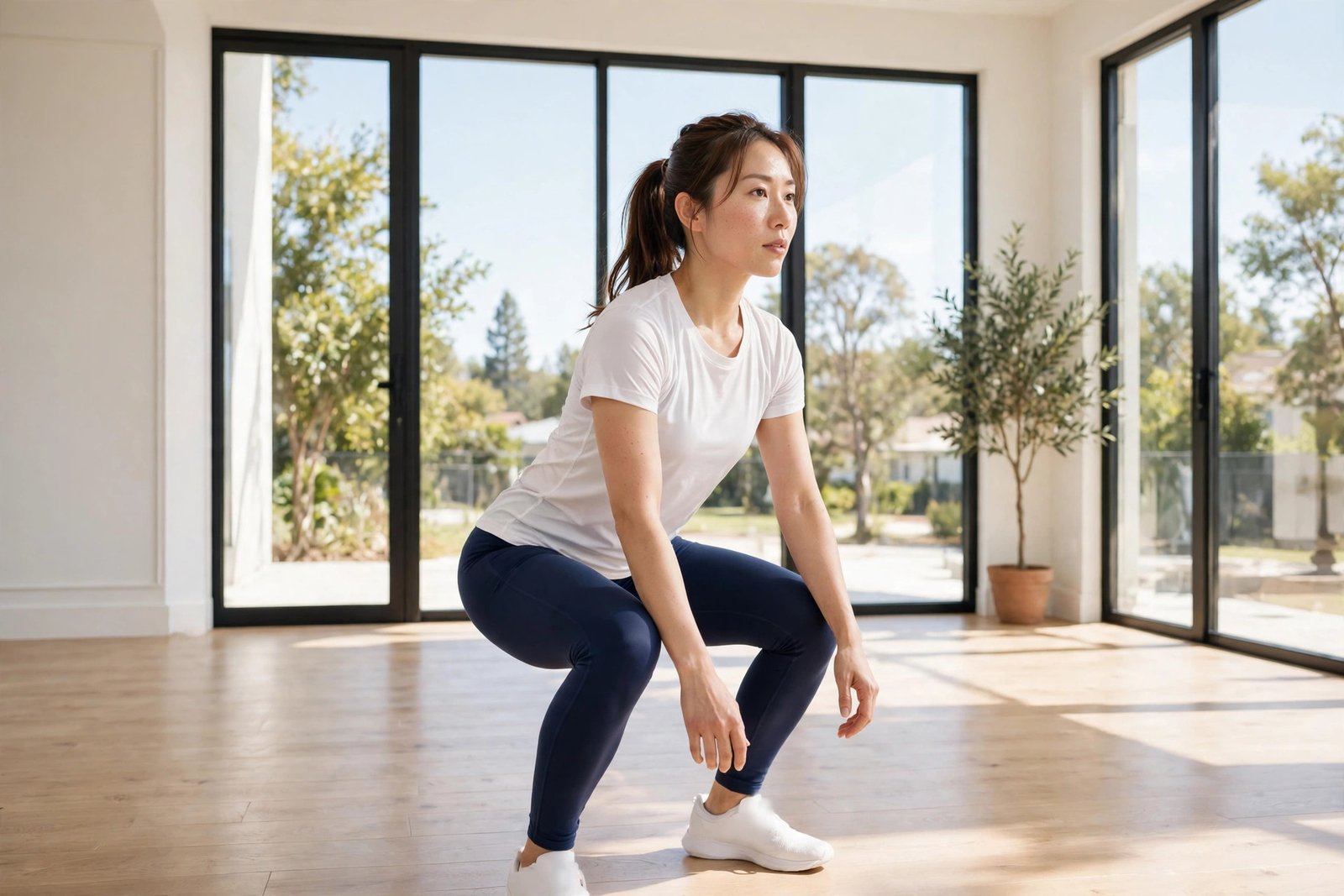
7. Full-Range Bodyweight Squats
Also, stand with feet shoulder-width apart and toes slightly out. Lower yourself slowly into the deepest squat you can manage while keeping your heels down and chest up, then stand back up.
Do 10 slow repetitions, pausing for a second at the bottom. This is one of the best mobility exercises without equipment because it moves your ankles, knees, and hips together.
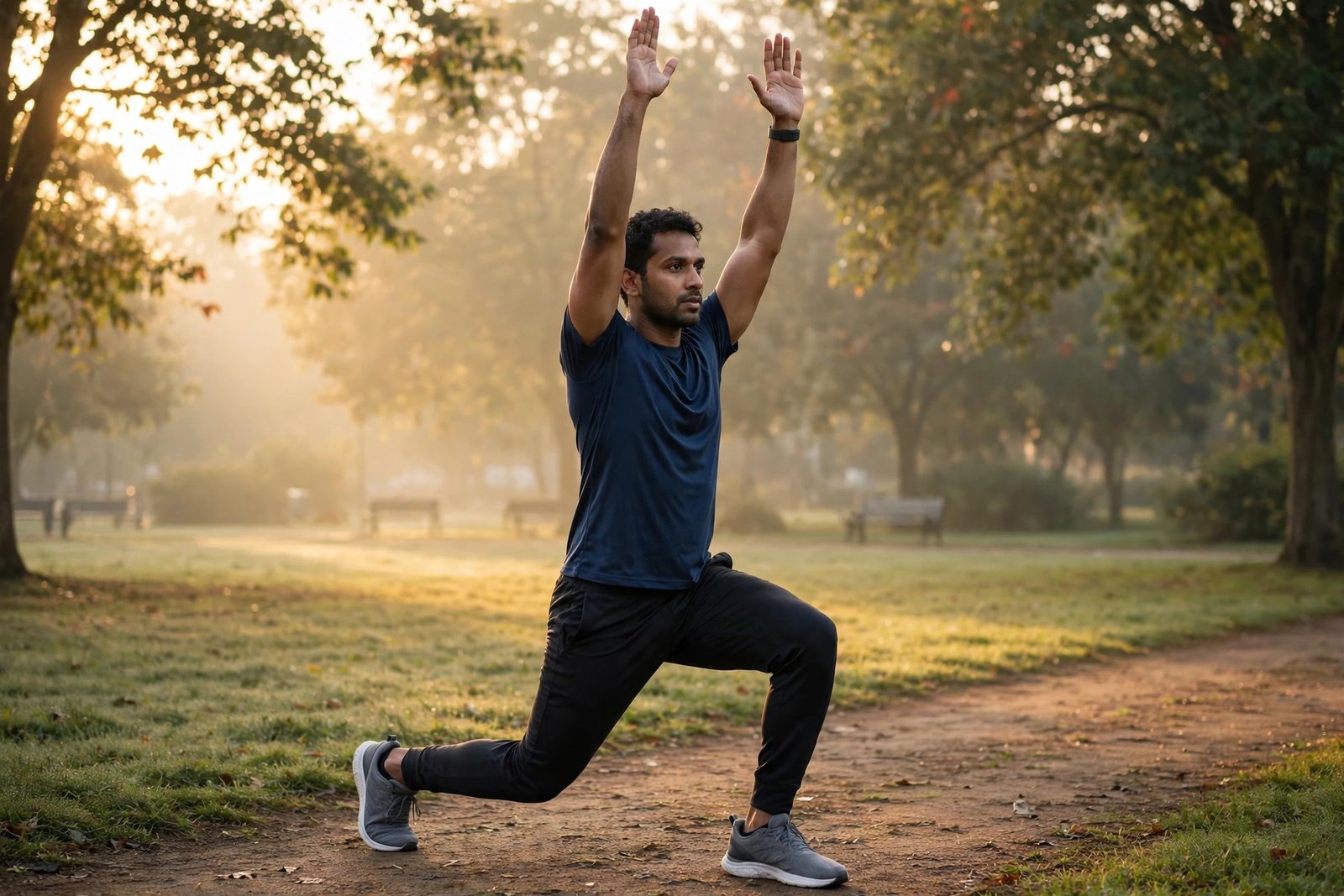
8. Walking Lunge With Overhead Reach
Also, step forward into a lunge and reach both arms overhead, leaning slightly toward the back leg’s side to open the hip flexors. Step through into the next lunge on the other side.
Then, take 8–10 total steps across the room and back. In addition, this flowing drill combines hip, spine, and shoulder mobility in one practical movement pattern.
9. Knee Circles
Also, stand with your feet together and hands resting lightly on your knees. Then, bend your knees slightly and draw slow circles, letting the knees track over your toes.
Do 10 circles in each direction. In addition, this gentle drill warms up the knee joint and the muscles around it, which is great before walking or climbing stairs.
10. Ankle Circles
Also, stand on one leg and lift the other foot slightly off the floor. Point your toes and draw the biggest slow circle you can with your foot, then reverse direction.
Then, do 10 circles each way per ankle. Healthy ankle mobility improves your balance and makes squats, lunges, and walking feel smoother.
How to Build a Simple Weekly Mobility Habit
In fact, the routine above works best when it becomes a habit, not a project. Pick a trigger you already do daily — like after your morning coffee or before your evening shower — and attach the routine to it.
Also, start with three sessions per week if you are new to this. If you want a gentler on-ramp first, check out our guide to mobility exercises for beginners and work your way up to the full routine.
Also, progress by increasing your range, not your speed. When a drill starts feeling easy and smooth, try taking each repetition a little deeper or adding a second round of your stiffest areas.
Missed a day? Just pick it up at the next session. Consistency over months matters far more than perfection over weeks.
Frequently Asked Questions
Are mobility exercises without equipment actually effective?
Yes. Your bodyweight provides plenty of resistance for joint mobility work, because the goal is controlled movement through range — not heavy loading. Research and clinical experience consistently show that regular bodyweight joint movement improves range of motion, coordination, and comfort.
How long does it take to notice better mobility?
In fact, most people feel looser after a single 15-minute session, especially in the neck, shoulders, and hips. Lasting changes in range of motion typically take 4–8 weeks of consistent practice, 3–5 times per week.
What is the difference between mobility exercises and stretching?
Mobility exercises move joints actively through their range using muscular control, like hip circles or squats. Stretching usually means holding a muscle in a lengthened position passively. Both have value, but mobility drills better prepare your joints for daily movement.
Should I do mobility exercises every day?
You can, since bodyweight mobility is low-intensity and easy to recover from. In fact, that said, 3–5 quality sessions per week is enough for most people to see steady improvement. Daily practice is great if you keep each session short and gentle.
Can mobility exercises help with back pain?
In addition, they can help when stiffness contributes to the pain, which is common with desk work. Gentle drills like cat-cow and thoracic rotations often bring relief. However, sharp, radiating, or persistent pain needs professional evaluation — mobility work is not a substitute for medical care.
Do I need to warm up before doing mobility exercises?
Not extensively. Mobility drills themselves act as a warm-up because they move your joints gently and raise your temperature. Just start with the easier drills and the smaller ranges, then work into deeper ranges as your body warms up.
Conclusion
Mobility exercises without equipment prove that you do not need a gym to move well. Ten simple bodyweight drills, fifteen minutes, three to five times a week — that is the whole formula.
Also, start with the routine in this guide and focus on smooth, controlled movement. In fact, your joints will feel the difference quickly, and the habit will pay off every time you bend, reach, twist, or climb.
Pick one session this week and just begin. In fact, your future self — the one who moves easily and pain-free — will thank you.
