


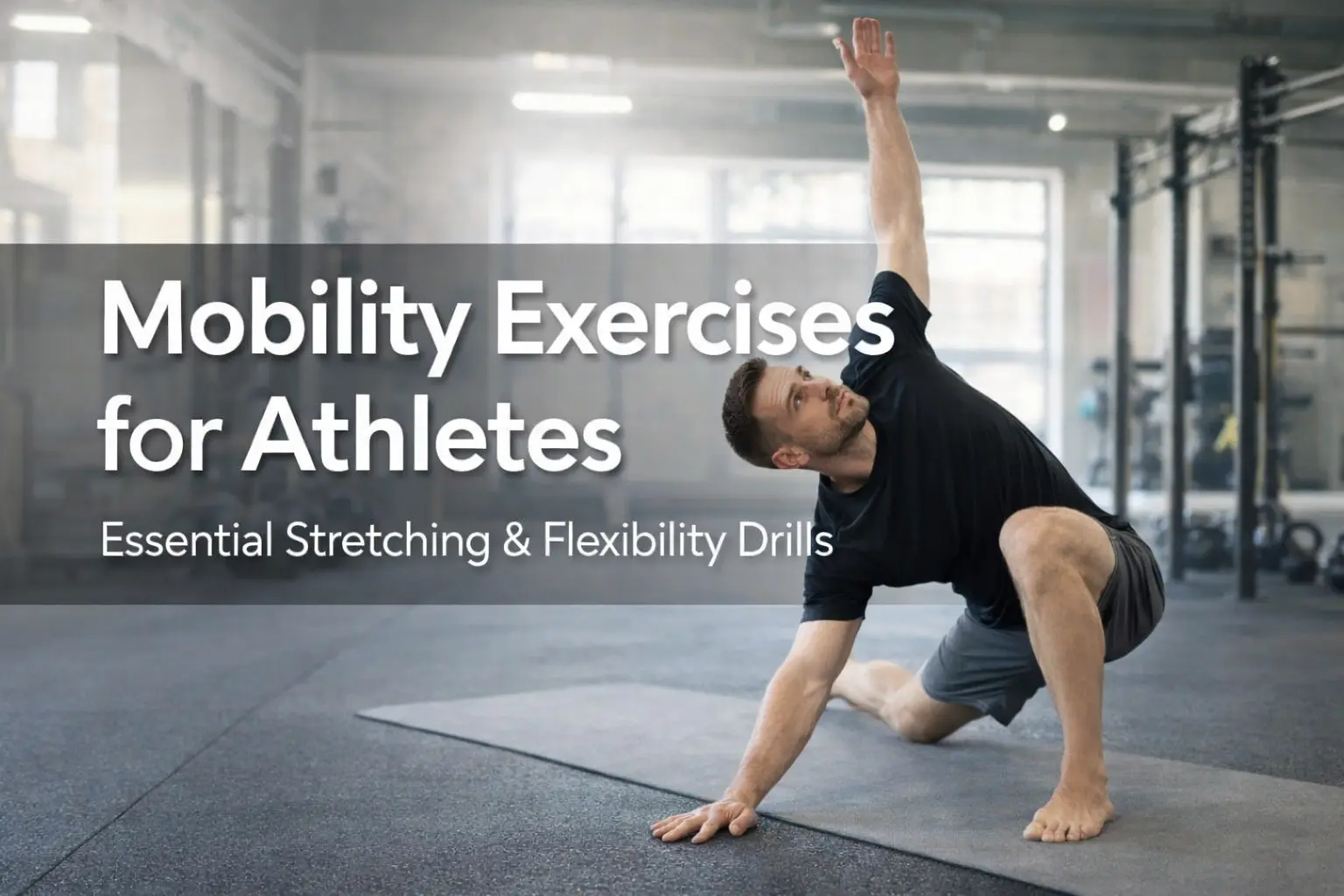
If you are an athlete, you have likely felt this before. Tight hips before practice. Stiff ankles during warm-ups. A lower back that feels sore even when you train hard and stretch often. Sometimes the body feels strong, yet movements feel heavy or restricted. Many athletes assume this is normal and try to push harder, thinking they need more strength or conditioning.
From real training experience and observation, these issues often improve once mobility work becomes consistent. When joints move freely, the body uses strength more efficiently and movements feel smoother and safer. Athletes commonly report better speed, easier changes of direction, and less discomfort after sessions. Mobility exercises for athletes are not just warm-up tools. They support performance, reduce injury risk, and help the body stay durable over time.
Table of Contents
Jump to a sectionUse the links below to jump to the section you need.
- Mobility Exercises for Athletes to Enhance Performance
- What Is Mobility Training?
- Mobility Is a MUST
- The Importance of Mobility in Sports Performance
- Mobility Exercises for Key Body Areas
- Mobility For Athletes: The Foot and Ankle
- Mobility For The Hip and Glutes
- Mobility For The Thoracic Spine
- Mobility For The Shoulders
- Top Mobility Exercises for Athletes
- How Long Should Each Mobility Exercise Take?
- How to Use Mobility Exercises in Training
- Simple Weekly Mobility Example for Athletes
- Mobility for Injury Prevention and Longevity
- Mobility for Gym Users and Lifters
- Mobility for Coaches and Team Training
- Mobility Exercises for Different Skill Levels
- Important Safety Note for Athletes
- Common Mobility Mistakes Athletes Make
- Sample Daily Mobility Routine for Athletes
- Frequently Asked Questions
- Conclusion
Who This Guide Is For
- Competitive athletes and serious trainees
- Recreational athletes who want to move better
- Gym users and lifters who want better form
- Runners and field sport players
- Coaches who need simple warm-up ideas
- Anyone dealing with stiffness or tight joints
If you want better movement, fewer aches, and stronger performance, this guide is for you.
Key Takeaways
- Mobility means range of motion with strength and control
- Better mobility supports speed, power, and cleaner technique
- Ankles, hips, upper back, and shoulders matter most for athletes
- Short daily sessions work better than long sessions done rarely
- Mobility can lower injury risk and improve recovery
Mobility Exercises for Athletes to Enhance Performance
Athletes need more than strength and speed. They need joints that move well. Good mobility allows the body to move freely, safely, and efficiently during sport.

Mobility exercises for athletes train joints to move through a full range of motion with control. This improves performance, supports recovery, and lowers the risk of injury. Athletes who train mobility regularly often run faster, jump higher, lift better, and feel less stiffness during daily training.
This guide explains mobility training, joint health, key body areas, practical exercises, and simple routines that athletes, gym users, and coaches can use right away.
What Is Mobility Training?
Mobility training focuses on joint movement with strength and control. It is different from simple stretching.
Flexibility refers to how far a muscle can lengthen. Mobility includes the ability to move a joint actively through that range while staying stable.
For athletes, controlled movement matters more than loose movement. Good mobility supports efficient running, jumping, lifting, and direction changes.
Mobility vs. Flexibility: The Importance of Control
Stretching alone does not prepare the body for sports.
Mobility training builds strength at the end range of motion. This allows athletes to stay stable in deep positions such as squats, lunges, and overhead movements.
That is why mobility exercises for athletes are generally more useful than passive stretching alone.
Why Joint Health Matters
Healthy joints move smoothly and handle force better. When mobility is limited, other parts of the body compensate. This often increases stress on muscles, tendons, or ligaments.
Good joint health helps athletes:
- Absorb impact safely
- Maintain balance and coordination
- Produce force efficiently
- Move with better technique
Long-term training becomes safer when joints remain healthy and active.
Mobility Is a MUST
Modern lifestyles reduce natural movement. Long hours of sitting tighten hips, weaken muscles, and restrict joint motion. Even athletes can develop stiffness from travel, school, or desk work.
Poor mobility limits performance. It can reduce stride length, power output, and posture during sport skills. Regular mobility work keeps the body prepared for training and competition.
The Importance of Mobility in Sports Performance
Mobility supports better movement quality and force transfer. Sports demand speed, strength, and rapid direction changes. If joint motion is limited, performance is also limited.
Athletes with good mobility typically move with more ease, stability, and control.
Mobility Enhances Strength and Power Output
Strength works best through a full range of motion. If joints cannot move properly, force production is reduced.
Better mobility allows deeper positions and smoother movement, which supports stronger lifts, faster sprints, and higher jumps.
Mobility Supports Safer Movement Patterns
Limited motion increases stress on tissues during sport actions. Mobility exercises help maintain proper alignment and control, which can reduce injury risk when combined with good training habits.
Mobility Improves Recovery and Training Readiness
Mobility work supports circulation and joint comfort. Athletes who recover well can train more frequently without feeling stiff or restricted.
Mobility’s Impact on Agility and Coordination
Quick cuts, turns, and balance adjustments depend on mobile joints. Ankles, hips, and the upper back play major roles in coordination during fast movements.
Mobility Exercises for Key Body Areas
Quick reference
Different joints affect different sport skills. Athletes should focus on areas most used in their sport.
Mobility For Athletes: The Foot and Ankle

The foot and ankle form the foundation of movement. Every step, jump, and landing begins here.
Limited ankle mobility can affect squat depth, sprint mechanics, and knee stress. This area is especially important for runners, football players, basketball players, and field athletes.
Benefits
- Better balance
- Stronger push-off
- Safer landings
- Improved lower-body mechanics
Exercises
- Knee-to-wall ankle movement
- Ankle rocks
- Slow calf movement with control
- Ankle circles
Mobility For The Hip and Glutes

The hips generate most athletic power. Tight hips reduce stride length, limit rotation, and increase lower-back strain.
Benefits
- Improved speed and stride
- Better squatting ability
- Faster direction changes
- Reduced back stress
Exercises
- 90/90 hip switches
- Hip flexor stretch
- Deep squat hold
- Hip circles
- Glute bridge with reach
Mobility For The Thoracic Spine
The upper back supports posture and rotation. Limited mobility here affects throwing, swinging, and overhead actions.

Benefits
- Improved rotation power
- Better posture
- Reduced lower-back strain
- Enhanced breathing mechanics
Exercises
- Seated upper-back rotations
- Quadruped rotations
- Thread-the-needle movement
- Cat-cow movement
Mobility For The Shoulders
Shoulders allow a wide range of motion and are heavily used in overhead sports and lifting.

Benefits
- Improved overhead movement
- Better throwing mechanics
- Safer lifting technique
- Reduced neck and upper-back strain
Exercises
- Arm circles
- Wall slides
- Band shoulder movement
- Controlled arm raises
Top Mobility Exercises for Athletes
These drills are widely used across many sports:
- Hip flexor stretch
- World’s greatest stretch
- Upper-back rotation
- Ankle movement drills
- 90/90 hip switch
- Quadruped rock back
- Deep squat hold
- Shoulder band movement
- Couch stretch
- Pigeon pose
Perform each movement slowly with control. Smooth motion is more important than speed.
How Long Should Each Mobility Exercise Take?
Mobility sessions do not need to be long.
- Controlled reps: 5 to 10 per side
- Slow holds: 20 to 40 seconds
- Short rest between sides
A full session usually lasts 5 to 15 minutes.
How to Use Mobility Exercises in Training
Mobility exercises for athletes work best when done regularly.
You can include them:
- Before training as a dynamic warm-up
- After training for recovery
- On rest days to maintain movement
Short daily sessions are often enough.
Simple Weekly Mobility Example for Athletes
- Before training: about 5 minutes of dynamic mobility
- After training: 5 to 8 minutes of slower mobility work
- Rest days: light mobility for 8 to 12 minutes
This approach fits busy schedules and supports consistency.
Mobility for Injury Prevention and Longevity
Injuries often occur when joints cannot move properly. The body compensates by stressing other tissues.
Regular mobility work helps athletes stay active for many years.
Benefits
- Lower risk of muscle strains
- Better joint protection during impact
- Reduced overuse stress
- Support for long athletic careers
Older athletes and those returning from injury benefit greatly from consistent mobility work.
Mobility for Gym Users and Lifters
Mobility is essential for strength training.
Better joint movement supports:
- Deeper squats
- Safer deadlifts
- Stronger overhead presses
- Improved lifting technique
Mobility does not replace strength training. It helps athletes lift more effectively and safely.
Mobility for Coaches and Team Training
Coaches often include mobility drills in warm-ups to prepare athletes for practice or competition.
Group routines focusing on ankles, hips, and shoulders improve movement quality and reduce injury risk across the team.
Mobility Exercises for Different Skill Levels
Mobility work can be adapted to all athletes.
Beginners
Use smaller ranges and slow movement. Stop before discomfort.
Advanced athletes
Use deeper positions while maintaining full control.
Progress comes from control, not force.
Important Safety Note for Athletes
Important
Mobility work should feel controlled. Mild tension is normal, but sharp pain is not. Keep the range comfortable, move slowly, and stop if pain shows up. If you have a serious injury or medical condition, speak with a qualified professional before starting.
Mobility work should not cause sharp pain.
Mild tension is normal. Pain is not. Reduce the range or stop if discomfort becomes sharp or intense.
Common Mobility Mistakes Athletes Make
Many athletes rush mobility or skip it entirely.
Common mistakes include:
- Forcing painful positions
- Holding stretches without control
- Using speed instead of precision
- Ignoring mobility due to lack of time
Short daily work is more effective than occasional long sessions.
Sample Daily Mobility Routine for Athletes
A short routine can maintain joint health and movement quality.

Example
- Ankle circles — 30 seconds each side
- Knee-over-toe rocks — 10 reps each side
- Hip circles — 10 reps each side
- Deep squat hold — 30 seconds
- Cat-cow — 8 slow reps
- Thoracic rotations — 8 reps each side
- Arm circles — 10 forward and backward
- Wall slides — 8 reps
Move slowly and breathe normally.
Frequently Asked Questions
How often should athletes do mobility exercises?
Most athletes benefit from mobility work 4 to 6 days per week.
Can mobility exercises improve performance?
Yes. Better movement supports strength, speed, and coordination.
Is mobility better than stretching for athletes?
Mobility includes strength and control, which makes it more useful for sports than stretching alone.
Conclusion
Mobility exercises for athletes play a major role in long-term performance and injury prevention. Strength, speed, and skill depend on joints that can move properly. Based on real training observations, athletes who practice mobility regularly tend to recover faster, move more efficiently, and experience fewer setbacks during a season.
Mobility work does not need to be complex or time-consuming. Simple movements done consistently can improve comfort, technique, and overall performance. Over time, this habit helps athletes train harder, feel better, and stay active for many years. Taking care of mobility today helps ensure the body remains strong, capable, and ready for every practice and competition ahead.
