


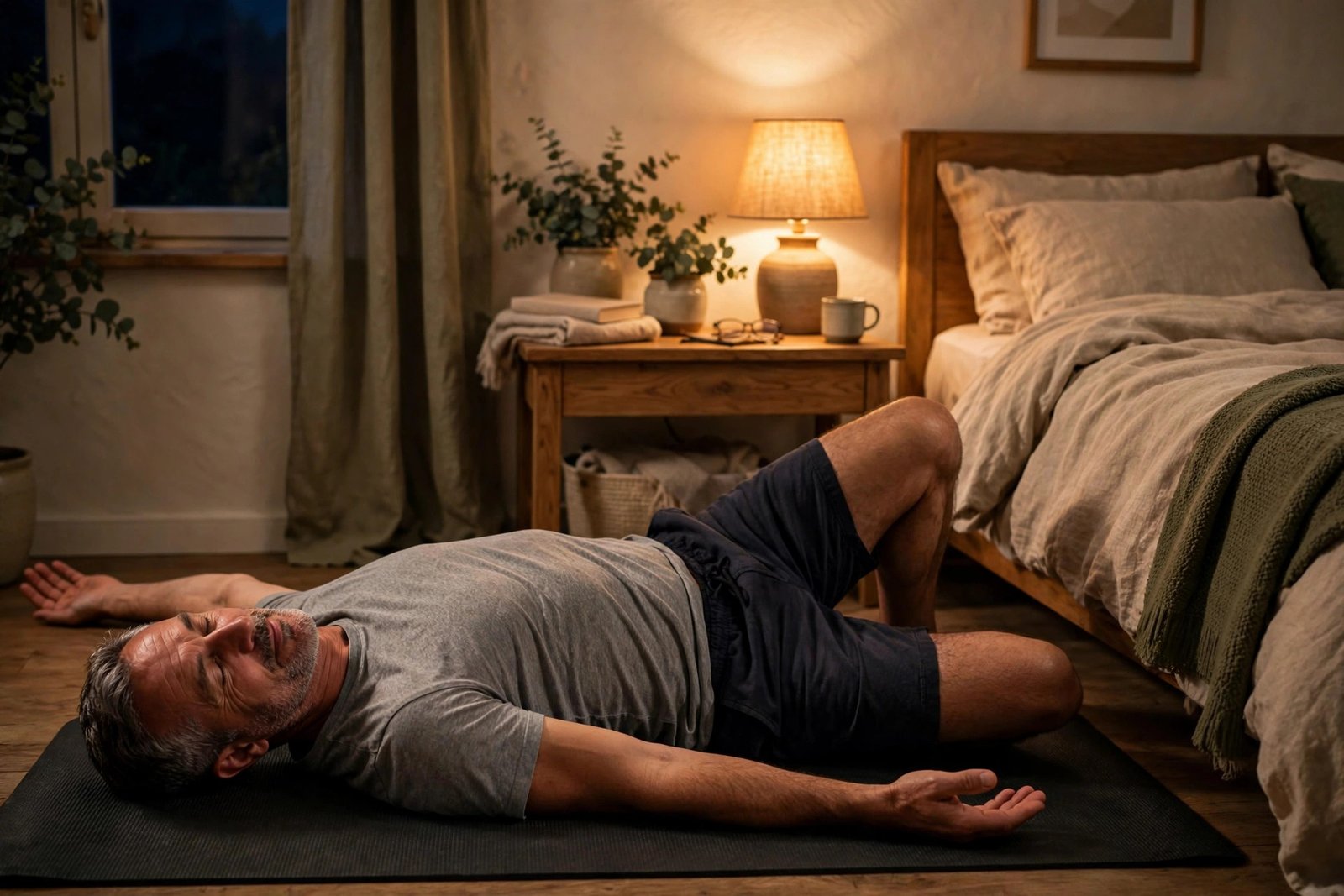
There’s a familiar kind of tiredness that shows up at the end of the day. In fact, your neck feels tight from hours at a desk. In fact, your hips complain when you stand up. Your lower back aches in a way that makes the couch look like the best possible answer. But an evening mobility routine is the gentler fix your body is actually asking for.
In fact, the good news: you don’t need a hard workout or a long stretch session to shake off that stiffness. In fact, a short evening mobility routine can help your joints move the way they’re meant to, settle your body down, and get you in the mood for sleep.
In addition, this routine takes about 15 minutes and focuses on gentle, controlled joint movement rather than holding long stretches. Think slow neck circles, easy shoulder rolls, and relaxed hip movements. The kind of movement that tells your body the day is over and it’s safe to unwind. Stay consistent with this evening mobility routine and the results will compound week after week.
Then, do it in your pajamas, on the bedroom floor, with the lights low. Also, no equipment needed, and no sweating required. The real magic of a evening mobility routine shows up after two to three weeks of steady practice.
Why an Evening Mobility Routine Works
After hours of sitting, driving, and scrolling, your joints spend a lot of time in the same positions. In fact, the result is that “rusty” feeling: shoulders that won’t sit back, a neck that turns in stiff little increments, hips that feel glued together. Even on busy days, a shorter version of this evening mobility routine beats skipping it entirely.
Mobility work addresses this directly. In addition, it moves each joint through its available range on purpose, slowly and with control. In fact, that gentle motion warms up the tissues around the joint and reminds your nervous system that the joint is safe to move. Most people feel the benefits of a evening mobility routine within the first ten days.
Doing it in the evening adds another benefit. Slow, rhythmic movement paired with steady breathing has a calming effect on the nervous system. In addition, it shifts you out of the alert, wired state of the day and into the relaxed state that makes falling asleep easier. Also, make this evening mobility routine a non-negotiable part of your day, like brushing your teeth.
Research summarized by the Sleep Foundation suggests that gentle evening movement does not ruin sleep the way intense late-night workouts can, and many people find a calm movement ritual improves how quickly they drift off. In fact, a evening mobility routine done regularly will change how your whole body feels.
In addition, this routine is designed with that in mind. Every drill is low-effort, joint-focused, and performed at a pace that winds you down rather than waking you up. Stay consistent with this evening mobility routine and the results will compound week after week.
Mobility vs. Stretching: What Makes This Routine Different
If you’ve read about what mobility exercises really are, you already know the key difference: stretching lengthens muscles passively, while mobility trains joints to move actively under your control. In fact, the real magic of a evening mobility routine shows up after two to three weeks of steady practice.
In practice, that means a stretch usually looks like holding a position — like pulling your knee to your chest and waiting. A mobility drill looks like movement — like slowly circling your hip through its full range while the rest of your body stays steady.
Both have their place at night. Passive stretching is excellent for releasing tension, and if you enjoy it, our evening stretching routine pairs perfectly with this one. But mobility drills offer something stretching alone doesn’t: joint control.
Think of it this way. Stretching can make a muscle feel longer for a while. Mobility work teaches the joint to actually use its range — which means the easy, free-moving feeling tends to last longer into the next day.
In addition, this routine sticks to the mobility side: slow circles, controlled rotations, and gentle spinal waves. You’ll feel your joints “wake up” without any pulling, yanking, or forcing.
What You’ll Need
Almost nothing, which is exactly the point. Here is the entire equipment list:
- A clear spot on the floor. A yoga mat is nice but not required — a carpet or rug works fine.
- Comfortable clothes. Pajamas are perfect. Wear anything that lets your joints move freely.
- About 15 minutes. Slightly less is fine too; consistency matters more than duration.
- Dim lighting if possible. It signals to your brain that bedtime is approaching.
That’s it. Also, no bands, no foam rollers, no apps. Just you and a little floor space.

Your 15-Minute Evening Mobility Routine
In fact, the routine moves from the top of your body to the bottom: neck, shoulders, mid-back, spine, hips, and ankles. Move slowly through each drill. If something feels pinchy or sharp, make the movement smaller — there is no prize for the biggest circle.
In fact, a good rule of thumb: each movement should feel like a 3 or 4 out of 10 in effort. Easy, smooth, almost meditative.
1. Neck CARs (2 minutes)
Also, sit tall on the floor or in a chair with your chin slightly tucked. Slowly roll your head in a full circle — ear toward shoulder, chin toward chest, ear toward the other shoulder, then the back of the head gliding back.
Then, make the circle as smooth as you can, breathing in through your nose as you go. Do 5 slow circles in one direction, then 5 in the other. Also, keep the movement small and pain-free; the goal is to oil the joints in your neck, not to crack anything.
2. Shoulder Circles (2 minutes)
From the same seated position, make big, slow circles with your shoulders. Then, lift them up toward your ears, roll them back, squeeze them down, and let them swing forward again.
After 5 circles backward, reverse direction for 5 circles forward. Also, focus on moving the shoulder joint itself rather than just flapping your arms. Imagine you’re drawing a wide circle with the tip of your shoulder.
3. Thoracic Open Books (2 minutes)
Then, lie on your side with your knees stacked and bent to 90 degrees, arms reaching straight out in front of you, palms together. Keeping your knees glued together, slowly open the top arm toward the ceiling and rotate your chest to follow it.
Pause at the end range, take one calm breath, then slowly return. Do 6 per side. In fact, this is one of the best drills for a mid-back that feels frozen after a day of hunching over a desk.
4. Spinal Waves (2 minutes)
Come onto all fours with your hands under your shoulders and knees under your hips. Begin a slow wave: tuck your chin and round your spine one vertebra at a time from the neck down, then reverse it, arching gently from the lower back up.
For instance, think of each vertebra getting its own little moment to move. Also, take 8 to 10 slow waves, breathing out as you round and in as you arch. Keep the range comfortable — this is a mobility drill, not a deep backbend.
5. Hip Circles (2 minutes)
From all fours, lift one knee slightly off the floor and draw a slow, wide circle in the air with it. As if you’re tracing a large coin with your kneecap. Also, keep your upper body as still as possible and let the hip joint do the work.
Do 6 circles each direction, then switch sides. If balancing is tricky, keep the knee close to the floor. You should also feel the deep muscles around the hip gently working and releasing.
6. 90-90 Hip Switches (2 minutes)
Also, sit on the floor with both knees bent at 90 degrees, one knee dropping to the left and the other to the right, feet flat. Without using your hands if you can manage it, lift both knees and smoothly switch them to the other side.
Then, move at a slow, controlled pace — 8 total switches. In addition, this trains both hip rotation directions at once and is a fantastic reset for hips that have been parked in a chair all day.
7. Ankle Circles (1 minute)
Sit with one leg extended. Slowly trace the alphabet of motion with your foot: point your toes down, circle them around, flex them up. Make the biggest smooth circle you can through the ankle.
Do 10 circles in each direction, then switch feet. In addition, it feels small, but your ankles carry you all day, and they deserve a minute of attention too.
8. Wind-Down Breathing (2 minutes)
Also, finish lying on your back with your knees bent and feet flat. Also, place one hand on your belly and one on your chest. Breathe in slowly through your nose for 4 counts, feeling your belly rise, then exhale gently through your mouth for 6 counts.
Repeat for 2 minutes. In addition, this longer exhale is a simple signal to your nervous system that the day is done. By the end of this drill, most people feel noticeably heavier and calmer.

How to Pace Each Drill
In fact, the magic of this routine isn’t in the exercises themselves — it’s in the pace. Mobility work done quickly becomes just another workout. Mobility work done slowly becomes a wind-down ritual.
Here are a few pacing rules that keep the routine calming rather than stimulating:
- Move at about half the speed you think you should. Slow movement gives your joints more time to explore their range and keeps your heart rate down.
- Breathe through your nose. Nasal breathing naturally slows your pace and keeps your nervous system settled.
- Match movement to breath. One full circle or wave per slow breath cycle is a good rhythm for most of these drills.
- Never push through pinching. If a joint pinches, shrink the movement until it feels smooth. Stiff is fine; sharp is not.
In fact, many people find it helps to put their phone in another room and do the routine in silence or with very quiet music. In fact, the fewer distractions, the stronger the wind-down signal to your brain.
For general context on staying active safely, the NHS’s exercise guidance also recommends gentle movement as part of a healthy weekly routine.
Turning It Into a Nightly Habit
In fact, the best evening routine is the one you actually do. At 15 minutes, this one fits into even busy evenings — but habits still need a little scaffolding to stick.
Then, try attaching the routine to something you already do every night. Right after brushing your teeth, or just before you get into bed, works well for most people. In fact, a consistent trigger beats willpower every time.
Start with just the first four drills if 15 minutes feels like a lot. In fact, a 7-minute version done nightly beats a 15-minute version done twice a week. You can also add the hip and ankle work once the habit feels automatic.
If you’re building a broader movement habit, this routine slots nicely into a daily mobility routine. Treat this as the gentle evening half, and do the more energetic drills earlier in the day.
Also, give it two weeks before judging the results. The first few sessions mostly feel nice in the moment. Around the two-week mark, most people notice their evenings feel calmer and their mornings feel less stiff.

Frequently Asked Questions
Is an evening mobility routine better than stretching before bed?
In addition, they serve different purposes, so one isn’t strictly better. Stretching passively releases muscle tension, while mobility drills actively train your joints to move through their range. Many people get the best results combining both — mobility first to wake up the joints, then a few gentle stretches. Just keep the intensity low either way so you wind down instead of waking up.
Will this routine make me too awake to sleep?
Not if you keep it gentle. In fact, the drills here are deliberately low-effort and paired with slow breathing, which calms rather than stimulates the nervous system. If you notice you feel energized afterward, slow down even more and skip the hip switches, which are the most demanding drill in the sequence.
How long before bed should I do it?
Also, aim for 30 to 60 minutes before you plan to sleep. In fact, that timing gives your body a chance to settle after the movement. If your schedule is tight, even 10 minutes right before bed is better than skipping it entirely.
Do I need to warm up first?
No warm-up needed. The first two drills — neck and shoulder circles — are gentle enough to serve as their own warm-up. Just start smaller and slower than you think you should, and let your body ease into the movement.
What if a joint clicks or pops during the drills?
Painless clicking is usually harmless and very common with joint circles. If the clicking comes with pain or swelling, stop that drill and make the movement smaller or skip it. Persistent joint pain is worth discussing with a healthcare professional rather than pushing through.
Can beginners do this routine?
Absolutely. Every drill is bodyweight-only, floor-based, and adjustable. Beginners should simply use a smaller range of motion and fewer repetitions. In fact, the routine is designed to be safe and approachable for anyone who can comfortably sit on the floor.
How often should I do it?
Nightly is the goal, but even 3 to 4 times per week makes a real difference in how stiff you feel in the mornings. In fact, the habit matters more than perfection — a shorter version done consistently outperforms a perfect version done rarely.
Conclusion
In fact, an evening mobility routine is one of the simplest ways to end your day well. Fifteen quiet minutes of joint circles, spinal waves, and slow breathing can undo the stiffness of a long day and set you up for better sleep.
You don’t need special equipment, a lot of space, or any experience. You just need a spot on the floor and the willingness to move slowly for a few minutes.
Start tonight. Do the first four drills, breathe slowly, and notice how your body feels when you climb into bed. Then do it again tomorrow — and let the habit quietly change your evenings.
