


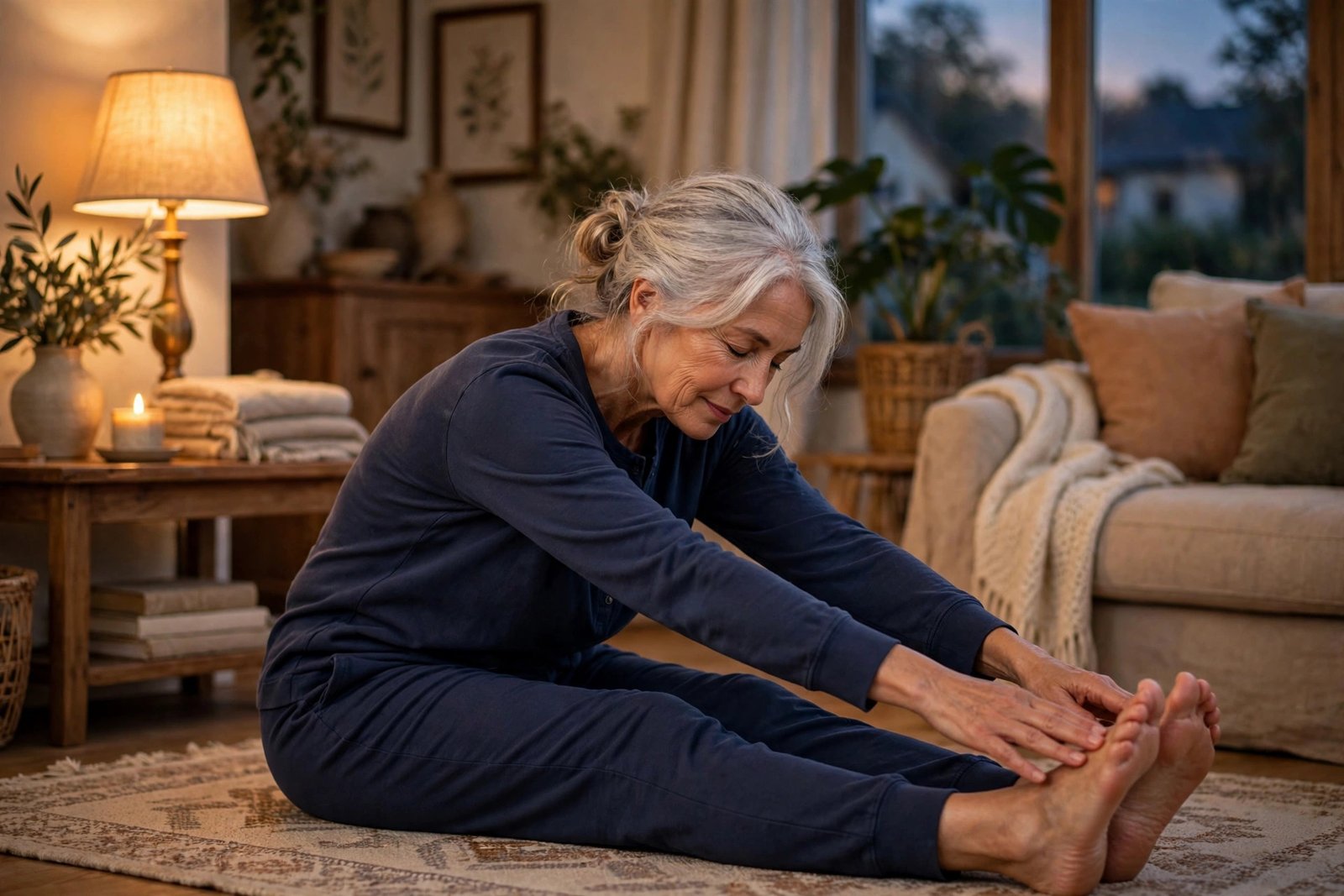
By the time evening arrives, your body is keeping score. Hours of sitting at a desk, hunching over a phone, or standing on tired feet leave your muscles tight and your mind buzzing. In fact, an evening flexibility routine is the gentle reset button your body has been waiting for.
Unlike an intense workout, an evening stretch session asks almost nothing of you. No equipment. No sweating. No pushing through pain. Just 10 to 15 quiet minutes of slow, deliberate movement that loosens what the day tightened and signals your nervous system that it is finally safe to wind down. Stay consistent with this evening flexibility routine and the results will compound week after week.
In addition, this guide gives you a complete, beginner-friendly evening flexibility routine you can follow every night. As a result, you will learn why stretching before bed helps you sleep better, how to set up a calming stretch space, and the exact sequence of gentle stretches to follow. Plus simple tips to turn it into a habit that actually sticks.
Why an Evening Flexibility Routine Works So Well
In fact, your muscles do not care what the clock says, but your nervous system does. During the day, your body runs in “fight or flight” mode: shoulders creep up, hip flexors shorten from sitting. Your lower back absorbs the stress of it all. Gentle stretching in the evening flips the switch to “rest and digest” mode. In fact, the real magic of a evening flexibility routine shows up after two to three weeks of steady practice.
Slow, sustained stretches activate the parasympathetic nervous system, which lowers your heart rate and eases muscle tension. Indeed, that is why a few minutes of stretching before bed can feel like the mental equivalent of dimming the lights. It tells your brain the day is over. Even on busy days, a shorter version of this evening flexibility routine beats skipping it entirely.
There is also a practical payoff. Spending the day hunched at a desk shortens your chest muscles, tightens your hamstrings, and stiffens your hips. Stretching those areas at night prevents that stiffness from cementing itself while you sleep. In fact, many people wake up feeling noticeably less stiff in the morning once they start an evening flexibility routine.
And unlike morning routines that compete with your alarm clock, evenings are naturally forgiving. You do not have to wake up earlier or carve time out of a busy day. In fact, the routine waits for you at the end of it, like a warm bath for your muscles. Most people feel the benefits of a evening flexibility routine within the first ten days.
How to Set Up Your Evening Stretch Space
You do not need a home gym or fancy gear. In fact, the best evening stretch space is simply a quiet corner where you will not be interrupted for 15 minutes. In fact, a living room rug, a bedroom floor, or even a hallway with a wall for balance support all work perfectly. Make this evening flexibility routine a non-negotiable part of your day, like brushing your teeth.
Dim the overhead lights and switch on a lamp if you can. Bright light signals alertness to your brain, while softer lighting supports the wind-down effect you are going for. If you use candles, keep them well away from anything you might bump while stretching. In fact, a evening flexibility routine done regularly will change how your whole body feels.
Wear loose, comfortable clothing — pajamas are ideal. Put your phone on silent or leave it in another room. If you enjoy background sound, a calm playlist or white noise can help, but silence works just as well. Stay consistent with this evening flexibility routine and the results will compound week after week.
In fact, a yoga mat is nice but not required. In fact, a folded blanket or thick towel gives your knees and spine enough cushioning. Keep a pillow nearby for stretches where you need head or knee support, and have a wall or sturdy chair within reach for balance. In fact, the real magic of a evening flexibility routine shows up after two to three weeks of steady practice.
One last thing before you begin: give yourself permission to be slow. This is not a performance. In fact, there are no reps to chase and no personal records to beat. In fact, the goal is simply to move gently and breathe deeply until your body feels a little softer than when you started. Even on busy days, a shorter version of this evening flexibility routine beats skipping it entirely.
The Evening Flexibility Routine: 12 Gentle Stretches in 15 Minutes
In addition, this sequence is designed to flow from standing to seated to lying down, so you finish the routine already in bed-ready position. Then, hold each stretch for 30 to 60 seconds per side, breathing slowly throughout. Never force a stretch — you should feel a gentle pull, never sharp pain. Most people feel the benefits of a evening flexibility routine within the first ten days.
Also, move through the four phases in order. In fact, the whole routine takes about 15 minutes, but feel free to linger on any stretch your body asks for. On nights when you are short on time, even 5 minutes of the neck, hip, and lower-back stretches will make a difference. Then, make this evening flexibility routine a non-negotiable part of your day, like brushing your teeth.

Phase 1: Unwind the Neck and Shoulders
In fact, your neck and shoulders collect tension from every email, every traffic jam, and every scroll through your phone. Start here, because releasing the upper body sets the tone for everything that follows. In fact, a evening flexibility routine done regularly will change how your whole body feels.
1. Slow neck tilts. Sit or stand tall. Gently tilt your right ear toward your right shoulder and hold for 30 seconds, feeling the stretch along the left side of your neck. Also, return to center and repeat on the left. Additionally, for a deeper stretch, rest your right hand lightly on the left side of your head. Let the weight of your hand do the work, not force. Repeat the pair twice. Stay consistent with this evening flexibility routine and the results will compound week after week.
2. Shoulder rolls and cross-body stretch. Roll both shoulders forward, up, back, and down in slow circles, five times each direction. Then bring your right arm across your chest and hug it gently with your left hand, holding for 30 seconds. Switch sides. In addition, this releases the deltoids and the rotator cuff muscles that tighten from desk posture. In fact, the real magic of a evening flexibility routine shows up after two to three weeks of steady practice.
3. Chest opener. Stand in a doorway and place your forearms on either side of the frame, elbows at shoulder height. Then, step gently through the doorway until you feel a comfortable stretch across your chest and the front of your shoulders. Hold for 45 seconds. If you spend your days hunched forward, this stretch will feel like the exact opposite of your workday — because it is.
Phase 2: Open the Hips and Lower Back
Sitting compresses the hips and loads the lower back for hours at a time. In addition, these stretches reverse that pattern, creating space in the joints that suffer most from a sedentary day.
4. Figure-four glute stretch. Lie on your back with knees bent. Cross your right ankle over your left knee, then gently pull your left thigh toward your chest until you feel a deep stretch in your right glute. Hold for 45 seconds per side. Tight glutes pull on the lower back, so this one often relieves more than just the hips.
5. Seated spinal twist. Sit on the floor with legs extended. Then, bend your right knee and cross it over your left leg, placing your right foot flat on the floor. Also, place your left elbow on the outside of your right knee and twist gently to the right, looking over your right shoulder. Hold for 45 seconds, then switch sides. Also, breathe into the twist and let each exhale take you a fraction deeper.
6. Child’s pose. Kneel on the floor, sit your hips back toward your heels, and walk your hands forward as you lower your forehead toward the ground. Also, let your whole back round and relax. Also, hold for a full minute, breathing slowly into your lower back. This is one of the most calming positions in any flexibility routine — your body reads it as a signal of safety.
7. Gentle cat-cow. From all fours, inhale as you drop your belly and lift your head and tailbone (cow), then exhale as you round your back and tuck your chin (cat). Then, move slowly, matching each movement to your breath, for 8 to 10 rounds. Also, keep the movement small and easy — this is about waking up the spine gently, not cracking it.
Phase 3: Release the Legs
Tight hamstrings, quads, and calves change the way you walk and stand, and they quietly pull on your lower back all night. Releasing them before bed helps you wake up feeling looser.
8. Supine hamstring stretch. Lie on your back and loop a towel or belt around the sole of your right foot. Gently straighten your right leg toward the ceiling, keeping a soft bend in the knee. Hold for 45 seconds per side. Then, keep your lower back pressed into the floor — if it arches, ease off. In fact, a towel makes this stretch accessible no matter how tight your hamstrings are.
9. Lying quad stretch. Lie on your right side with your head resting on your right arm. Then, bend your left knee and catch your left foot or ankle with your left hand, gently drawing your heel toward your glute. You should also feel the stretch down the front of your thigh. Hold for 45 seconds per side. If grabbing your foot is too intense, use the towel loop from the previous stretch instead.
10. Standing calf stretch. Face a wall and place your hands on it at shoulder height. Then, step your right foot back, press your heel firmly into the floor, and bend your left knee slightly. As a result, you will feel the stretch in your right calf. Hold for 45 seconds per side. Tight calves contribute to morning foot and ankle stiffness, so do not skip this one even though it seems minor.
Phase 4: Calm the Spine and Nervous System
In fact, the final phase is pure wind-down. In addition, these last stretches are done lying down, and they transition you directly into rest. By the end, your heart rate should be slow and your breathing deep.

11. Supine spinal twist. Lie on your back with arms out in a T shape. Bend your knees, then let them drop slowly to the right while keeping your shoulders on the floor. Then, turn your head to the left for a full-body twist. Also, hold for a full minute per side. This gentle rotation wrings out the day’s tension from your mid and lower back like a sponge.
12. Legs up the wall. Sit sideways against a wall, then swing your legs up as you lie back so your body forms an L shape. Also, rest your arms at your sides, close your eyes, and stay here for 2 to 3 minutes. In addition, this passive inversion improves circulation, releases the lower back, and is one of the most deeply relaxing positions you can hold. It is the perfect final stretch before sleep.
When you are done, do not jump up. Also, roll to one side, sit up slowly, and notice how your body feels compared to 15 minutes ago. In fact, that difference is the whole point.
Breathing Tips That Make Your Evening Flexibility Routine Work Better
How you breathe during stretching matters as much as the stretches themselves. Deep, slow breathing does two things at once: it lowers your heart rate and it relaxes the muscles you are trying to stretch, letting you ease a little deeper with each exhale.
Try the 4-6 breathing pattern: inhale quietly through your nose for 4 counts, then exhale slowly through your mouth for 6 counts. In fact, the longer exhale is the key — it is the part that activates your body’s relaxation response. Also, use this rhythm for the entire routine, and you will double its calming effect.
As a general rule, exhale as you ease into a stretch and keep breathing into it once you are there. Never hold your breath while stretching. If you catch yourself holding it, that is a sign you are pushing too hard — back off until you can breathe easily again.
On your final exhale of each stretch, see if your body lets you sink a tiny bit deeper. Do not force it. For instance, think of it as an invitation, not a demand.

Common Mistakes to Avoid in Your Evening Flexibility Routine
Evening stretching is simple, but a few common mistakes can turn a relaxing routine into an uncomfortable one. Also, avoid these and you will get far more out of your 15 minutes.
- Stretching too aggressively. Evening is not the time for deep, intense stretching or pushing toward your limits. Save ambitious flexibility goals for another time of day. At night, aim for about 60 to 70 percent of your maximum stretch.
- Bouncing in and out of stretches. Ballistic stretching. Bouncing to force more range — is risky at any time, and especially counterproductive when your goal is relaxation. Hold each position still and let gravity and breath do the work.
- Doing it right after a heavy meal. Twists and forward folds feel miserable on a full stomach. Wait at least 60 to 90 minutes after eating before you start your routine.
- Skipping the legs. Many people only stretch where they feel pain, usually the neck and back. But tight hips and hamstrings are often the hidden cause of that back discomfort. Follow the full sequence for balanced results.
- Checking your phone between stretches. One glance at a stressful message or bright screen can undo the calming effect you just built. Keep the phone away until you are done.
- Turning it into a workout. If you finish your evening routine sweating and energized, something went wrong. This is a cool-down for your day, not a training session. Slow is the whole point.
If you are already following a daytime plan, this routine pairs beautifully with it. You might do a short daily flexibility routine in the morning to wake up your joints, then use this evening sequence to unwind. And if you want to explore more movements over time, our guide to flexibility exercises offers simple options you can swap into the sequence as your body gets used to it.
How to Make It a Habit That Actually Sticks
In fact, the best flexibility routine is the one you actually do. Research on habit formation shows that attaching a new behavior to an existing one. A technique called habit stacking — makes it far more likely to stick. Pick an anchor you already do every night and link your stretching to it.
Good anchors include: right after brushing your teeth, after changing into pajamas, or when you would normally start scrolling on the couch. In fact, the cue should be something that happens every single evening without fail. Then, start the routine within a minute of the cue, before your brain has time to negotiate.
Also, begin with the smallest possible version. On night one, just do three stretches for five minutes. Master showing up before you worry about doing the full 15 minutes. In fact, a short routine done consistently beats a perfect routine done twice.
Also, keep your mat or blanket visible — laid out on the floor where you will see it, not rolled up in a closet. Every bit of friction you remove makes it more likely you will follow through. Some people also find it helps to set a gentle phone reminder for the first two weeks, then let the habit run on its own.
Finally, track your streaks simply. In fact, a paper calendar with an X on each night you stretch is surprisingly motivating. After a week of X’s in a row, you will not want to break the chain. If you miss a night, do not spiral — just pick it up the next evening. Consistency over weeks matters far more than perfection on any single day.
Frequently Asked Questions
How long should an evening flexibility routine take?
Ten to fifteen minutes is the sweet spot for most people. Indeed, that is enough time to address the major tension areas — neck, shoulders, hips, lower back, and legs — without turning it into a chore. In fact, the routine in this guide takes about 15 minutes at a relaxed pace. If you only have 5 minutes, do the neck tilts, figure-four stretch, child’s pose, and legs up the wall. Those four cover the biggest tension zones.
Is it better to stretch before or after dinner?
Wait at least 60 to 90 minutes after a large meal before stretching. Twists, folds, and anything that compresses the abdomen will feel uncomfortable on a full stomach. In fact, most people find the ideal window is about an hour after dinner, roughly 30 to 60 minutes before bed. That timing also lets the relaxation effect carry straight into sleep.
Can stretching before bed actually help me sleep better?
Yes. Gentle stretching lowers your heart rate, eases muscle tension, and shifts your nervous system toward rest mode — all of which support better sleep quality. Research summarized by the Sleep Foundation notes that regular physical activity improves sleep quality, and calm, low-intensity movement close to bedtime avoids the stimulating effects of vigorous exercise. For instance, think of it as telling your body the day is officially over.
Should evening stretches be static or dynamic?
Static stretches — holding a position still — are the right choice for evenings. Dynamic stretching (controlled leg swings and arm circles) is better suited to warming up before activity. At night, your goal is the opposite: calming down. Slow, held stretches paired with deep breathing match that goal perfectly. Also, hold each stretch for 30 to 60 seconds and keep everything still.
What if I am not flexible at all? Can I still do this routine?
Absolutely — this routine was designed for beginners and stiff bodies. Every stretch includes built-in modifications, like using a towel for the hamstring stretch or keeping a soft bend in your knees. You do not need to touch your toes or achieve any particular position. If you feel a gentle pull in the right muscle, you are doing it correctly. Flexibility improves with consistency, not with forcing. For more relaxation-focused nighttime sequences, you can also explore our evening stretching routine, which takes a similar gentle approach.
Is it safe to stretch every evening?
For most healthy people, gentle stretching every evening is completely safe and even beneficial. In fact, the key word is gentle — you should never feel sharp or shooting pain. If you have an injury, a herniated disc, or a medical condition affecting your joints, check with your doctor or physical therapist first. Healthline’s guide to stretching before bed offers additional gentle bedtime stretches and safety pointers if you want to expand your routine safely.
When will I start noticing results?
Most people feel an immediate difference after the first session — less tension, calmer breathing, and an easier transition to sleep. Longer-term flexibility gains typically appear within 2 to 4 weeks of nightly practice. The sleep benefits often show up fastest, sometimes within the first week. Morning stiffness usually decreases next, followed by gradual improvements in range of motion. Also, keep your expectations modest and your consistency high, and your body will take care of the rest.
Conclusion
In fact, an evening flexibility routine is one of the smallest investments you can make with one of the biggest payoffs. Fifteen quiet minutes, no equipment, no gym — just you, your breath, and a sequence of gentle stretches that undo the day and prepare your body for rest.
Start tonight. You do not need to be flexible, you do not need the perfect setup. You do not need to do the full routine on day one. Just pick three stretches, dim the lights, and begin. In fact, your future self — the one who wakes up looser and sleeps more soundly — will thank you.
Simple movement, better living. Indeed, that is what evenings are for.
