


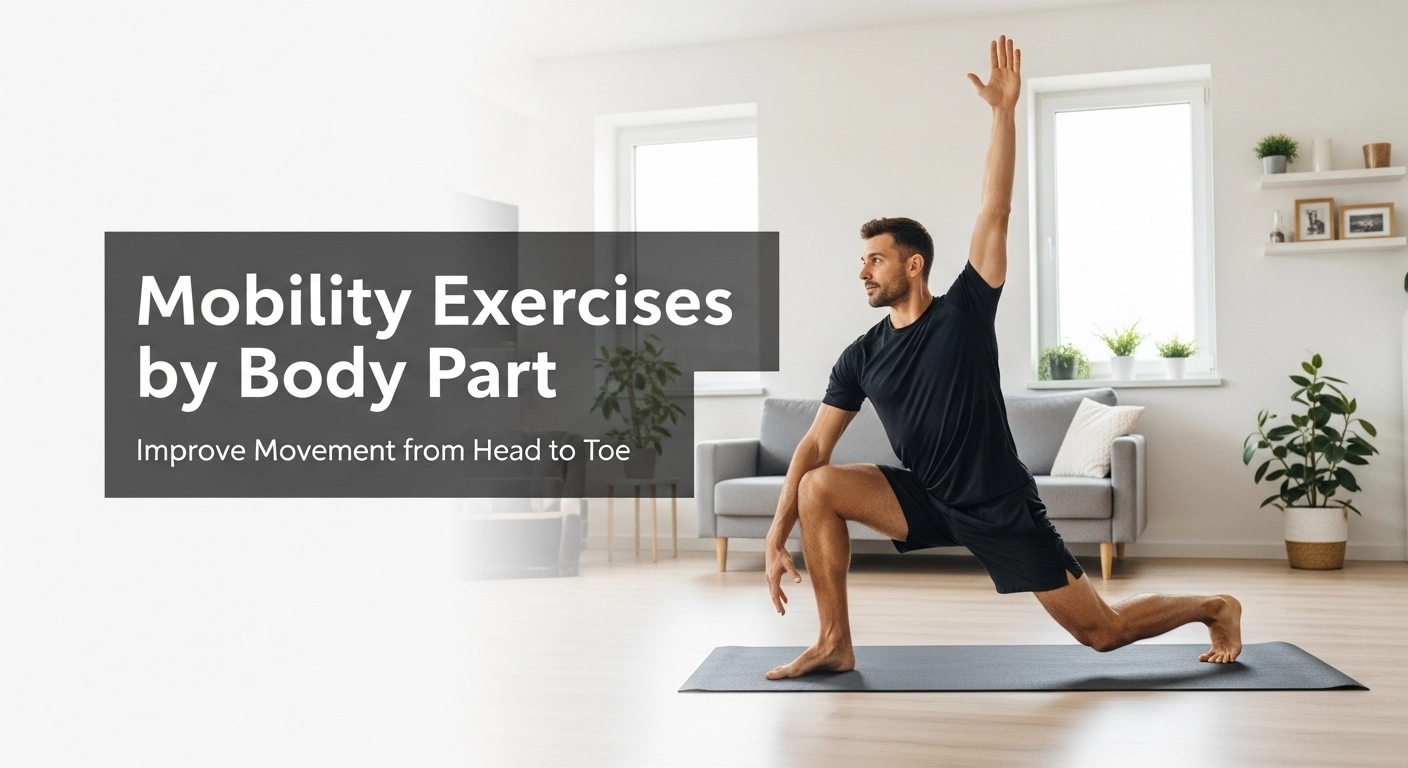
Most people do not search for mobility exercises out of interest. They search because something feels wrong. The neck feels tight after hours at a desk. The hips feel stiff when standing up. The shoulders feel blocked when reaching overhead. These problems show up in people who sit all day, people who train often, and people who do very little exercise. Stretching may help for a short time, but the stiffness usually returns.

I have faced this myself. Long hours of sitting made my back and hips feel heavy and slow. I tried stretching, but it never solved the problem. What worked was mobility. Slow, controlled movement for the joints that felt limited. Over time, I also saw the same pattern in others. Many issues come from joints that do not move well, not from weak muscles. That is why this guide on mobility exercises by body part focuses on working on the joint that actually needs attention.
Table of Contents
Jump to a sectionUse the links below to jump to the section you need.
- What Are Mobility Exercises?
- Why Mobility Matters
- How to Use This Guide
- Quick Self-Checks to Find Tight Areas
- Mobility Exercises by Body Part
- Simple Daily Mobility Routine
- How Often Should You Do Mobility Exercises?
- When to Do Mobility Exercises
- Mobility vs Stretching
- How to Progress Mobility Over Time
- Common Mistakes to Avoid
- Frequently Asked Questions
- Final Thoughts
Who this guide is for
- Desk workers with neck, shoulder, hip, or wrist stiffness
- Beginners who want safe, easy mobility drills
- Casual gym-goers who want better warm-ups and better form
- Busy people who can only spare 5 to 10 minutes
Key Takeaways
- Most people improve faster when they focus on the tight joint, not the whole body.
- Short sessions done often work better than long sessions done once in a while.
- Use quick self-checks to pick the body part that needs attention.
- Slow, controlled reps matter more than forcing range.
What Are Mobility Exercises?
Mobility exercises help joints move through their full range with control.
They combine movement and light strength.
Stretching holds a muscle in one position.
Mobility trains the body to use that range while moving.
Both have value.
Mobility usually comes first.

Why Mobility Matters
Good mobility helps you:
- Sit and stand with less stiffness
- Move joints with control
- Train with better form
- Reduce joint stress
- Feel smoother during daily tasks
You do not need long sessions.
Short, regular practice works well.
How to Use This Guide
This guide works best when you keep it simple.
You do not need to do every exercise.
Use quick checks to find which joints feel limited.
Focus on problem areas first.
Do short sessions often.
Even 5 to 10 minutes is enough.
Quick Self-Checks to Find Tight Areas
These checks help you decide where to focus.
Each one takes less than a minute.

Ankle check
Stand facing a wall.
Keep your heel down and move your knee forward.
If the knee cannot reach the wall, ankle mobility may be limited.
Hip rotation check
Sit tall with knees bent.
Let one knee drop inward and outward.
If movement feels blocked, hip mobility may need work.
Shoulder reach check
Raise both arms overhead while keeping ribs down.
If arms cannot reach near the ears, shoulder or upper back mobility may be limited.
Important
- Move slowly and stay in control.
- Stop if you feel sharp pain, numbness, or tingling.
- Do not force range. Smooth motion matters more.
- If you have a recent injury or swelling, talk to a qualified professional.
Mobility Exercises by Body Part
Below is a simple breakdown.
Each section targets one area.
Neck Mobility Exercises
Signs you need neck mobility
- Stiffness when turning the head
- Tension from screen use

Exercises
- Neck circles
- Chin tucks
- Side rotations
How often
- Daily
- 6 to 10 slow reps
Quick reference
Shoulder Mobility Exercises
Signs you need shoulder mobility
- Trouble lifting arms overhead
- Tightness after sitting

Exercises
- Arm circles
- Wall slides
- Thread the needle
How often
- 3 to 5 times per week
- 6 to 10 controlled reps
Upper Back (Thoracic Spine) Mobility Exercises
Signs you need upper back mobility
- Rounded posture
- Limited twisting
Exercises
- Cat-cow
- Thoracic rotations
- Thoracic extensions
How often
- Daily or before workouts
- 6 to 10 slow reps
Lower Back Mobility Exercises
Signs you need lower back mobility
- Stiffness after sitting
- Discomfort during bending
Exercises
- Pelvic tilts
- Knee-to-chest pulls
- Controlled spinal waves
How often
- 3 to 4 times per week
- Slow and controlled movement
Hip Mobility Exercises
Signs you need hip mobility
- Tight hips when sitting
- Limited squat depth

Exercises
- 90/90 hip rotations
- Hip circles
- World’s greatest stretch
How often
- 4 to 6 days per week
- 6 to 10 reps per side
Knee Mobility Exercises
Signs you need knee mobility
- Stiffness during squats
- Poor control on stairs
Exercises
- Knee circles
- Assisted split squats
- Slow step-downs
How often
- 3 to 4 times per week
- Light, controlled reps
Ankle Mobility Exercises
Signs you need ankle mobility
- Heels lifting during squats
- Limited forward knee movement
Exercises
- Ankle rocks
- Heel-to-toe rocks
- Calf pulses
How often
- Daily
- 8 to 12 slow reps
Foot and Toe Mobility Exercises
Signs you need foot mobility
- Poor balance
- Toe stiffness
Exercises
- Toe lifts
- Toe spreads
- Foot rolls
How often
- Daily
- Short sessions work best
Wrist and Forearm Mobility Exercises
Signs you need wrist mobility
- Discomfort during push-ups
- Tightness from typing
Exercises
- Wrist circles
- Palm lifts
- Elbow rotations
How often
- Daily or after work
- 6 to 10 reps
Simple Daily Mobility Routine
This routine takes under 10 minutes.

- Neck circles
- Cat-cow
- Shoulder rotations
- Hip circles
- Ankle rocks
Move slowly.
Breathe steady.
How Often Should You Do Mobility Exercises?
For most people:
- 5 to 10 minutes per day
- Focus on tight joints
- Full-body sessions 2 to 3 times per week
Short sessions done often work best.
When to Do Mobility Exercises
Before workouts
Use mobility as a warm-up.
During the day
Short sessions reduce stiffness from sitting.
After workouts
Slow movements help joints relax.
Mobility vs Stretching
Stretching holds muscles in place.
Mobility moves joints with control.
Mobility supports movement quality.
Stretching supports muscle length.
Both work better together.
How to Progress Mobility Over Time
Start with small movements.
As control improves:
- Increase range slightly
- Slow the tempo
- Add one extra set
Progress should feel smooth.
When not to do mobility
Skip mobility work for that area and get help if you have:
- Swelling, heat, or sudden loss of motion
- Sharp pain that gets worse with movement
- Numbness, tingling, or spreading pain
- A recent injury you have not checked
Common Mistakes to Avoid
- Moving too fast
- Forcing range
- Skipping breathing
- Ignoring pain signals
Mobility should feel controlled.
Frequently Asked Questions
Can I do mobility every day?
Yes. Light mobility works well daily.
Is mobility good before workouts?
Yes. It prepares joints for movement.
Do I need equipment?
No. Most drills use bodyweight only.
Can mobility help back stiffness?
Yes. Hip and upper back mobility often reduce stress on the lower back.
Is mobility better than stretching?
They serve different goals. Mobility improves control. Stretching improves length.
Conclusion
Mobility works best when it is simple and focused. Working on one joint at a time makes progress easier to notice and easier to maintain. From experience, people improve faster when they stop guessing and start paying attention to what feels limited. Slow, controlled movement done often brings better results than long sessions done once in a while. When joints move better, daily life feels easier and training feels more stable. That is the purpose of mobility work: movement you can trust.
